
 English
 Italy
Italy
The Step Pyramid of Saqqara: Inside King Djoser’s Revolutionary Underworld
King Djoser: The Visionary Pharaoh Who Built the First Pyramid
Way before those gigantic Giza pyramids showed up and sort of punctured the skyline of ancient Egypt, one ruler maybe shifted everything for world architecture, like really. This monarch was King Djoser, also called Netjerikhet, the second pharaoh of the Third Dynasty in the Old Kingdom era, about c. 2670 BC, more or less.
Before Djoser was on the throne, Egyptian kings ended up in mudbrick tombs known as mastabas. These were flat topped, rectangular bench like structures, sitting over underground chambers. Then Djoser, together with that famous mastermind, Imhotep, broke that old pattern. They turned toward stone architecture, and not just in a small way, but in a massive, monumental manner. By stacking stone mastabas on top of one another, reducing the size step by step, they made what is often described as the very first stone pyramid, the Step Pyramid at Saqqara.
Below is the full account of King Djoser, the way his reign rewrote expectations, the partnership with Imhotep, the groundbreaking pyramid complex, and how he stayed in human history, kind of forever, even if people say it differently.
1. The Divine King: Identity and Reign
While modern historians tend to know him mainly as Djoser (a name that showed up in the records only centuries after his death, and it kind of means “Holy” or “Sacred”), the inscriptions made during his own life called him Netjerikhet, which roughly translates into “Divine of Body.”
It was, in a way, a golden era of steadiness
Djoser ruled Egypt for something like two to three decades, and during that time there was political consolidation, internal quiet, and also clear technological advance :
Border keeping: he carried out successful military actions into the Sinai Peninsula to reach valuable copper and turquoise resources, plus he defended Egypt’s southern frontier around Aswan.
Religious consolidation: he reinforced the bond between the king and the sun god Ra, and also with the funerary god Anubis. In practice the capital shifted more decisively to Memphis, the political and administrative center of both Upper and Lower Egypt.
2. The Architectural Genius: Imhotep
No account of King Djoser really feels whole unless we properly honor his royal chancellor and supreme architect, Imhotep (“He Who Comes in Peace”).
Imhotep was, in many ways, a kind of polymath , architect , high priest of Ra in Heliopolis , scribe, and physician too. What made his bond with Djoser feel different from the rest of pharaonic life, was that Djoser respected him so deeply that he let Imhotep’s name be carved on the base of a royal statue of the king himself. That kind of privilege was basically unheard of for a person who wasn’t royal.
The Invention , or rather the pivot, to stone architecture
Before Imhotep, Egyptians leaned on materials that fade with time : dried mudbrick, wood, reed matting, and palm trunks. Imhotep understood something practical, if the king’s soul (Ka) was meant to live on, then his funerary monument had to be built from an unbreakable, imperishable kind of stone , carved limestone.
And it wasn’t only that Imhotep built with stone; he kind of coached Egyptian craftsmen on how to quarry it, how to shape it, how to move it, and how to stack the blocks. In that sense, he laid down the engineering groundwork that later enabled the Great Pyramids of Giza, generations on, even if nobody at the time could see it quite so clearly.
3. The Step Pyramid Complex: Engineering Eternity
On the high desert plateau at Saqqara, a view of ancient Memphis was there, and in that kind of landscape Djoser’s burial complex sits like a stone city meant for the king’s afterlife , kind of immense, almost unreal.
About how the Step Pyramid turned out
This pyramid didn’t start as a pyramid really, it sort of changed shape over six separate building phases, like people kept adding and refining it bit by bit.
- First, the Mastaba at the bottom (M1): it began as a plain square limestone mastaba.
- Then more horizontal building (M2 to M3): it was widened in two steps, so it could include extra shaft tombs for royal family members.
- Next, the first “pyramid” phase (P1): Imhotep chose to stack three smaller mastabas on top of each other, and it formed a four-tiered stepped arrangement .
- Finally, the main monument (P2): it was pushed even further, into six stone tiers, and it rose to about 60 meters, (197 feet) so it became the tallest structure of its time, for real.
The Subterranean Labyrinth
Below the pyramid there is this kind of dizzy underground maze of shafts , corridors and galleries that stretches out for more than 5.7 kilometers ,or about 3.5 miles in length :
The Granite Burial Chamber: down at the base of a 28-meter-deep central shaft, sealed by a massive stone stopper.
The Blue Faience Tiles: a few royal chambers were dressed with thousands of glittering blue-green faience wall tiles, made to look like woven reed mats, like an earthly palace of the king but still kinda symbolic.
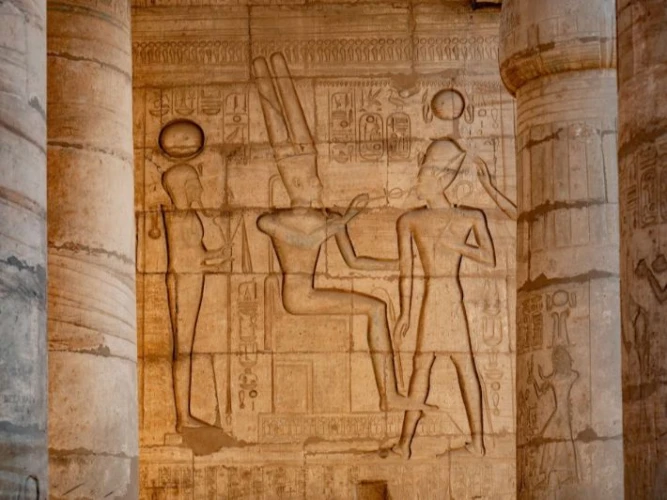
The Relief Panels: careful carvings along the walls show Djoser running in the Heb-Sed race, basically demonstrating his physical vitality in front of the gods.
The Enclosure Wall and Heb-Sed Court
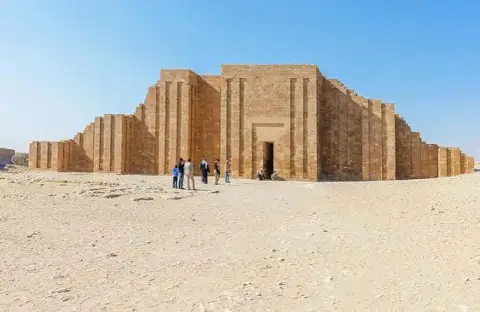
The pyramid sat within a large 15-hectare compound enclosed by a 10-meter-high white limestone wall, with 13 fake doors and just one real entrance. Inside that place, there was a large yard where the Heb-Sed Festival happened—a sacred jubilee ceremony, where the king’s spirit could renew its earthly liveliness again and again and keep its right to rule Egypt.





-webp.webp "Hilton")
-webp.webp "dusit")
-webp.webp "Marriott Hotels")
-webp.webp "Azimut Hotel")
-webp.webp "Golden Tulip")
-webp.webp "sheraton")
-webp.webp "westin hotel")
-webp.webp "Movenpick")