
 English
 Italy
Italy
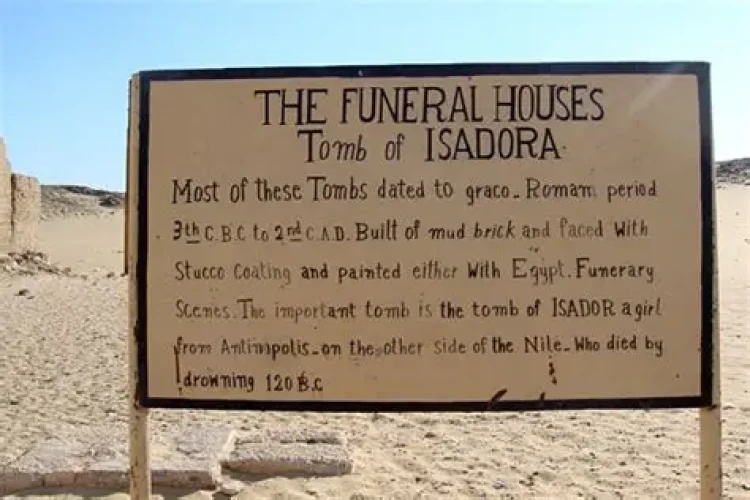
Isadora’s Tomb in Tuna el-Gebel: A Love Story Immortalized in Time
Isadora’s Tomb in Tuna el-Gebel: A Love Story Immortalized in Time
The ancient Egyptian cemetery of Tuna el-Gebel necropolis in Minya Governorate Upper Egypt presents a unique narrative which exists beyond all other burial sites found in Egypt. The narrative of the site reaches beyond its royal and priestly figures through Isadora's tomb which presents a story about love and tragedy and memory through its exceptional burial site.
Tuna el-Gebel exists as an exceptional archaeological site which contains valuable historical artifacts that extend through the complete timeline of Egyptian history from the Ptolemaic period to the Roman Empire. The necropolis contains an extensive collection of rock-cut tombs which each demonstrate different cultural practices and beliefs about the afterlife. The tomb of Isadora shows a unique story which combines human feelings with mythical elements to reveal a love story which crossed social boundaries and remains relevant after many centuries.
The Birth of a Legend: Who Was Isadora?
The name Isadora shines in the folds of history and folklore. She was a young woman who lived in Egypt during the late Ptolemaic and early Roman periods. Her wealthy family background enabled her to experience life in comfort that most people during her time could never obtain. Her most important value in life existed beyond her privilege which she possessed throughout her existence.
The story follows a young man from the common people who local tales refer to as "Hapi." The love between them appears to be typical but their relationship became special because of their different social backgrounds. Isadora's father followed the marriage customs of his time because he wanted to use marriage to boost his social and financial position. He would reject any proposal from his daughter to marry a man who held lower social status.
The couple maintained their secret relationship despite all existing obstacles. The couple arranged their meetings at secret locations where they made quiet promises to each other. The couple exchanged love notes but only brief parts of their romantic messages remained intact through the oral stories that later generations passed down.
The Tragedy That Immortalized Her Name
The plot of every great narrative reaches a critical moment which defines its direction and Isadora experienced this essential plot point through her Nile River day. She attempted to cross the river because she wanted to see her lover before her arranged marriage took effect. The Nile River current which flowed through her territory became her forceful opponent. The community remained shocked because her body stayed missing for several days before its discovery.
She was no longer just a girl who had drowned because she became a symbol of love that battled against social norms and the unchangeable nature of destiny. Her narrative transformed into a legendary tale from that point onward.
Her father constructed an elaborate tomb in Tuna el-Gebel to honor her memory because it stood on the exact location where her body had been found. The tomb functioned as more than a burial ground because it served as a memorial to the life and love which had impacted everyone who heard her tale.
Isadora’s Tomb: Stone and Spirit
The tomb of Isadora functions as an architectural expression of religious devotion which shows the importance of the woman who rests there. The tomb's small size creates an illusion of limited space which actually contains two distinct elements of design that create a serious atmosphere. The visitor enters through an entrance which leads them to a series of interior chambers whose walls display decorations that show the Hellenistic and Roman artistic styles which existed in Egypt during that period.
The remains of Isadora were placed inside the tomb on a bed which might have been used for ceremonial purposes and covered with a glass casing to protect her memory. The design of the tomb serves two purposes: it provides a burial ground and creates a space for people to reflect on her life while they remember her and visit her burial site.
The site has drawn visitors from both Egypt and abroad throughout the years because it offers both artistic and historical value and presents a deeply human story which describes a timeless experience of grief and love and defiance.
Cultural Legacy and Oral Tradition
The enduring presence of Isadora's tale in Egyptian folklore and contemporary culture makes her story highly captivating. The local communities have maintained the love story throughout time because they consider it a timeless tale of everlasting love. Writers and poets have drawn inspiration from her life, turning her story into short stories, poems, and even informal oral histories.
Modern Egyptian intellectuals found her story to be an inspiring source of intellectual motivation. Some people called her the emotional freedom symbol who demonstrated that love could not be contained by social standards.
Visiting Tuna el-Gebel: A Journey Through Time
The archaeological site of Tuna el-Gebel provides visitors with more than its historical artifacts because it enables direct interaction with past events. The necropolis contains tombs of priests, officials, and even sacred animals, including ibis birds associated with the god Thoth. The atmosphere changes when visitors arrive at Isadora's burial site. The space allows visitors to experience her final moments while they understand her emotional connection to others.
Visitors pause at the site to observe stone and inscriptions. Visitors to the space seek two experiences: first they want to feel the emotional atmosphere of the place and second they want to see how a young woman who challenged her destiny would walk her final path. The tomb space invites people to think deeply about existence and relationships and the social forces that determine our life paths.
The Symbolism of Isadora’s Story
Most historians argue that they need to prove Isadora's story through evidence because they must protect its core value as a cultural and emotional symbol. Her tomb functions as a burial site which also demonstrates how memory sustains love while people fight against their society's limitations. The display demonstrates to visitors that human existence ends yet our emotional experiences and life choices and social interactions create stories which persist through time.
The stone walls create a question which every visitor must face: Do we leave traces of our love in the hearts of others, as Isadora did? Her story shows that love, courage and memory create enduring power which can overcome all obstacles.
Isadora’s tomb
Isadora's tomb at Tuna el-Gebel combines historical elements with legendary stories and human emotional displays. Her tomb goes beyond simply marking her death because it shows her complete life story which includes both her love relationships and her tragic experiences. The tomb serves as a bridge to ancient times which displays both Egyptian social practices and the human experience of yearning and devotion.
The tomb attracts visitors and researchers and storytellers who use it to show how love endures after death while their memories create eternal legends from transient experiences. The story of Isadora which exists in stone form and in the minds of those who listen to it tells a permanent story about love and bravery and the resilient nature of the human experience.





-webp.webp "Hilton")
-webp.webp "dusit")
-webp.webp "Marriott Hotels")
-webp.webp "Azimut Hotel")
-webp.webp "Golden Tulip")
-webp.webp "sheraton")
-webp.webp "westin hotel")
-webp.webp "Movenpick")
