


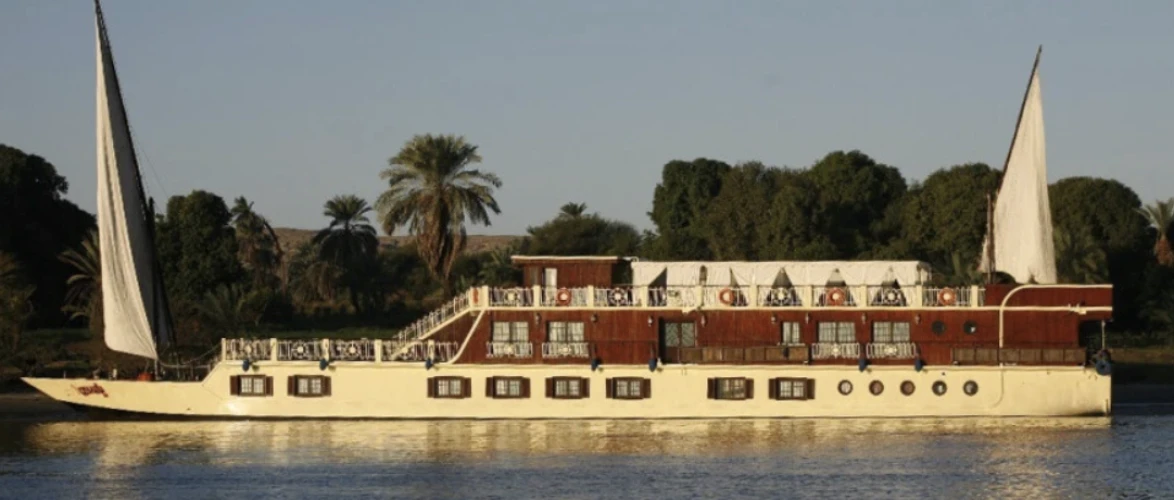
Sailing in Style: Why You Should Book a Private Dahabiya Nile Cruise.
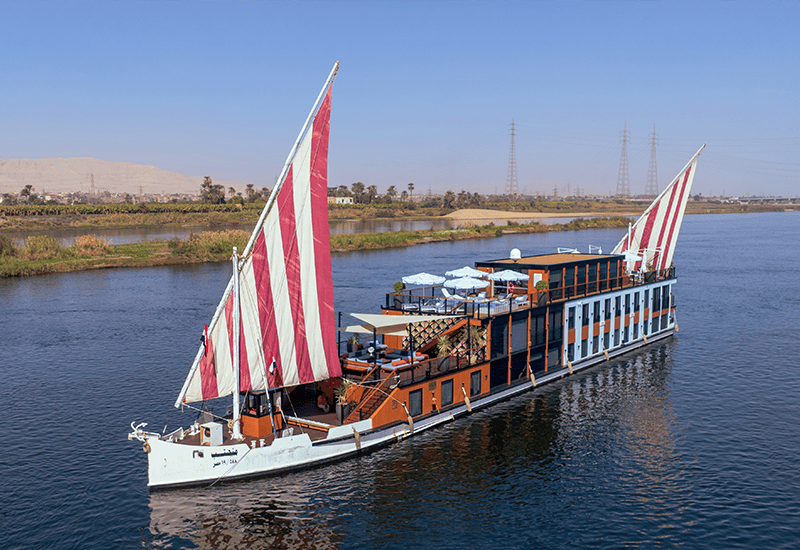
1. What Exactly is a Dahabiya?
A Dahabiya is a traditional Egyptian sailing boat. Historically, these were the "private jets" of the 19th-century elite—royalty and aristocrats used them to travel between Cairo and Aswan before engines existed.
In 2026, a modern Dahabiya is a masterpiece of wooden craftsmanship. It typically has only 4 to 8 cabins, meaning you are sharing the boat with a handful of people—or, if you book a private charter, just your family or friends. Unlike the massive cruise ships, a Dahabiya has no roaring engine; it relies on two large lateen sails and the natural current of the river. When the wind drops, a small tugboat (kept at a distance to maintain the silence) gently pulls you along.
2. The Luxury of Silence
The first thing you’ll notice in 2026 when you step onto the polished teak deck of your Dahabiya is the quiet.
On a standard cruise ship, you are constantly surrounded by the hum of generators and the chatter of hundreds of people. On a Dahabiya, the only sounds are the water lapping against the hull, the wind in the sails, and the occasional call to prayer echoing from a distant village. For a foreigner, this silence is the ultimate luxury. It allows you to actually process the history you are seeing, rather than just rushing from one temple to the next.
3. Access to the "Hidden" Nile
This is the real "human" advantage of a Dahabiya. Because these boats have a shallow draft, they can dock almost anywhere.
While the giant ships are forced to dock 4-deep in crowded ports like Esna or Edfu, your Dahabiya can pull up to a small, sandy bank or a private island. In 2026, the best itineraries include stops at places like Gebel el-Silsila—an ancient sandstone quarry that most tourists only see from a distance. You can walk right off your boat and explore shrines carved into the cliffs that feel completely untouched. You aren't just visiting a site; you’re discovering it.
4. 2026 Logistics: Planning Your Private Sail
To give your readers the 1,200-word depth they need, let's break down the practical side of booking for 2026:
| Feature | Large Cruise Ship | Private Dahabiya |
| Capacity | 100 - 300 Guests | 8 - 12 Guests |
| Pace | Fast / Rigid | Slow / Flexible |
| Food | International Buffet | Farm-to-Table Egyptian |
| Privacy | Low | Very High |
| 2026 Cost | ~ $150 - $300 / night | ~ $500 - $800 / night |
Pro-Tips for the 2026 Traveler:
-
Book Early: There are only a limited number of high-quality Dahabiyas in Egypt. For a 2026 trip, you should be booking 8 to 10 months in advance, especially for the peak winter months (November to February).
-
The "Private Chef" Factor: On a Dahabiya, the food is personalized. In 2026, the best boats employ chefs who source ingredients daily from the riverside farmers. You’ll eat fresh Baladi bread, Nile perch, and organic vegetables that haven't spent a second in a freezer.
-
Connectivity: While most Dahabiyas offer Wi-Fi, the signal in the middle of the Nile can be weak. Use a local eSIM (Orange or Vodafone) to ensure you can still upload your sunset photos.
-
The Route: Most sails go from Esna to Aswan (usually 4 nights). This is the "sweet spot" of the river where the scenery is most dramatic.
5. Dining Under the Milky Way
In 2026, "Luxury" is defined by experiences that money can't buy in a city. One night on every Dahabiya trip, the crew will set up a dinner on a deserted island.
You’ll step off the boat onto a candlelit sandbank. There are no other tourists, no streetlights, and no noise. You eat around a campfire while the stars of the Sahara shine brighter than you’ve ever seen them. It’s a moment of pure human connection—to the land, to the river, and to the person you're traveling with. It is, quite simply, the most romantic dinner on the planet.
6. A Slower Pace of History
Standard cruises are a sprint. Dahabiyas are a marathon.
Because you aren't rushing to beat 50 other ships to the next dock, your guide (who is usually a private Egyptologist assigned to the boat) can tailor the tours to your interests. If you want to spend two hours studying the hieroglyphs at Kom Ombo, you can. If you want to skip a temple and just swim in a clean stretch of the Nile, you can do that too. In 2026, this flexibility is what separates a "tour" from a "journey."
7. The Human Connection: The Crew
By the third day on a Dahabiya, the crew starts to feel like family. They know how you like your tea, they share stories about their villages along the river, and they take genuine pride in showing you their country.
In a world of automated service and "standardized" hospitality, the Dahabiya remains a bastion of genuine Egyptian warmth. When you finally dock in Aswan, saying goodbye to the crew is often the most emotional part of the trip. You aren't just leaving a boat; you’re leaving a home that moved you through time.




-webp.webp "Hilton")
-webp.webp "dusit")
-webp.webp "Marriott Hotels")
-webp.webp "Azimut Hotel")
-webp.webp "Golden Tulip")
-webp.webp "sheraton")
-webp.webp "westin hotel")
-webp.webp "Movenpick")