


The Egyptian Crook and Flail: Meanings, Connection to Osiris, and Royal Secrets
The Shepherd and the Provider: Decoding the Crook and Flail in Ancient Egypt
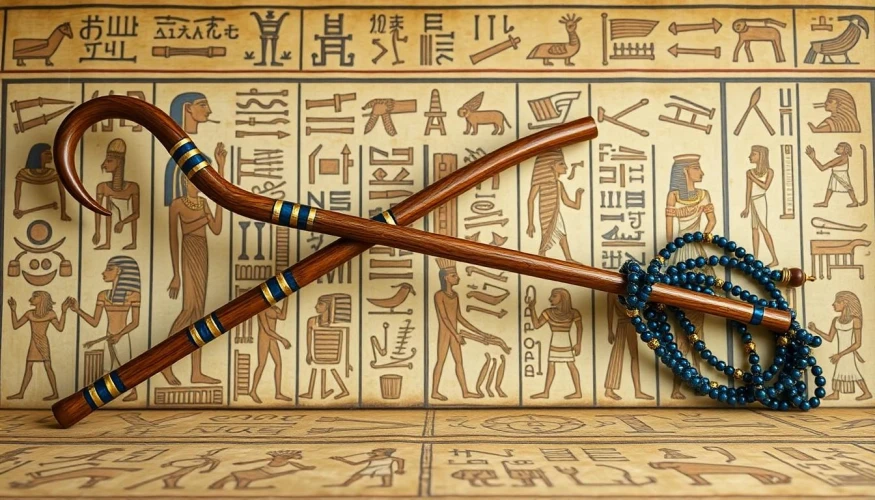
If you stand before the dazzling golden death mask of King Tutankhamun, or just peer at the detailed carvings on the stone sarcophagi inside those royal tombs, you will always notice two distinct things kept firmly across the Pharaohs chest. In one grip , the king holds a staff with a curved, hooked handle. In the other, he clutches a rod that is linked to three dangling beaded strands.
To the outside world, these can look like straightforward decorative scepters of royalty . But in ancient Egyptian eyes, this well known pair became the whole visual image of absolute power. They were not merely little signs of wealth either , they also carried the dual duty of a leader: the gentle herding guidance, and the stern dominion of a provider.
Let us take it slow and look in a more detailed way at the rustic beginnings of the crook and flail, their long deep bond with the god Osiris, and the way these symbols mapped royal leadership for more than three thousand years.
1. Simple Tools turned Regal Symbols: The Anatomy and Origins
Like a lot of Egypt’s most revered royal symbols, the crook and flail didn’t really begin inside some super polished palace. Not at first anyway, they came from small, practical tools that everyday workers used, out in the fields and pastures near the Nile, kind of close to daily life not far from it.
The Crook (Heka)
Anciently called the Heka, the crook has the same shape as a usual shepherd’s staff. In the early pre-dynastic times, nomadic herders relied on that curved wooden stick, to grab the legs of stray sheep or pull a fragile lamb out of nasty thick brush. Then, as early leaders stitched together local tribes, the Heka hieroglyph slowly shifted, and it started to mean “to rule” or “to govern.” In the end it became a quiet visual nudge that a genuine king should shepherd his people, protect them and guide them, more than just command them.
The Flail (Nekhakha)
Known as the Nekhakha, the flail has a short handle with three long flexible strands hanging from it, usually with heavy beads or wooden cylinders. Originally, this was basically an agricultural beat-stick, farmers used it to strike wheat stalks at harvest time. The point was to separate useful grain from the useless chaff, simple really. It also served shepherds, who used it to scare away dangerous desert predators like wolves, so the flock could breathe easy. Later on, it turned into a sign of unshakable authority, strict enforcement and even agricultural plenty, you could say abundance itself.
2. Fusing with the Divine: The Staffs of Osiris
While the reigning Pharaoh carried these objects during those massive state ceremonies, the crook and flail were basically tied, to Osiris, the legendary god of agriculture, rebirth, and the underworld.
In traditional temple art, Osiris is almost always pictured sitting, in a sort of majestic stillness on his divine throne, his arms crossed over his chest in an “X” shape, holding the crook in his left hand and the flail in his right.
That exact posture carried a lot of theological weight. By crossing those two distinct implements over his heart, Osiris was proving he had the proper equilibrium of authority traits
The crook showed, his mercy and the willingness to guide his followers safely into paradise.
The flail made clear his firm power to judge the dead, correct wickedness, and command the fertile cycles of the earth.
And when a human Pharaoh held these same objects, they were basically telling their subjects that they were the living, breathing likeness of Osiris on earth, keeping the whole nation balanced and secure.
3. The Practical Value: Guiding the State and Harvesting Order
The idea behind the crook and flail got dropped pretty much straight into how ancient Egypt did its day to day running, in a way that was practical not just symbolic. It kind of set the tone for what a king was supposed to do on a daily political level.
The coronation moment: right at the time a new prince was made official, and crowned as Pharaoh, the high priests ceremonially put the sacred crook and flail in his hands. That legal gesture felt like a doorway, he went from being a regular person, into a divine protector who supposedly managed the fates of millions, like literally.
Jubilee renewal: then during the Sed Festival, the king moved out before his people while carrying these scepters, as if to demonstrate that his bodily vigor for steering the land, (the crook), and for safeguarding the economic yield, (the flail), was completely back again.
4. Packing for Eternity: The Scepters in Royal Tombs
Since the crook and flail were basically the key, unmistakable symbols of royal identity, they ended up having a big part in ancient Egyptian funerary customs. A king couldn’t really imagine arriving to the afterlife without anything in his hands, so he had to carry those tools of dominion, to actually take his proper place among the stars, in a way that felt rightful and sure.
1. The physical placement , Phase 1.
Artisans made tiny but extremely detailed versions of the crook and flail from precious gold, dark obsidian, and blue glass , then set them right inside the hands of the royal mummy before sealing the coffin layers.
2. Facing the judges, Phase 2.
When the deceased pharaoh stood before the divine court down in the underworld, holding these sacred scepters helped him display unwavering kingship, kind of like a proof to the gods that he wasnt just another everyday citizen.
3. Claiming the divine throne, Phase 3.
Once Osiris accepted him, the king drew on the spiritual force of the crook and flail, transforming into an eternal presence. Then he could occupy a star like rulership role, assisting with the cosmic order for all time, as if forever was the natural next step.



-webp.webp "Hilton")
-webp.webp "dusit")
-webp.webp "Marriott Hotels")
-webp.webp "Azimut Hotel")
-webp.webp "Golden Tulip")
-webp.webp "sheraton")
-webp.webp "westin hotel")
-webp.webp "Movenpick")