


-webp.webp)
The Ancient Egyptian Vulture Symbol: Meanings, the Goddess Nekhbet, and Golden Royal Crowns
.webp)
Sovereignty in the Skies: Decoding the Vulture Symbol in Ancient Egypt
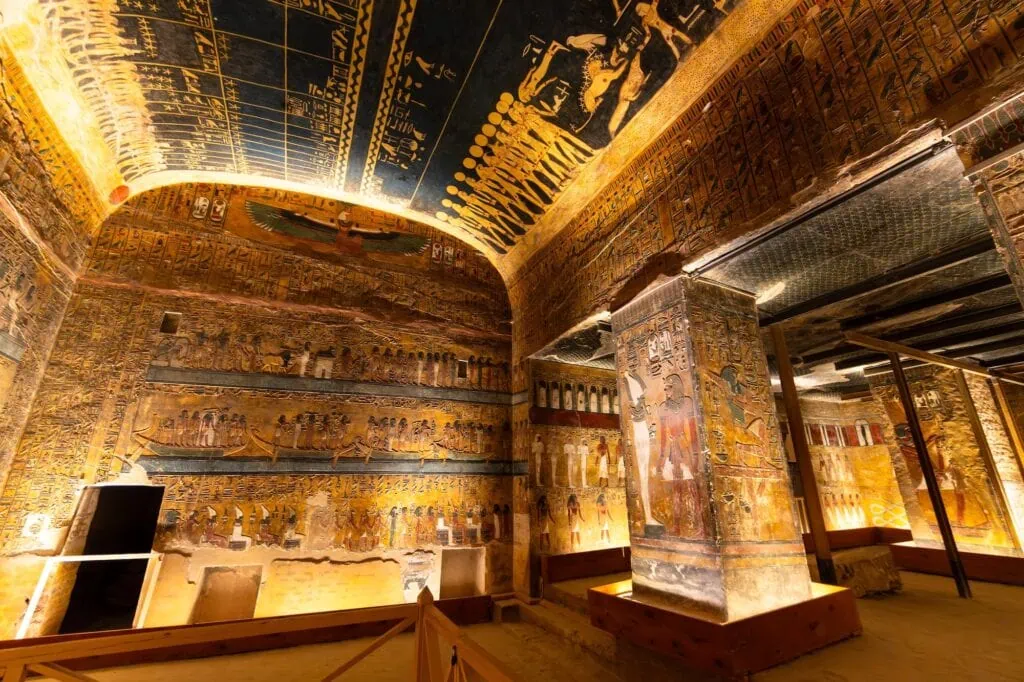
If you step inside the newly restored , vividly painted temples of Esna or Luxor, or just look up at the high ceilings inside the royal New Kingdom tombs, you will quite often see this mind-blowing celestial scene. There, spread ing its massive, intensely detailed wings across the stone ceiling , as if it is physically holding up the roof of the whole monument is a giant, powerful bird. And in those sharp claws are the sacred Shen rings, those ancient signs for endless cosmic shielding.
Now, a modern viewer might think of a vulture and get grim ideas about rot, scavenging, or bad omens. Yet for the ancient Egyptians, this bird was not taken as something ominous. It was an elite, deeply cherished emblem for maternal care, firm royal protection, cosmic cleansing, and feminine authority. The vulture was not treated as some dreadful messenger of death; instead it was praised as a magnificent guardian of life , and also as a major title holder for queens and pharaohs who ruled along the Nile.
So let us slow down, and take a careful, detailed look at the natural biology that helped inspire this sky guardian, its key role in the official crowns worn by Egypt’s great queens, and how a bird that feeds on carrion turned into the ultimate symbol of protective motherhood.
1. The Cleaners of the Desert: The Biological Blueprint
To appreciate why the vulture was lifted up into the top ranks of temple art, we kind of have to see how these birds actually lived, along the desert cliffs of the Nile Valley. The ancient scribes mostly tracked two separate kinds, not just one, the massive Griffon Vulture (Gyps fulvus) with its impressive eight foot wingspan, and then the smaller, recognizable Egyptian Vulture (Neophron percnopterus).
The Egyptians were pretty pragmatic, they understood that the vulture carried a crucial, sacred task in the ecosystem:
Since the vultures helped turn the bleak aftermath of death into clean renewed desert spaces, the Egyptians linked them with transformation, and purification. They pictured the bird as a sort of magical force that could counteract decay, and make it return into a safe, well ordered world, (Ma'at).
2. Nekhbet: The Protective Mother of the South
In the spiritual mapping of ancient Egypt, the vulture was basically the living embodiment of Nekhbet, that primordial white goddess who watched over Upper Egypt, the southern river valley.
Nekhbet was seen as the ultimate cosmic mother. The people noticed, that mother vultures are intensely protective of their nests, using their huge wingspans to shelter the vulnerable chicks from the burning desert sun, and predatory snakes too.
When a pharaoh took the throne, he would use the Nebty, (Two Ladies) title, to show he had the backing of the nation's two oldest maternal protectors, kind of like official proof. On his royal brow sat the rearing Uraeus cobra (Wadjit) standing for the north, and beside it the beautiful head of the vulture (Nekhbet) standing for the south. Together the snake and the bird, made an unbroken shield of divine protection around the king’s mind, no gaps.
3. The Queen’s Headdress: The Crown of Divine Motherhood
Because the vulture was, like, the ultimate symbol of a mother’s fierce protection, its image was permanently gifted to the most commanding women in the empire—the Great Royal Wives and Queen Mothers
From the iconic Queen Nefertari to the ruling Pharaoh Hatshepsut , royal women wore a magnificent, form fitting Vulture Cap made from pure gold and set with precious gemstones.
The whole design of this crown felt deeply psychological and deliberate, not just decoration. The golden vulture body sat close around the queen’s head, while its long protective wings folded down in a soft arc along the sides of her cheeks, to shield her face. With this headdress on, the Queen wasn’t only wearing a beautiful piece of jewelry , she was visibly turning into the goddess Nekhbet, like right in front of everyone, showing her people that she was the ultimate maternal anchor of the royal line, responsible for nurturing the next divine heir to the throne.
4. The Phonetic Groundwork: Writing the Sound of 'A'
While the vulture glided over temple ceilings and royal crowns, it also kind of worked under the surface as a base part within the everyday written speech of the scribes.
The shape of the upright Egyptian vulture was taken as an essential uniliteral hieroglyphic sign, and it carried a separate sound marker, the glottal stop. Many people translate it today into the letter "A" (or Aleph) and that’s the point i guess.
1. The tail angle : Phase 1.
The scribe drew that familiar sloped back of the standing vulture, and made sure the long tail feathers dropped downward toward the baseline at a precise formal angle, no fuss.
2. The curved beak : Phase 2.
The artist outlined the long slender neck, then added the sharp hooked end to the beak. It’s basically the signature biological instrument of the real bird out in the desert.
3. The inking of truth : Phase 3.
On painted papyrus documents or palace walls, the body got filled with clean white and soft grey tones , and bright yellow legs were laid in as accents, so the sign stayed instantly recognizable for readers across the whole land.


-webp.webp "Hilton")
-webp.webp "dusit")
-webp.webp "Marriott Hotels")
-webp.webp "Azimut Hotel")
-webp.webp "Golden Tulip")
-webp.webp "sheraton")
-webp.webp "westin hotel")
-webp.webp "Movenpick")