


The Ancient Egyptian Sky Symbol: Meanings, the Goddess Nut, and Temple Ceilings
The Celestial Canopy: Decoding the Sky Symbol in Ancient Egypt
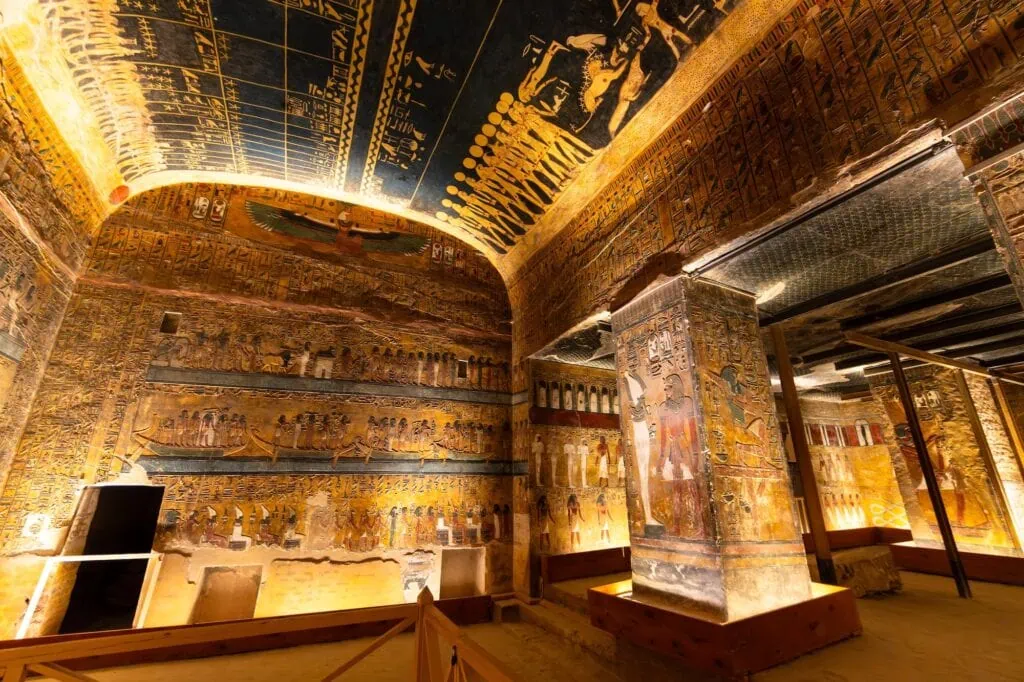
If you step inside those dimly lit deep chambers at the Hathor Temple in Dendera, or you look up at the soaring ceilings in the royal tombs of the Valley of the Kings you might feel like you’re standing under some massive cosmic thing. The ceilings were painted in deep brilliant lapis lazuli blue, and they’re covered with hundreds of tiny golden stars that shimmer. They weren’t ever left blank, not really. Instead they were built to feel like a permanent protective roof, a kind of covering for everything the universe contains.
And right in the middle of all that, there’s this simple neat hieroglyphic sign. It’s basically a straight horizontal bar, but both ends drop down in two vertical lines, and they do it at a sharp angled turn, kind of like a very austere bracket.
Ancient scribes knew it phonetically as “Pet”. To a modern eye it could look like a flat lintel, or like an ordinary table edge, nothing more, you know. But to the Egyptians this same mark stood for divine protection. It was also the boundary line of the physical world, and the infinite womb of creation. In their thinking, the sky wasn’t just empty dark space. It was alive, a protective ceiling that actually breathes and shields the fragile balance of life on earth from the wild roaring ocean of chaos (Nun) that surrounds the cosmos.
So now lets take a slow , detailed look at the real world observations that likely shaped this symbol, then its deep mythological roots in the story of the goddess Nut, and finally how the sky sign turned ordinary temple rooms into living replicas of the universe.
1. The Anatomy of the Horizon: Translating the Sky into Stone
To really get the special form of the Pet hieroglyph, you gotta picture yourself standing there in that enormous, flat desert belt around the Nile Valley. When you stare out across Egypt, the terrain pulls off this strong visual trick , like the huge ceiling of the sky is suddenly sinking, right down to where the ground seems to end, and it does that right at the far edges, resting there on unseen supports at the horizon.
The old scribes, they basically put that same horizon geometry right into the Pet sign. That long, level top line is the high sky spread out over the land, while the shorter upright marks that fall down on the left and the right show the limits of the horizon, the spot where the sky sort of cradles the eastern and western mountain masses. It is a clean minimalist sketch, sort of like a blueprint of the whole visible atmosphere.
2. The Mother of Stars: The Myth of the Goddess Nut
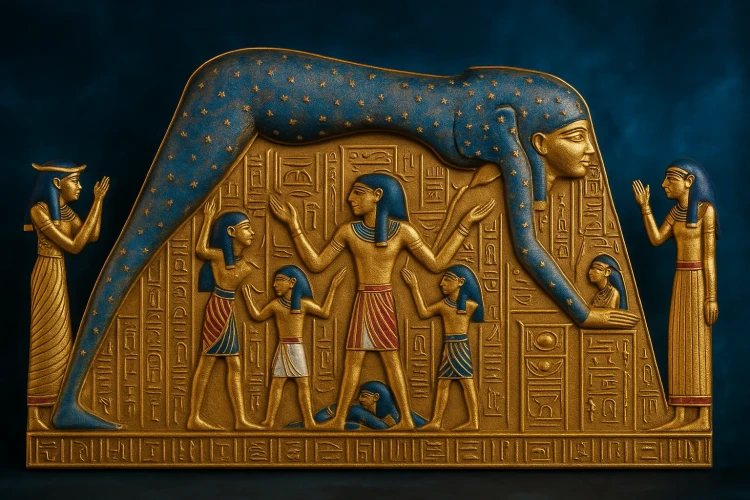
Even though the hieroglyphic symbol was drawn with clean geometric lines, the mythological imagination of Egypt kinda looked at the sky as a beautiful, loving, and fiercely protective female spirit, like Nut.
In the old creation tales from Heliopolis, Nut was described as the daughter of the air god Shu and the moisture goddess Tefnut. She fell into deep love with her twin sibling, the earth god Geb. At first, the earth and the sky were locked together in this intense, permanent embrace, so there was absolutely no room for light, air, or even human life to grow anywhere in between.
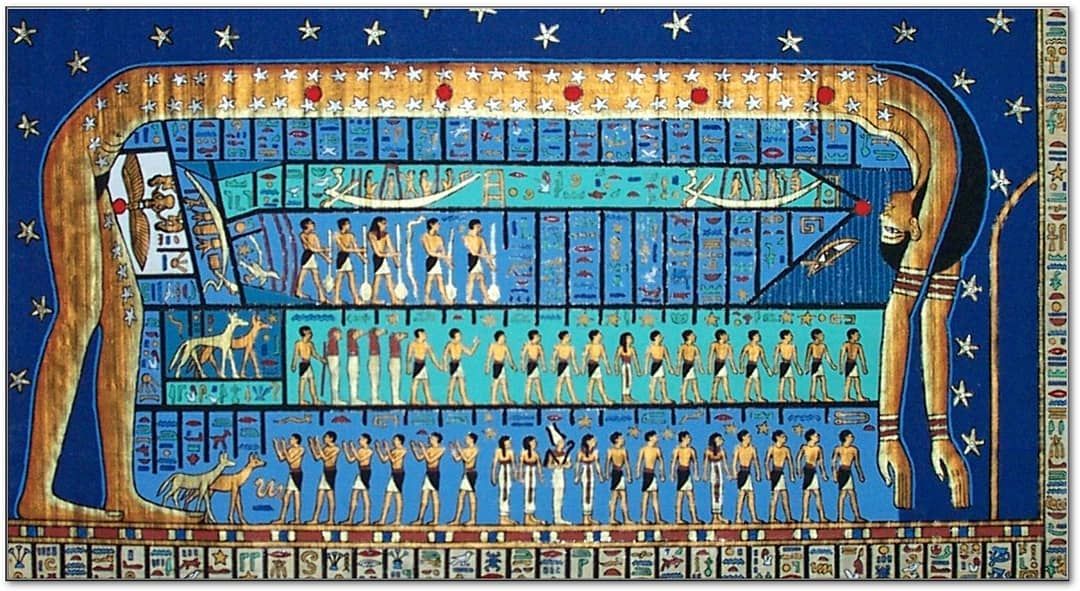
So, to make sure the cosmos could breathe their father Shu had to step between them, lifting Nut high up into the air. She arched her long, slender body into a sort of protective canopy over Geb, and she touched the ground only with her fingertips and the tips of her toes, at those far corners of the horizon. Her star-speckled skin became the deep blue night sky. And her body then turned into the cosmic barrier that stopped the primeval waters of chaos from spilling down and drowning the earth.
3. The Great Astronomical Cycle: The Daily Birth of the Sun
The sky symbol wasn’t really just some passive shield either; it was seen as this active, shifting theater where those big cycles of time, life, and rebirth were staged again and again every day. And the Egyptians followed the movement of Ra the sun god across Nut’s body with this very firm religious devotion, like, without missing a step or anything.
In those beautiful collections of texts that survived inside royal tombs, Nut is described as doing a continuous everyday kind of renewal, almost like it never stops:
The Sunset: Each evening, when the sun slipped under the western horizon, the sky goddess Nut swallowed the bright solar disk of Ra, and the earth was left in this cool, quiet sleep, for the night.
The Journey: During the dark hours, the sun traveled safely through the inner parts of Nut’s body, sheltered from the dangerous serpent creatures of the underworld.
The Dawn: Every morning, after that long night of spiritual cleansing, Nut gave birth to the glowing sun disk again in the East, filling the Nile Valley with warm golden light and showing people, in a plain and steady way, that life will always triumph over darkness.
4. Building the Cosmos: The Sky in Temple Architecture
Because the Pet symbol, sorta like the ultimate divines canopy, ancient Egyptian builders worked its protective geometry right into the actual placement of their stone temples, so these dim spaces became sacred blueprints of creation, kinda in a lived-in way.
1. Carving the architraves: Phase 1.
Masons lifted huge stone beams over the tops of stout columns. This made a firm structural horizontal roof, which also matched the flat top line you’d see in the Pet hieroglyph, not just in style but in the whole “feel” of it.
2. Applying the cosmic blue: Phase 2.
Painters brushed the whole stone ceiling with a thick coat of deep, open blue, made from crushed lapis lazuli , or azurite, and it sort of erased the heavy stone look, turning it into something more airy, like a held atmosphere.
3. Strewing the golden stars: Phase 3.
Then artists laid down repeating lines of five pointed golden stars across the entire blue field, so it stayed as a lasting, magical night sky that guarded the inner holy sanctuaries, for eternity .



-webp.webp "Hilton")
-webp.webp "dusit")
-webp.webp "Marriott Hotels")
-webp.webp "Azimut Hotel")
-webp.webp "Golden Tulip")
-webp.webp "sheraton")
-webp.webp "westin hotel")
-webp.webp "Movenpick")
