


-webp.webp)
The Ancient Egyptian Owl Symbol: Meaning, Language Phonetics, and Afterlife Guardians
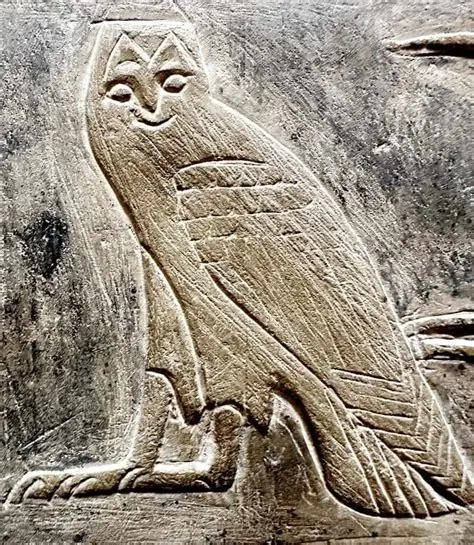
The Watcher of the Dark: Decoding the Owl Symbol in Ancient Egypt
If you slowly trace your fingers over the deeply carved limestone walls of the great temples of Abydos, or browse through the rows of immaculate graphic signs inside the tombs of Saqqara, your eyes will often get stuck on an incredibly striking avian figure. Unlike almost every other bird hieroglyph—drawn with strict care from the side, to show a sleek profile—this one is carved so the whole body stays in profile, but its large, circular head is turned fully around, staring straight out at you with a piercing , wide-eyed gaze.
Known phonetically to ancient scribes as M, the owl is one of the most common, yet oddly misunderstood symbols in the entire Nile Valley. For modern Western minds, the owl is kind of a cozy emblem of bookish wisdom. For other communities, it can feel like a sign of bad luck, and that’s it. But for the ancient Egyptians, this night predator lived in a complicated dual-natured space: it acted as a marker of uncompromising truth, a form of silent mastery, a subterranean crossing, and an absolute need for inner attention.
So let’s do this slowly, with a careful, detailed look at the real-world biology that gave birth to this unusual forward-facing icon, its massive job as a fundamental pillar within written language, and the strange link it seems to hold with the hidden underworld.
1. The Anatomy of a Look: Why Does the Owl Stare Forward?
To really understand why those ancient master artists, broke their strict multi-millennial rules of artistic perspective just to sketch the owl’s face looking ahead, we kind of have to sit with what was around them, mostly along the Nile fringes. The creature most often shown by Egyptian scribes was the Barn Owl, (Tyto alba) and the Pharaoh Eagle-Owl (Bubo ascalaphus) as well, sort of.
The Egyptians, were good at natural watching and they saw two particular traits that made owls stand apart from nearly all other birds.
First, the scribes recognized that when an owl looks straight at you, it hands you its complete, undivided attention. So by carving the owl head facing forward entirely, the older artists were capturing that core of the bird’s reality: a harsh, penetrating awareness that seems to slice right through the night’s darkness, not joking.
2. The Sound of 'M': A Pillar of the Written Language
While the animal carried deep spiritual energy, it worked tirelessly every single day, as one of the absolute most critical building blocks within the ancient Egyptian alphabet, sort of. The owl, is a uniliteral hieroglyphic sign representing the soft, nasal consonantal sound "M", in other words.
And because the sound "M" is extremely foundational in the Egyptian language, the owl was carved millions of times across the empire, in order to build essential words and phrases.
Every single time an architect wanted to write about a monument that endures for millions of years, or when a scribe wanted to record the name of the legendary first unifier of Egypt, King Menes, the proud forward-staring form of the owl, had to be chiseled into the stone. It served as a visual tether for the idea of stability, ongoing presence, and lasting truth.
3. The Lord of the Night: The Owl and the Underworld
Beyond its usefulness with language, the owl’s nocturnal way of living sort of naturally stitched it to the deep and mysterious sphere of what comes after, and also to that dangerous nightly trek of the sun god, Ra.
Where diurnal birds, like the falcon (Horus) and the vulture (Nekhbet) took control of the bright sunlit daytime stretches, the owl stayed as the uncontested ruler of the pitch-black desert night.
To the Egyptians the night wasn’t seen like some plain empty void. Instead it was treated as a concealed, inverted counterpart of the world itself. And because the owl could move through even the absolute darkest caves, rocky desert tombs, and dim valleys where human eyes were basically blind it was regarded as a careful guardian of the subterranean network.
In this view the owl didn’t stand for physical death as just a harsh stopping point, but more like a sign of the capacity to witness what is hidden—an inner kind of sight. That spiritual sight, was what a human soul needed in order to travel safely through the trials of the underworld before it was returned, to reborn, in the morning light of eternity.
4. The Scholar’s Precision: How Scribes Carved the Bird
Because the owl hieroglyph kept showing up in almost every single sentence of formal state literature, apprentice scribes in temple schools spent years practicing how to draw its proportions just right, even if it sometimes felt a bit too rigid for real life.
Making an official owl inscription needed a meticulous, multi stage routine, so the cosmic balance stayed steady (Ma’at), sort of like the world needed that sign to behave.
1. The Proportional Grid: Phase 1.
With red ink the scribe laid down a clean grid of little squares on the smoothed stone wall, so the bird’s overall height, its chest, and the tail all lined up with the legal canon laws.
2. The Head Rotation: Phase 2.
The artist outlined the streamlined body profile, then set the two big concentric circles of the eyes, directly over the chest line and in a way that made the face turn fully toward the viewer.
3. The Deep Chisel: Phase 3.
Master sculptors took copper chisels and cut deep along the outlines, and they would also texture the chest with small, delicate diagonal lines, to imitate the softer speckled camouflage feathers, the desert owl kind.


-webp.webp "Hilton")
-webp.webp "dusit")
-webp.webp "Marriott Hotels")
-webp.webp "Azimut Hotel")
-webp.webp "Golden Tulip")
-webp.webp "sheraton")
-webp.webp "westin hotel")
-webp.webp "Movenpick")