


-webp.webp)
The Ancient Egyptian Earth Symbol: Meanings, the God Geb, and the Secrets of Rebirth
The Foundation of Life: Decoding the Earth Symbol in Ancient Egypt
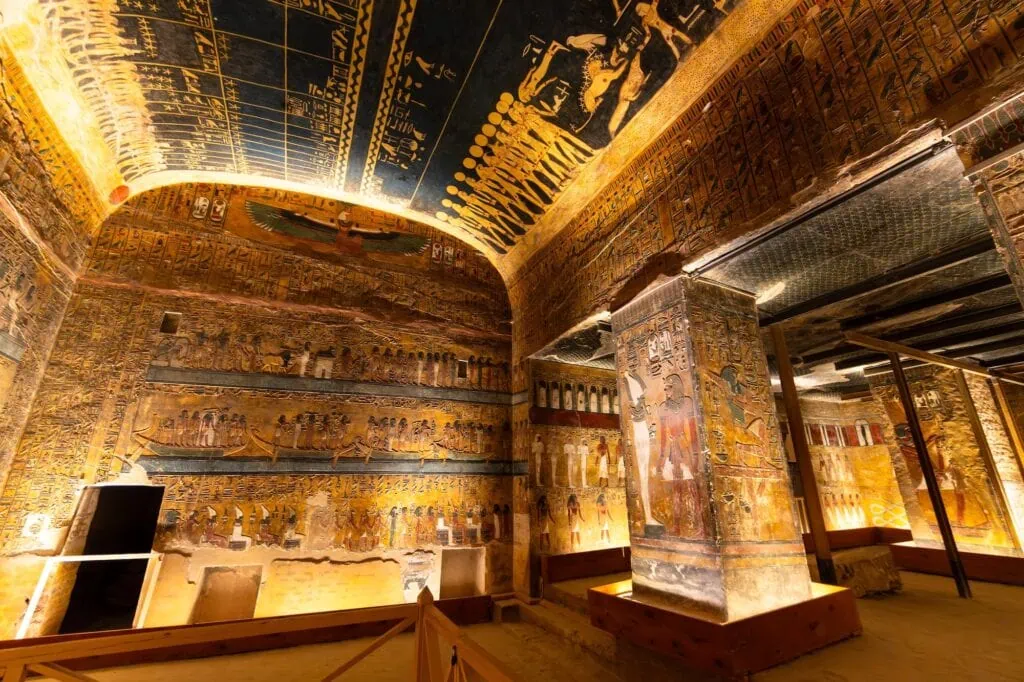
If you walk along the lower baseboards of the great temples at Luxor or Medinet Habu, or you examine those detailed landscape paintings that run across the walls of private tombs, your eyes sort of naturally settle on this very specific grounded design. Like, right at the bottom of the whole scene, underneath those massive statues of gods and the heavy pillars of stone, there is always a long thick horizontal strip. Most of the time that flat line has texture—delicate cross hatching, tiny dots that act like grains of sand, or sometimes it is painted a rich dark color meant to look like the muddy banks of the Nile.
Ancient scribes knew it phonetically as Ta , so a modern casual viewer might see it as nothing more than a border line. But for the ancient Egyptians, that symbol meant absolute stability, a physical presence, and the fertile womb where all material existence begins. Earth wasn’t just cold dirt or something dead. It was a living, breathing foundation that held human life in place, fed the whole nation through its agricultural surplus, and gave the physical stage for the great story of creation to unfold, again and again.
So, let us take it slow, and look closely at the actual natural setting that inspired this symbol, then at its deeper mythological personification as the god Geb, and finally how the idea of the earth linked the rhythm of farming to that long promise of eternal life.
1. The Anatomy of the Soil: Translating the Valley into Stone
To really get the particular visual character of the Ta hieroglyph you have to look, real close, at how the Nile Valley actually is in geography. Egypt is a place of very strong, sharp contrasts . Like one side has this huge, lifeless, burning desert sand (Deshret). And on the other side there is a narrow strip, rich and dark black alluvial soil (Kemet) that gets dropped every summer when the Nile floods.
The scribes made the earth hieroglyph as if it were a kind of direct slice through that valuable, life-giving stuff.
That long, straight top line, shows the visible horizon , where the solid ground meets the open air. The interior dots or those small cross-hatched marks stand for what you’d find down under, in the concealed realm—the tightly pressed layers of river silt , mineral matter, and buried seeds waiting for the proper instant to rise up. Honestly it reads like a calm minimalist drawing, of the physical earth itself.
2. The Reclining Giant: The Myth of the God Geb
While the everyday scribal script used that geometric Ta-bar thing to write about land and geography, the religious imagination of Egypt sort of personified the earth as a strong, masculine deity: Geb, yeah.
Now in sharp contrast to a lot of other ancient mythologies where the earth is shown as a sweet, nurturing mother goddess, the Egyptians did a kind of cosmic swap. For them, the sky was the feminine canopy (Nut) and the earth was a reclining king, green-skinned too.
In the creation tales, Geb lies flat on his back, under his sister Nut, and in a very literal way his body made the actual contours of the world, like mountains , plains , all of it, just there.
And the old texts tell us that
The Mountains and Valleys: Those jagged rises of the mountains and the lowered hollows of the valleys came from the exact curves and turns of Geb’s heavy limbs as he stayed resting on the ground.
The Earthquakes: Every time Geb shifted his weight, turned over, or basically laughed out loud in the deep underground realms, the physical ground on earth would start shaking, and that’s what we call earthquakes today.
The Green Skin: Artists often colored Geb’s skin deep, vibrant green or a darker brownish tone, so it would point to the plants, trees and barley crops growing straight from his divine body, no detour.
3. The Great Cycle of Renewal: The Earth as a Spiritual Womb
Because the earth symbol, kind of meant the spot where seeds were buried before they come back as golden barley crops , the ancient Egyptians just saw the ground as a huge, magical womb for spiritual rebirth. And honestly that belief removed the sharp, terrifying sting of death, almost like it didn’t belong there.
They never truly treated the burial of a person deep in the earth as a final ending. Instead it was handled, pretty much like sowing a seed in the spring, with patience and the same quiet confidence.
This deep spiritual link helps explain why the "Osiris Beds" were so common inside New Kingdom tombs. Priests built a small wooden frame shaped like Osiris, filled it with fertile Nile mud taken from the earth itself, and then placed fresh barley seeds within it.
When those seeds started to sprout into bright green stalks, in the darkness of the tomb, it gave the family a living kind of evidence. Like , since the earth coaxes new life from buried seeds, it would also coax their loved one’s soul out of the dark and into paradise.
4. Establishing Balance: The Earth in Temple Layouts
Ancient Egyptian architects were really, deeply into making buildings that felt like the cosmos, like they were copying its exact order. They used the Ta symbol as kind of a literal starting ground for their architectural work, not just an idea on paper.
1. The Textured Baseboards, Phase 1.
Sculptors carved long, unbroken ribbons of the Ta symbol along the very bottom levels of temple walls, kind of holding the whole stone structure down, right to the physical realm of the earth.
2. The Papyrus Columns, Phase 2.
Architects raised huge stone columns meant to resemble giant papyrus, or lotus stalks, lifting out of the earth band, like they were imitating how growth began in the primeval marsh.
3. The Rising Floor, Phase 3.
As someone walked further in, moving toward the holy inner sanctuary, the stone floor slowly started to climb upward while the ceiling seemed to dip down, as if the space itself was recreating that first rising of the primeval mound of creation from the waters.


-webp.webp "Hilton")
-webp.webp "dusit")
-webp.webp "Marriott Hotels")
-webp.webp "Azimut Hotel")
-webp.webp "Golden Tulip")
-webp.webp "sheraton")
-webp.webp "westin hotel")
-webp.webp "Movenpick")