


-webp.webp)
The Ancient Egyptian Cartouche: Meaning, History, and How It Unlocked Hieroglyphs
.webp)
Shielding the Royal Name: The Power of the Cartouche in Ancient Egypt
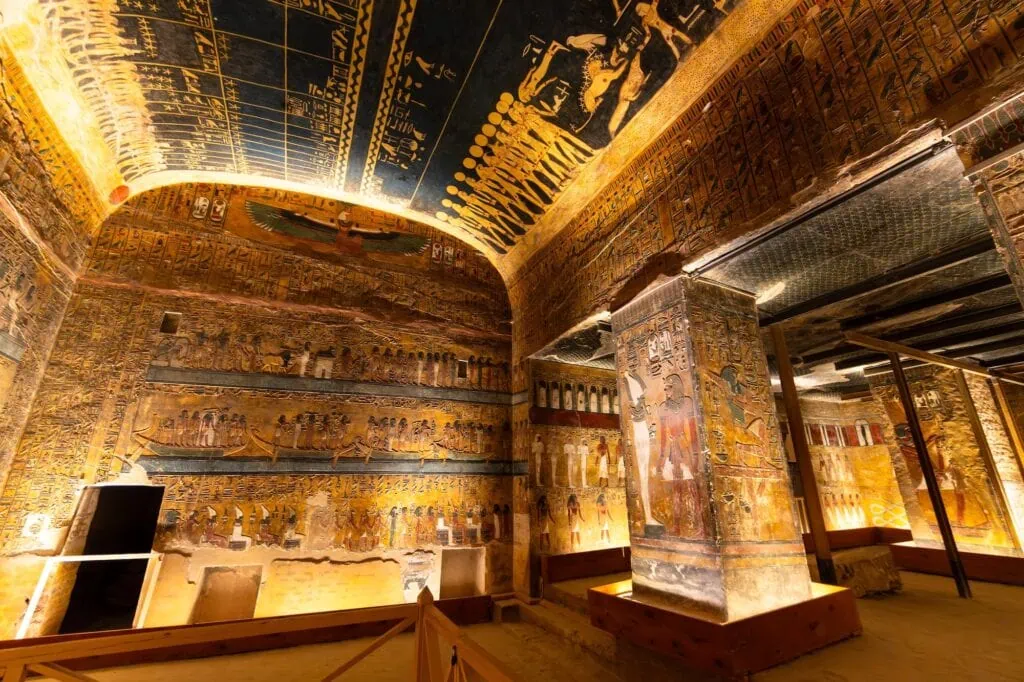
If you walk, through the monumental entrance of the Temple of Kom Ombo, or trace your fingers along the deeply incised wall reliefs inside the tombs of the Valley of the Queens, your eyes will almost automatically drift toward one recurring motif. Between rows of birds, seated figures, and geometric shapes, you will keep seeing that distinct elongated oval loop, with a horizontal line that really anchors the base. Within that oval, there is a tight small cluster of sacred hieroglyphic symbols, perfectly grouped.
For the outside world, this loop works like a useful archaeological label, a clean visual prompt that a king or queen’s name is written inside. But for the ancient Egyptians, the cartouche was far more than a tidy administrative frame or a royal title box. It was, in their thinking, an all-purpose magical protection, a kind of cosmic boundary line meant to enclose a Pharaoh’s living essence soul and keep their identity from getting erased across eternity.
So, lets take a slow, a very detailed look at the fascinating history of the cartouche, its origins tied to cosmic geometry, and how this plain loop helped unlock the long lost secrets of an entire civilization.
1. What Exactly is a Cartouche?
While we use the word Cartouche universally today, the ancient Egyptians had they own native term for this particular symbol, kind of like, they called it a Schenu (it comes from the ancient verb Sheni, which literally means “to encircle” or “to surround” ).
The modern name actually dates back to the late 18th century, during Napoleon Bonaparte’s military expedition to Egypt. When the French soldiers marched through the desert temples, they noticed these oval signs carved everywhere, and it seemed obvious to them. To their eyes, the long ovals looked exactly like the paper gunpowder cartridges used in their standard firearms, which were called cartouches in French. The nickname stuck, eventually becoming the standard term used by global scholars, more or less.
As we discussed before, the cartouche is the direct design evolution of the perfectly round Shen Ring. While the original round rope loop was ideal for holding small singular concepts or divine emblems, it simply wasn’t physically spacious enough to contain the multiple intricate hieroglyphic characters that made up a Pharaoh’s official title.
To solve this practical layout problem, Old Kingdom scribes carefully stretched the top portion of the braided rope loop vertically into an elongated oval, and they kept the protective horizontal knot locked tightly at the lower base.
2. Cosmic Bodyguards: Protecting the Five Names of the Pharaoh
To really understand why wrapping a name inside a cartouche was so critically important, you kinda have to look at how ancient Egyptians saw the spiritual anatomy of a human being, not just like “mind and body”, but more layered. They believed a person soul was split into distinct components, and one of the most vital parts was the Ren, the hidden name.
If someone’s name was totally forgotten, or spoken aloud with hatred, or even physically chiseled off a stone wall, then the soul would immediately start to wander around lost, stuck in the darkness of the underworld, basically it would stop existing. And for a reigning Pharaoh, keeping the royal Ren safe wasn’t only a personal issue , it was national survival plus cosmic survival too.
By the time a king actually ascended the throne of Egypt, he held five completely separate royal names. But only the two most important ones got the magical protection of the cartouche, like the rest were kind of secondary.
The Prenomen , (the throne name) : this was the official title chosen at the exact moment they became king. It almost always included the name of the sun god, Ra, so the king’s rule on earth got tied to divine solar law.
The Nomen , (the birth name) : this was the private name given to them by their parents at birth, like Ramses , Tutankhamun , or Hatshpsut. It was introduced with the phrase “Son of Ra,” so their lineage was anchored to the sky rather than just bloodlines
So when the priests enclosed these two names inside that protective boundary formed by the stretched Schenu rope, they kind of locked the Pharaoh identity to the endless sun cycle, meaning no human enemy or tricky evil spirit could ever really reach their cosmic soul.
3. The Rosetta Stone: How the Cartouche Unlocked History
For over a thousand years, after the fall of the New Kingdom, the ability to read Egyptian hieroglyphs was basically lost to the world. The spectacular temples sat there, completely silent, while travelers looked at those elaborate wall carvings and treated them like nothing more than gorgeous confusing kind of magical drawings, you know?
And then that whole situation shifted, kind of suddenly, because of a brilliant French scholar named Jean-François Champollion and the unusual shape of the cartouche.
Once scholars started digging into the famous Rosetta Stone (it carried the same decree, in Hieroglyphs, Demotic script, and Ancient Greek), they ended up getting nowhere. Hieroglyphs didn’t follow a standard alphabet, so cracking them felt brutally hard, like trying to read fog.
1. Isolating the Ovals: Phase 1
Champollion noticed that certain clusters of hieroglyphic characters were enclosed by those very specific oval frames, the cartouches. He reasoned that these special “containers” were intentionally used to point out foreign royal names.
2. Cross-Referencing the Greek: Phase 2
Then, by checking the Greek portion on the stone, he knew the name Ptolemy (Ptolemaios) had to be hidden somewhere inside. He lined up the letters from the Greek name with the particular symbols sitting inside the corresponding cartouche.
3. The Cleopatra Confirmation: Phase 3
After that, he examined another inscription , from an obelisk at Philae, which included a different cartouche. That one was recognized as pointing to Queen Cleopatra. By comparing the shared or overlapping signs between the two ovals (like the letters P , L , and O), he managed to show that his translation approach was actually correct.
So because the cartouche served as this obvious visual guide, Champollion could crack, piece by piece, the phonetic system behind ancient Egypt’s writing. And within only a few years, the silent stones of the Nile Valley were suddenly able to “talk” to the modern world again.



-webp.webp "Hilton")
-webp.webp "dusit")
-webp.webp "Marriott Hotels")
-webp.webp "Azimut Hotel")
-webp.webp "Golden Tulip")
-webp.webp "sheraton")
-webp.webp "westin hotel")
-webp.webp "Movenpick")