


-webp.webp)
The Ancient Egyptian Ba Bird: Meaning, Mummification, and the Unconquerable Mind
.webp)
The Winged Personality: Decoding the Ba Symbol in Ancient Egypt
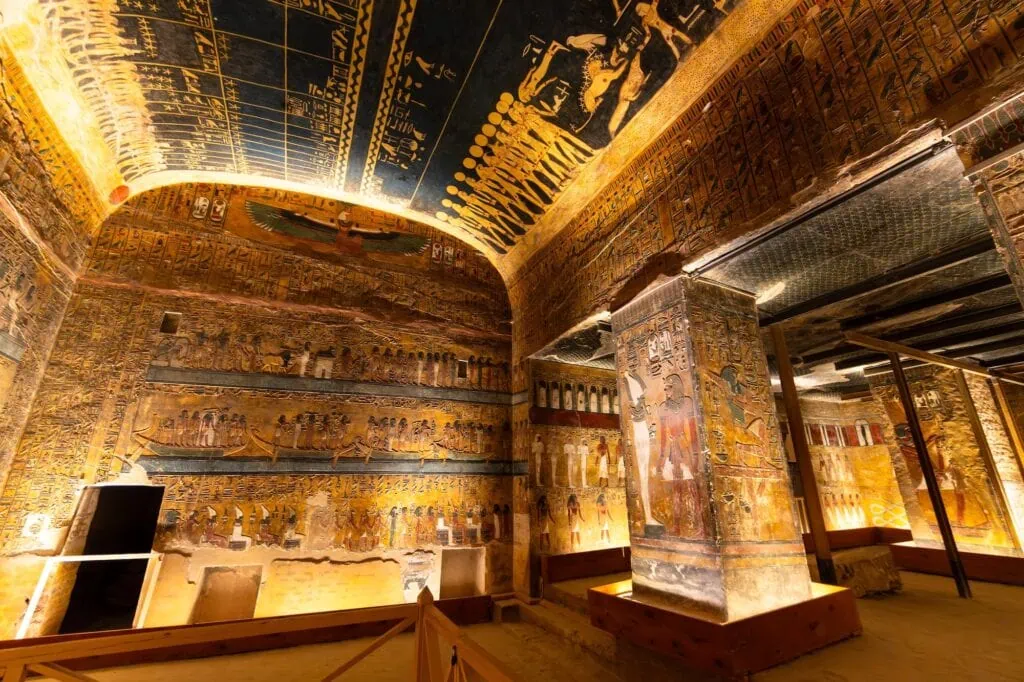
If you read carefully through the brightly illustrated funeral papyri from the New Kingdom, or you shine a flashlight onto the painted ceilings of those hidden tombs in western Thebes, you will eventually run into something odd, like a highly unusual creature looking straight back at you. It’s a large bird—usually a falcon or a jabiru stork—and yet instead of a standard feathered head, it has the completely detailed , fully expressive face of a human being.
For anyone visiting Egypt’s monuments today, this hybrid creature can feel like a surreal mythological monster straight out of a fairy tale. But to the ancient Egyptians, the Ba was not just “strange art” or a decorative symbol, it was an indispensable part of what made a human being fully whole. In other words, it functioned as the personification of your individuality, that distinctive personality of yours, and your freedom of movement. It was the one part of your soul that refused to be trapped inside a dark tomb , choosing instead to spread its wings and fly directly into the sunlight.
So, let us take it slowly, and do a more detailed look at the spiritual nature of the Ba, and also at how it worked alongside its spiritual twin the Ka, and then why this bird-like emblem represented the ultimate ancient dream of freedom after death.
1. What is the Ba? (The Face of Your Unique Self)
When we looked back at Egyptian theology earlier, we sort of unraveled how the soul got split into a few layered, but kinda tangled parts. We already talked about the Khat as the physical flesh, and the Ka as that shared life force, like a battery, that kept the body running.
The Ba was a different story though. It wasn’t flesh, and it wasn’t that life current either. The Ba was basically you in the everyday sense , your personality, your character, and your ego.
All the things that made you, you—your specific sense of humor, your voice your kindness, your temper, and your gathered memories—were put away inside your Ba. Since it stood for your inner character, artisans often drew it with a human head, so folks could recognize at a glance whose soul it was that was moving on.
And the bird body choice , honestly, felt like a stroke of pure psychological genius. The ancient Egyptians watched birds and saw the best image of complete mobility. A bird can fly over defenses, cross wide rivers without a boat and just go upward without stopping. So by picturing the personality as a human-headed bird, they made sure that death couldn’t really pin their conscious minds down.
2. The Daily Flight: The Ultimate Commute Between Realms
While the Ka had to remain comfortably tucked inside the tomb, to draw in the spiritual essence from bread and meat offerings, the Ba really had this kind of fast moving, practical daily calling to do in the afterlife. Think of it as a connection bridge between two worlds that are totally separate, like no overlap at all.
In the spells that were preserved inside the Book of the Dead, a Ba that had been transformed properly followed a strict, repeating day to day routine:
The day time wandering: right after the sun rose over the eastern horizon, the Ba bird would just fly out from the dark burial shaft. It would spend the daylight moving through the living world, sitting in the shade of green sycamore trees, sipping fresh water from the Nile, and going around to the beloved places the person remembered from their earthly life.
The night time coming back: when darkness covered the desert and Ra the sun god sank into the underworld, the Ba bird flew back down into the tomb’s depths, it was faithful about it. It went straight to its physical anchor — the mummified body — and rejoined it for the night, to rest, refill spiritual strength, and even drift into those paradise dreams.
3. The Critical Reunion: Why Mummification Mattered
This intense daily commute sort of explains why the ancient Egyptians treated the preservation of the human body through mummification as an absolute, non negotiable, matter of life and death.
The Ba was pretty mobile, yes, but it didn’t have a lasting physical shape of its own. It was more like a traveler. Every single night, when the Ba bird settled back down into that pitch black burial chamber, it had to be able to instantly pick out its matching body among all the other tombs.
So if the face on the mummy got completely ruined, or it decayed, or some grave robbers chiseled it away, then that returning Ba bird would end up permanently misplaced, deeply confused, and unable to anchor itself.
To avoid this catastrophic spiritual separation, the ancient embalmers did two things , more or less:
First, they produced extremely detailed mummy masks (similar in idea to the gold mask of King Tut) , and these duplicated the exact human features of the deceased. That made recognition easier for the Ba bird from above.
Second, they carved the face of the deceased onto interior stone statues, so the Ba had an emergency backup body, in case the main mummy took any damage across the centuries.
4. Embracing the Universe: The Transformation into an Akh
The actual aim of the old Egyptian spiritual path wasn’t only to stay a stand alone bird, and a separate double, for all eternity. The real focus was much more like to get the parts of the self to properly align, sort of in harmony, after the last judgment gets finished.
1. The split up of Flight : Phase 1.
At the moment physical death happens, the human headed Ba bird is released from the constraints of the heavy skull, and it starts to rise, taking flight into the open air around the tomb chapel.
2. The nightly binding : Phase 2.
Then, as night arrives, the Ba bird comes back to the wrapped mummy. It settles, locking its small talons over the chest of the body, so it can draw again vital spiritual life back into the preserved organs, almost like a careful return.
3. The end change into something new : Phase 3.
When the heart lines up just right, balanced against the Feather of Ma’at, the moving Ba and the unmoving Ka finally merge without coming apart. That is how the deceased becomes an Akh—a shining immortal star, that remains forever in the northern sky.




-webp.webp "Hilton")
-webp.webp "dusit")
-webp.webp "Marriott Hotels")
-webp.webp "Azimut Hotel")
-webp.webp "Golden Tulip")
-webp.webp "sheraton")
-webp.webp "westin hotel")
-webp.webp "Movenpick")