


Echoes from Qubbet el-Hawa
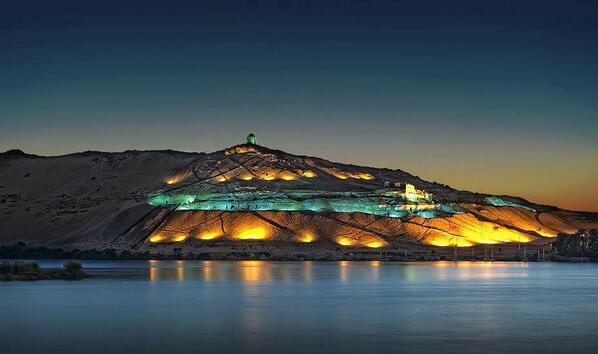
If you stand on the boardwalk of Aswan in the late afternoon, kind of looking across the slow moving sapphire-blue of the Nile, your eyes will naturally wander past Elephantine Island , and then go to this high golden sandstone hill that rises kind of hard up out of the Western Desert. By day, it seems like a tough fortress of rock and sand. By night, when illuminated by golden spotlights it starts to look like a glowing staircase climbing toward the stars.
Right up there near the top of the hill there’s a small white domed tomb, dedicated to Sidi Ali bin el-Hawa, a local Muslim holy man. And it’s that place, that little shrine, that gives the mountain its modern Arabic name: Qubbet el-Hawa, or “The Dome of the Wind.”
Though, the wind isn’t the only thing that murmurs through the cracks of the hill . Cut straight into the rock face below the dome is an ancient city of the dead—a vertical necropolis, full of the stories, hopes, and heartache of the men and women who ran Egypt’s wildest border, thousands of years ago.
The Guardians of the Gate
To understand Qubbet el-Hawa you kinda have to get Aswan’s place in that old world. The pharaohs knew it as Abu, a name that meant both “Elephant” and “Ivory,” and yeah, it felt like the outer rim of everything the ancient Egyptians thought existed. It was the absolute southern border, a busy frontier place where the smooth, passable Nile just… abruptly banged into jagged granite boulders, right at the First Cataract. After that, beyond, lay Nubia a land of immense wealth, strange merchandise, and constant risk. The men buried in the tiers of Qubbet el-Hawa weren’t the gentle, pampered court types from Memphis or Thebes. No. They were travelers, military leaders, envoys and deep cover scouts. They carried the title “Keeper of the Door of the South,” and that wasn’t decorative either. Their work was to guard the border, arrange trade for gold, incense and ebony, and also lead armed campaigns into territories that nobody really charted. And when they died, they did n’t want to rest out there in flat desert sand. So they cut their tombs up high into the cliff face, oriented to the east toward the rising sun, and toward the city they ruled, forever looking over the river boundary they defended, for their whole lives.
Walking Up the Tiers of Time
Visiting Qubbet el-Hawa today is a physical, immersive experience of sorts . Unlike the subterranean Valley of the Kings where you descend into the earth, here you climb. You walk up ancient steep stone causeways , that were originally built to pull heavy stone sarcophagi from the riverbank up to the tombs, basically a kind of grim logistics.
As you ascend , the modern world sort of falls away , replaced by that unyielding pull of desert wind . The tombs are organized, roughly by time, carved into successive layers of the cliff face, so everything feels like it is stacking up.
The Old Kingdom: Hard-Edged Pioneers
The oldest and highest tombs land in the Sixth Dynasty, around 2300 BCE. The building style is a bit raw, but also surprisingly strong. Massive pillars, roughly hewn, prop up broad dark rooms. And the inscriptions on those walls, they’re among the most crucial documents we have from Egypt, yet they’re not written like some stiff, sacred routine. Instead, they read like lively, first-person accounts, more personal than people expect. The most well-known one is tied to Harkhuf, the kind of explorer people later talk about like a legend. On the front of his tomb, he cut, carved the tale of his journeys straight into deep Africa. He tells of his fourth expedition, from which he returned with a "dancing dwarf" (most likely a Pygmy), taken from the central heart of Africa. Harkhuf also brags— in a calm way— about a letter he received from the boy-pharaoh Pepi II, who was only eight when it happened. Pepi was apparently so anxious about the whole thing that he wrote to Harkhuf with worried clarity: "When he goes down with thee into the vessel, appoint trustworthy people to sleep beside him on each side of the cabin... my Majesty desires to see this dwarf more than all the gifts of the mine-land." And if you read it now, after all those thousands of years, it kind of collapses the distance. You almost feel the child-king’s frantic thrill, plus the explorer’s huge pride, right there in the way he carved that royal note onto his eternal home.
The Middle Kingdom: The Artists and Governors
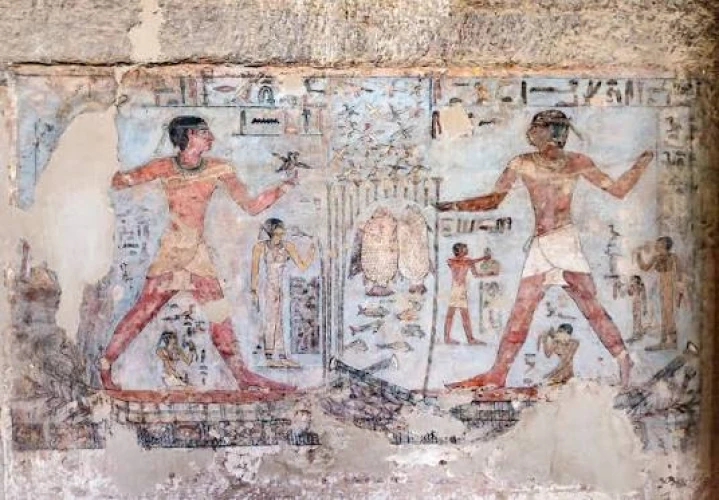
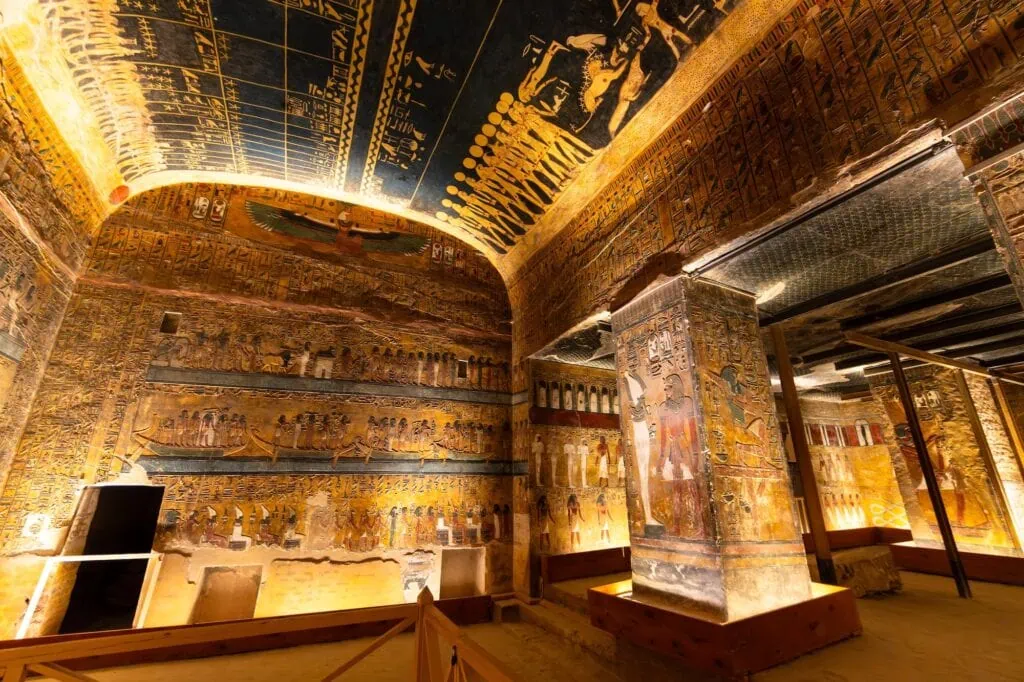
Further down the hillside, the craftsmanship shifts a bit, not in a loud way, but you can feel it. The Middle Kingdom tombs, around 1900 BCE, show a society that had become richer, more polished, and honestly more artistic too. The tombs of Sarenput I and his grandson Sarenput II are, without exaggeration, masterpieces of rock-cut architecture. If you pass through the threshold of Sarenput II’s tomb, Tomb 31, you end up in a long corridor that’s beautifully aligned, and it is flanked by six columns cut straight from the living rock. The colors here are startlingly vivid. Since Aswan is so incredibly dry and these chambers were entombed under desert drifts for centuries, the pigments look like they were laid down last week, or nearly that. On the walls you see Sarenput in the papyrus marshes, hunting with his dog. Or you see him sitting quietly at a table stacked with offerings. The details feel breathtakingly human. There’s the delicate feathering of a bird that was startled and then takes flight, and there’s that intentional muscle definition on Sarenput’s arms. And then there is the gentle, close way his wife and mother are shown alongside him, almost as if they’re right there, breathing. These weren’t only monuments to authority. They also work like visual prayers, asking for the preservation of the life they cherished and held close.
The Echoes of Everyday Lives
What makes Qubbet el-Hawa so uniquely moving is that it isn’t just some monument to the elite 1% , you know, like it only cares about the big names or the highest ranks, and that’s it. In recent years, continuous excavations by joint Egyptian and international archaeological teams, including a lot of work by the University of Jaén, have uncovered hundreds of burials that were basically left untouched. These were the families, the servants, and the middle class citizens who kept Aswan running, quietly, day after day, not in speeches, just in real life. They found mummies of people suffering from degenerative bone diseases, and in a way it tracks the physical toll of hard manual labor in that brutal Egyptian heat. They found graves of young children laid to rest with their favorite clay toys , and also communal family crypts, where generations were placed side by side like a long chain of arrivals and departures, all in the same ground. In 2015, archaeologists discovered a unique tomb containing the remains of ten slaughtered crocodiles, buried as part of a dedicated ritual meant to invoke Sobek’s protection, the crocodile god of the Nile. For ancient folks living right next to the treacherous river rapids, the threat from wildlife was this terrifying, always present reality of everyday life.
Preserving the Spirit of the Place
Today, Qubbet el-Hawa still feels like a vital bridge between what was, and what is. Local guards, whose families have lived in the villages of the West Bank for generations, carry those heavy iron keys, that open the tomb doors. They sort of lead you through the darkness with small flashlights , and they stop to point out little, hidden things in the reliefs, with a quiet generational pride, like it is both duty and memory.
When the sun starts to go down , the sky turns into a deep bruised violet, and the sandstone hill gets this crimson light. Then the call to prayer echoes from the mosques of Aswan , rising over the river and sliding up the slopes of the mountain. The wind also gets interested , swirling around the old rock-cut portals and the white dome of Sidi Ali bin el-Hawa, up at the summit.
All of that, feels like a soft reminder that kingdoms crumble, gods rename themselves, and centuries move by without a real sound, yet the human wish to be remembered, to watch over the people we love, and to leave something lasting on the land stays basically unchanged. Qubbet el-Hawa is not only a bunch of old stones and dusty bones, it is a real and profound proof of the enduring human spirit , carved right into the very bones of Egypt.



-webp.webp "Hilton")
-webp.webp "dusit")
-webp.webp "Marriott Hotels")
-webp.webp "Azimut Hotel")
-webp.webp "Golden Tulip")
-webp.webp "sheraton")
-webp.webp "westin hotel")
-webp.webp "Movenpick")