
 English
 Italy
Italy
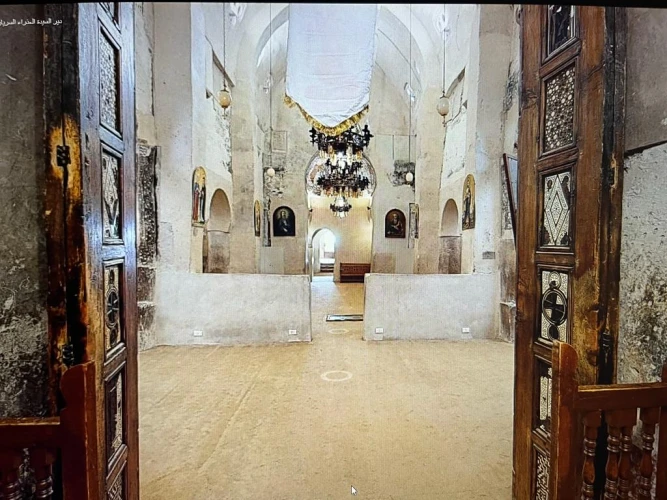
Where Coptic and Syriac Heritage Met: The Story of Deir Al-Suryan
The Monastery of the Syrians (Deir Al-Suryan): History, Art & Sacred Heritage
Hidden inside the quiet depression of Wadi El Natrun, with the soft sands of Egypt’s Western Desert all around it, there is the Monastery of the Syrians, also known as Deir Al-Suryan. It is dedicated to the Virgin Mary and it has become, over time, one of the most well known Coptic sanctuaries. People often describe it as a truly remarkable stash of early Christian art, unusual architectural details, and ancient manuscript history, right there in the wider Mediterranean world.
Now, yes , it’s true that nearly every monastery in Wadi El Natrun carries some deep spiritual memory. Still, Deir Al-Suryan is a little different. For many centuries it functioned like a living connection between Egyptian Coptic monastic life, and the Syrian tradition, you could almost say it was a patient kind of bridge. In practice, that meant scholarship flowed through it, artistic expression was encouraged there , and prayer never really stopped , even when centuries moved on.
Starting from its beginnings as a 6th-century monastic community, and reaching onward toward its famous early medieval frescoes, and those important manuscript finds that people still talk about today, this is the full tale of the Monastery of the Syrians.
1. The Origins: A Sanctuary Born in Desert Scetis
The story of Deir Al-Suryan starts around the 6th century AD, in a time where theological debates were basically everywhere, and across the Byzantine Empire they rumbled on and on.
After doctrinal disagreements kicked off in the aftermath of the Council of Chalcedon, a cluster of monks from the nearby Monastery of Saint Bishoy , sort of decided to set up their own place, a distinct residence for the Virgin Mary. At first it was called the Monastery of the Holy Virgin Mary of St. Bishoy , though the name didn’t really stick the same way for long.
Then, in the 8th century , a community of Syrian monks moved into Scetis (Wadi El Natrun). They arrived and were received with a warm hospitality by the local Coptic community, and from there things grew steadily. The Syrian monks lived there, they expanded the complex, and they carried out renovations too, and the locals began to refer to it as Deir Al-Suryan , meaning the Monastery of the Syrians.
What’s interesting is that this shared presence of Coptic and Syrian monks lasted for almost eight centuries. In that stretch, it became this calm spiritual corner where Syriac and Coptic , languages, liturgies and even artistic styles , were mixed together in a way that felt natural, like it was always meant to be.
2. The Golden Age of Abbot Moses of Nisibis
The most transformative stretch of the monastery’s history happened in the early 10th century, under the guidance of its celebrated abbot, Moses of Nisibis (Mar Musa). and kinda yeah, it really marked a turning point.
In 927 AD, Abbot Moses went on a notable expedition toward Mesopotamia , Baghdad, and Syria, and over the course of several years he gathered theological writings , biblical commentaries, plus philosophical treatises, all in Syriac, Greek, and Arabic.
When he came back to Wadi El Natrun in 932 AD, he had hauled back more than 250 truly rare manuscripts. After that he broadened the monastery’s scriptorium and the library itself, so Deir Al-Suryan became the leading intellectual hub, not just locally but for Syriac scholarship across the Middle East. Abbot Moses also set in motion remarkable wooden works and structural additions, like the well known wooden door adorned with ivory inlays , which still stands today as a genuine masterpiece.
3. World-Famous Art: The Rediscovery of Ancient Frescoes
Deir Al-Suryan , in a architectural and artistic sense, is sort of one of the most astonishing places in Egypt, really.
In the late 20th century there was a fire , a truly devastating one , inside the main church. Because of it , conservators started looking carefully at the soot coated walls. And then, behind thick coats of plaster and medieval paints, the experts found multiple strata—intact fresco layers from the 9th to 13th centuries, Coptic and Syrian works, in an unusually good condition for something so old.
The Main Church, its so-called masterpieces, feel almost unreal to stand in front of them.
The Annunciation , for example, is a mind catching mural showing Archangel Gabriel as he appears to the Virgin Mary , and he s surrounded by ancient prophets holding scrolls.
Then there is the Nativity, which is a highly detailed painting of the birth of Christ. It uses rich earth pigments and it leans into expressive iconography in a way that feels very immediate.
Finally, the Ascension and Dormition combine two scenes into one strong visual story: Christ rising toward heaven and the calm, almost tender departure of the Virgin Mary. You can really see a refined blending of Coptic, Syriac, and Byzantine artistic traditions, not just together but woven in a single coherent language.
4. Key Architectural Highlights
The whole physical complex at Deir Al-Suryan kind of gives a look at early desert architectural engineering, that was meant to face rough weather and also old historical dangers, not just one thing.
The Church of the Virgin Mary (Al-Adra)
This church, built in the 7th century, acts like the central sanctuary for the monastery. People often mention its three-domed sanctuary (khorus), and then the historic Door of Symbols (Bab al-Rumuz) too. The door itself was crafted during the tenure of Moses of Nisibis in the 10th century, it’s a wooden door, with six panels carved and it has ivory inlays, those details symbolically follow seven epochs of church history. From the beginning of the world, right up to the end of time , and that’s the idea.
The Cave of Saint Pishoy
Inside the monastery grounds, there’s a small underground cell, it’s traditionally described as Saint Pishoy’s private solitude cave where he prayed. Coptic tradition says Saint Pishoy tied his hair to a rope fixed to the cave ceiling, so he wouldn’t drift off and fall asleep, during long night vigils, basically.
The Fortified Keep (Al-Jawsaq)
This one rises about four stories, and it’s the monastery’s stone keep from the 5th century. It was raised to house the monks during invasions. You can also see the retractable wooden drawbridge, a chapel dedicated to Saint Michael, food storage vaults, and even an ancient water well. It was like a fortress tower, and it was meant to ensure the community stayed alive through long sieges , even when things got tight.
5. The Legendary Manuscript Legacy
The library of Deir Al-Suryan is historically famous among scholars around the world ,though people sometimes forget how widely known it became.
Between the 18th and 19th centuries, European collectors and researchers slowly began to recognize the immense treasure kept inside the monastery’s keep. Thousands of rare Syriac, Coptic, and early Arabic manuscripts were gathered, and they are now preserved in major international libraries, like the British Library in London and the Vatican Library.
Among these documents were some of the oldest surviving copies of the Gospels , ancient Syriac translations of Greek philosophical works that otherwise disappeared, and the early desert theologians’ foundational writings. Today the monastery operates a modern climate-controlled library ,not only to protect the remaining historic documents but also to guard the digital archives meant for future scholars.
Historical Snapshot
Location: Central Wadi El Natrun ,Western Desert, Egypt.
Dedicatory Name: The Monastery of the Holy Virgin Mary (Deir Al-Suryan).
Key Historical Figure: Abbot Moses of Nisibis (10th Century).
Architectural Gems: The Door of Symbols, 5th-century Keep, and ancient frescoes.
Cultural Significance: A historical bridge between Coptic and Syria





-webp.webp "Hilton")
-webp.webp "dusit")
-webp.webp "Marriott Hotels")
-webp.webp "Azimut Hotel")
-webp.webp "Golden Tulip")
-webp.webp "sheraton")
-webp.webp "westin hotel")
-webp.webp "Movenpick")
