
 English
 Italy
Italy
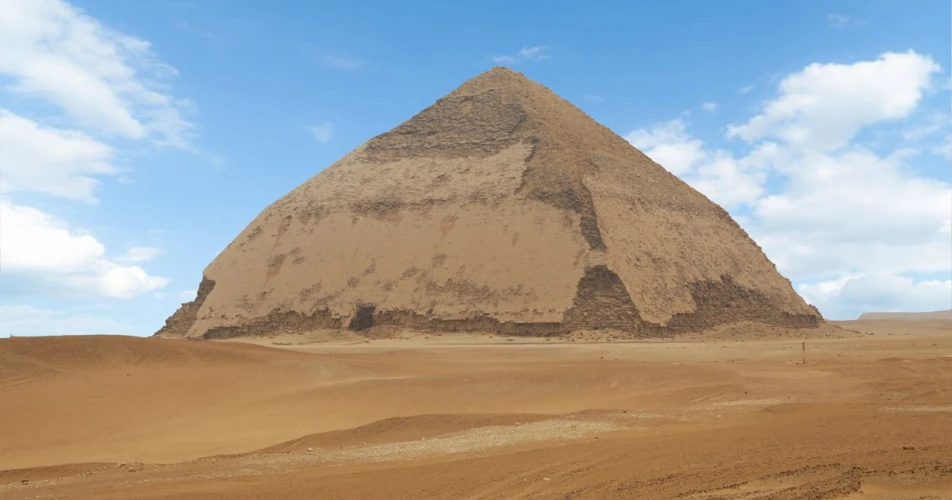
Trial, Error, and Tura Limestone: Inside King Sneferu’s Bent Pyramid at Dahshur
The Bent Pyramid: Ancient Egypt’s Most Brilliant Architectural Mistake
Rising dramatically above the desert sands of Dahshur, around 40 kilometers south of Cairo, there stands one of the most intriguing and visually distinct monuments from the ancient world: the Bent Pyramid. It was built under the guiding vision of Pharaoh Sneferu (c. 2600 BC), the founding ruler of the Fourth Dynasty, and this massive structure feels like a turbulent experimental bridge between the early stepped pyramids and the smooth, soaring pyramids seen later at Giza.
Now here’s the part that makes it so different, unlike any other pyramid on Earth, the Bent Pyramid changes its slope mid-way up. The lower portion climbs at a steep 54-degree angle, then suddenly shifts and relaxes to a 43-degree angle as it nears the top, which gives it this uniquely bent, slightly bowed look. yes, it really looks as though it’s trying to correct itself in mid-flight.
And no, it wasn’t simply a failure. The Bent Pyramid is a glorious proof of ancient engineering resilience , it captures the exact moment Egyptian architects learned through real time trial, error, and constant adaptation, how to shape smooth sided stone monuments that could resist gravity and outlast time.
So, this is the captivating story of the Bent Pyramid—its king, its structural drama, its inner secrets, and the preserved beauty that still lingers today.
1. The Prolific King: Sneferu’s Pyramidal Ambition
To get why the Bent Pyramid even exists, you have to glance at its creator, King Sneferu. His son Khufu later built the single largest pyramid (The Great Pyramid of Giza), but Sneferu stays, somehow the biggest pyramid maker in human history, just in terms of volume of stone moved , not even close.
During his long reign, around 24 to 30 years, Sneferu set in motion three huge royal pyramids:
The Meidum Pyramid: Egypts first serious try at a smooth sided pyramid, but it ran into nasty structural trouble, and never really held together well.
The Bent Pyramid at Dahshur: his bold second major effort, begun from nothing as a smooth faced pyramid, so, yeah, it was meant to look different right away.
The Red Pyramid at Dahshur: Egypt’s first pyramid that was finished in the true smooth sided style, and it actually worked as planned.
Sneferu’s rule seems to have been pulled forward by theological change. He wanted to step away from the stepped, “stairways to the stars” style built for Third Dynasty kings like Djoser. Instead he aimed for smooth, shining stone ramps that would echo the sun god Ra’s rays, or at least that’s how it’s commonly described.
2. The Architectural Drama: Why Is the Pyramid Bent?
When Sneferu’s royal architects broke ground at Dahshur, they acted like they were going for the stars. They started with that pretty ambitious, and honestly unusually steep incline of 54 degrees, and their plan was to raise this massive sleek pyramid, over 125 meters tall , or at least that’s what they intended.
But then, as the build kept going past the 45-meter point, things started to get bad, in a way you could feel. Structural alarms, serious ones, began ringing across the whole site, not metaphorically either.
The Warning Signs
Unstable Foundation: Unlike the rock solid bedrock beneath the Giza plateau, the Bent Pyramid was set onto soft shifting gravel and clay shale. The huge pressure from millions of tons of limestone started making the ground sink in uneven, almost stubborn ways.
Internal Cracking: Once the foundation moved, deep structural fractures began spreading through the heavy stone masonry, especially inside the burial chambers and along the descending corridors.
Inward Sloping Blocks: The early course, they used stone blocks angled inward toward the center, supposedly for stability. But here’s the twist, it created more inward crushing pressure on the interior rooms. So it sort of helped in one direction, and hurt in another, all at once.
The Mid-Construction Crisis Management
When collapse felt close, Sneferu’s master builders made a decision that sounds smart but was also absolutely panic-driven. They didn’t just walk away from the project, they adapted as they went, in real time:
Shallow Angle: They drastically lowered the upper angle from 54 degrees down to 43 degrees, like they suddenly changed the rules.
Horizontal Stacking: Then they altered the masonry approach, laying the upper stone blocks completely horizontal, so the outward and downward weight got distributed more evenly instead of concentrating harshly.
That steep reduction calmed the overall load, cutting the weight of the upper part by more than half. In the end, the monument stood firm, and the famous “bent” silhouette was born, kind of by accident, and kind of by speed.
3. The Casing Paradox: Egypt’s Best-Preserved Exterior
One of the most remarkable things about the Bent Pyramid today is its extraordinary outer casing, which is kind of hard to overstate. While the Great Pyramid of Giza had its smooth limestone outer layer stripped away centuries ago by medieval builders, the Bent Pyramid still keeps almost 80 percent of its original Tura limestone casing in place.
But why did that outer shell survive here, when it disappeared elsewhere?
Interlocking Angles: The casing stones in the lower, more steeply slanted area were placed with a slight inward lean. In a sense, they sort of locked into each other, so that even skilled ancient quarrymen would find it very difficult to pry them loose or pull them out cleanly.
Isolated Location: Dahshur stayed relatively out of the big way, compared with places like Giza or Saqqara. That distance helped shield its monuments from the intense medieval urban quarrying. so the damage just never scaled up the same way.
And when you stand at the base of the Bent Pyramid, visitors can literally see how Egyptian pyramids were meant to look in the first place: smooth, bright white, and polished, almost solid-glass, like it was made to catch the sun.





-webp.webp "Hilton")
-webp.webp "dusit")
-webp.webp "Marriott Hotels")
-webp.webp "Azimut Hotel")
-webp.webp "Golden Tulip")
-webp.webp "sheraton")
-webp.webp "westin hotel")
-webp.webp "Movenpick")
