
 EN
 IT
 ES
 FR
 ZH
The Tomb of Ptahhotep: Wisdom and Artistry in Fifth Dynasty Saqqara
Situated to the west of the Saqqara Step Pyramid complex, the Tomb of Ptahhotep is arguably one of the most famous Old Kingdom noble tombs. Constructed in the later part of the Fifth Dynasty (around 2380 BCE), it acted as a joint tomb for Ptahhotep who was Vizier to King Djedkare Isesi, and his son Akhethotep. Alongside the spectacular wall-paintings, it is also famed as the tomb of the esteemed philosopher Ptahhotep, author of one of the world’s oldest books of philosophy – The Maxims of Ptahhotep.
1. Ptahhotep’s Prominence and Joint Tomb
Ptahhotep was highly influential in the Old Kingdom, holding the key positions of Vizier and supervisor of royal projects. Rather than erecting individual tombs, Ptahhotep and his son Akhethotep created a double mastaba, thus linking both father and son as one, in the hereafter.
After passing through Akhethotep’s pillared antechamber, tourists enter Ptahhotep’s elaborately decorated chapel. This has a clear structure and comprises a long, slender offering chamber, again constructed from high quality Tura limestone. Two false western doors enabled Ptahhotep’s Ka (spirit) to exit in order to accept everlasting offerings.
2. Outstanding Bas-reliefs
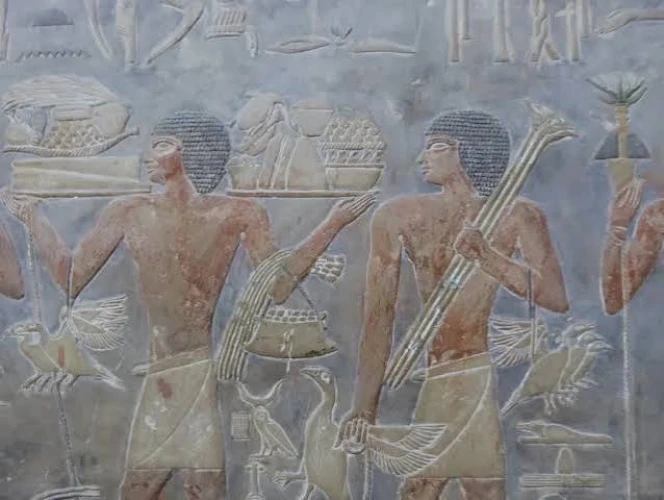
Ptahhotep’s chapel is widely recognised as housing some of the best examples of bas-relief artwork in ancient Egypt. Highly skilled artisans were able to expertly chisel detailed representations of musculature, plumage and body language from the limestone. Many of these are beautifully coloured, having been originally decorated with vivid mineral paints.
Throughout the chapel, the walls illustrate various aspects of daily life in the Nile Valley. These include young people taking part in sport such as boxing, sprinting and racing; papyrus boat construction; stone jar manufacture; and shepherds leading their flocks of cattle, gazelles and donkeys through the land.
3. Ptahhotep’s Self-Worth and Afterlife Support
Ptahhotep’s self-importance and everlasting material support are emphasised on the south and east walls. In one popular image, Ptahhotep relaxes in his pavilion whilst his servants give him a morning beauty treatment. They polish his fingernails and help him to dress, whilst harps and flutes are played.
Opposite Ptahhotep’s false doors, an unending line of individuals present offerings of bread and beer, fowl and lotus flowers together with new crop items. Using powerful ancient funeral spells, these sculpted offerings ensured that Ptahhotep’s Ka would continually be well-fed, respected and experience peace in the afterlife.
4. Visitor Information
Whilst exploring Saqqara, a visit to the Tomb of Ptahhotep is an extremely memorable way to experience outstanding Fifth Dynasty artwork. It is conveniently situated only a short stroll to the west of the enclosure surrounding Djoser’s Step Pyramid.
As the tomb is relatively small and contains fragile ancient paintings, visitor numbers are restricted in order to ensure its continued good condition. People must therefore walk slowly along Ptahhotep’s chapel, must not touch the limestone and also must not take photographs with a flash so that these exceptional bas-reliefs can continue to be appreciated by future generations.