
 EN
 IT
 ES
 FR
 ZH
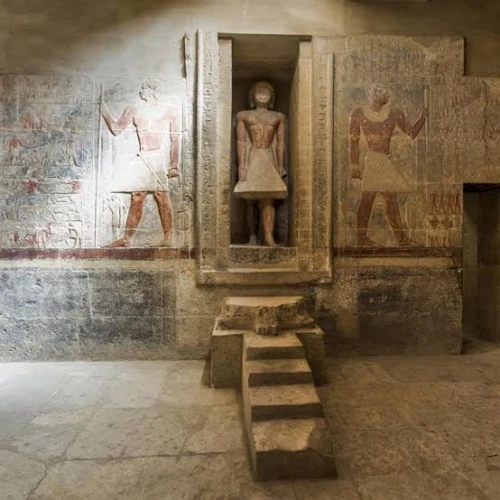
The Tomb of Mereruka: A Masterpiece of Old Kingdom Funerary Art
Situated within the Teti Cemetery which lies to the north of the famous Step Pyramid, the Tomb of Mereruka is the largest and richest non-royal tomb from the Old Kingdom. It dates back to around 2330 BCE and was constructed during the early 6 th dynasty. Mereruka was a highly influential man, who held the titles of Vizier and Chief Justice and was also the son-in-law to King Teti. The tomb comprises of numerous rooms, magazines and chapels, and provides fascinating information about wealth, family and everyday life 4000 years ago along the Nile.
Structure and multi-family tomb
Contrary to the more traditional sole-use Old Kingdom mastaba structure, the Tomb of Mereruka was intended to be a large multi-generational tomb consisting of three inter-linked areas and highlighting Mereruka’s high status and association with the royal family.
Mereruka’s area contained 21 rooms and included colonnaded halls, an offering room and a long well for accessing his below ground sarcophagus room. There was also a further 5-room section devoted to Mereruka’s royal bride – Princess Watetkhethor, the eldest daughter of King Teti. Finally, another 5-room section was allocated to their son, Meryteti. As such, the whole family were united in death and could all partake in the continual offering rites conducted by the mortuary priests.
2. Full scale Ka Figure and Offering Room
Within Mereruka’s colonnaded hall is one of the most recognised pieces of ancient Egyptian artwork. The full scale statue of Mereruka is chiselled from the surrounding false door recess in the northern wall. The figure projects slightly outwards and holds his arms down in a sign of respect.
To the ancient Egyptians, the Ka (essence of life) of Mereruka was thought to inhabit his statue. Directly above a stone offering table, which has been shaped to resemble the hieroglyph for offering, this enabled Mereruka’s spirit to metaphorically ascend from the land of the dead so that he could receive daily offerings of bread, beer, incense and roasted meat from both priests and family members.
3. Illustrations of Life and Industry
The limestone tomb walls of Mereruka are adorned with thousands of square feet of exquisite low relief carvings which illustrate the richness and balance of life on earth. Rather than illustrating dangers of the afterlife, these images had a spellbinding function; they guaranteed that all the behaviours they portrayed would be perpetually repeated for the tomb occupant in the blissful Field of Reeds.
Colourful illustrations show Mereruka hunting and fishing in a swamp. He throws his harpoon to catch fish and poaches hippos from a papyrus boat, all whilst surrounded by reeds and plentiful avian and crocodile life. Further areas of the tomb depict lively artisan workshops, displaying gold collar manufacture by jewelers, woodworking by carpenters and stone statue production by sculptors. In addition, there are images representing farming work such as sowing, reaping and herding.
4. Visitor Information
As well as viewing the royal pyramids, a visit to the Tomb of Mereruka alongside other Old Kingdom private, upper class tombs, provides a useful comparison.
The tomb is part of the wider Saqqara archaeological site and is conveniently walkable from the Pyramid of Teti. Explore the various linked tomb rooms at a leisurely pace and note the faint remains of initial red, blue and green mineral-based paints on the beautifully carved tomb artwork.
To optimally view the detailed, lightly etched limestone artwork, it is advisable to have a compact torch or alternatively to utilise the torch facility on a smartphone (without taking flash photographs). Internal natural light in the tomb rooms is limited and directional light will emphasise the fine quality of the carvings.