
 EN
 IT
 ES
 FR
 ZH
The Tomb of Idut: Royal Princess and Remarkable Reliefs at Saqqara
The Tomb of Idut is both aesthetically and interestingly unique when compared to other Old Kingdom mastabas. Constructed in the late Fifth Dynasty (around 2360BC) and then reworked in the early Sixth Dynasty, it was the tomb of Princess Idut (Seshseshet), and is thought to have been related to either King Unas or King Teti. Despite being a modest sized tomb, it is famed for its colourful reliefs, for portraying a princess indulging in activities more commonly associated with men of nobility and for the interesting history of its repurposing.
History and tomb re-use
It was common in Ancient Egypt for tombs to be re-used, especially during times of political change or when there was a need for swift royal interment. Inside the tomb it has been established that it was initially constructed for a senior vizier called Ihy, before being converted for Princess Idut.
Rather than destroying the tomb, the royal craftsmen delicately altered the original wall art to reflect the new royal resident. Firstly, they carved out previous male representations together with text. Then, they re-carved the elegant image of Princess Idut and inscribed her regalia above her forehead in the form of a cobra (uraeus). Occasionally, faint remnants of the original artwork can still be seen, and so this provides a very special insight into how Ancient Egyptian artists updated their work from one era to the next.
Structure and ritual areas
Like many late Fifth Dynasty mastabas, the Tomb of Idut consists of a series of five stone rooms which were utilised by mortuary priests to transport goods to the temple of offerings located within the tomb.
Upon entering via the eastern doorway, an antechamber and cross-rooms lead to the principal offering temple. On the western side of this temple is a beautifully sculpted false door, coloured in shades of red and yellow to resemble highly valued Aswan granite. It was through this door that the Ka of Princess Idut was believed to emerge from her below-ground tomb chamber so that she could receive daily food, beverage and fragrance offerings.
Life by the Nile and offering workers
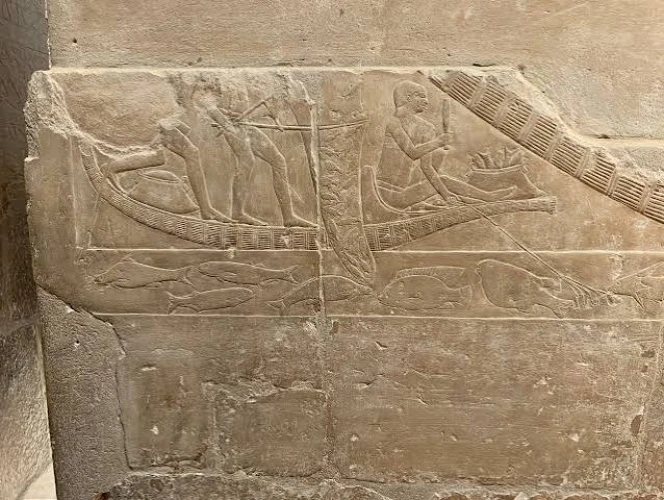
Irrespective of the excellent condition of the Tomb of Idut’s pigments, it is the dynamic nature of its reliefs which is so distinctive. Contrary to normal Old Kingdom portrayals where marshland hunting was predominantly a male activity, Princess Idut is illustrated as elegantly rowing a narrow boat through papyrus reeds. Birds, fish, hippos and crocodiles are all included in the scene.
Further reliefs illustrate dynamic images of fishermen pulling in nets full of Nile perch and catfish, and herders leading cows through shallow river regions. Within the deeper offering chambers, lengthy lines of female servants and land workers present trays of bread, vessels of beer, lotus blooms and even birds to Princess Idut. By magic, these provisions will thus continually be available to ensure her perpetual wellbeing in the hereafter.
Travel Information
As the Tomb of Idut is only a short distance from the Pyramid of Unas in Saqqara, it is readily visitable. Those wishing to do so should take the opportunity to closely observe its exquisite artwork.
As the tomb rooms are small and contain original Fifth and early Sixth Dynasty wall-paintings, walk warily around the tomb and view the walls slightly obliquely in order to observe the under-cutting, where Idut’s image superseded that of the original tomb owner. Never touch the stone walls and avoid employing flash photography so as to ensure the stunning blue, green and ochre colours of this royal lady’s tomb can continue to be enjoyed in the future.