
 English
 Italy
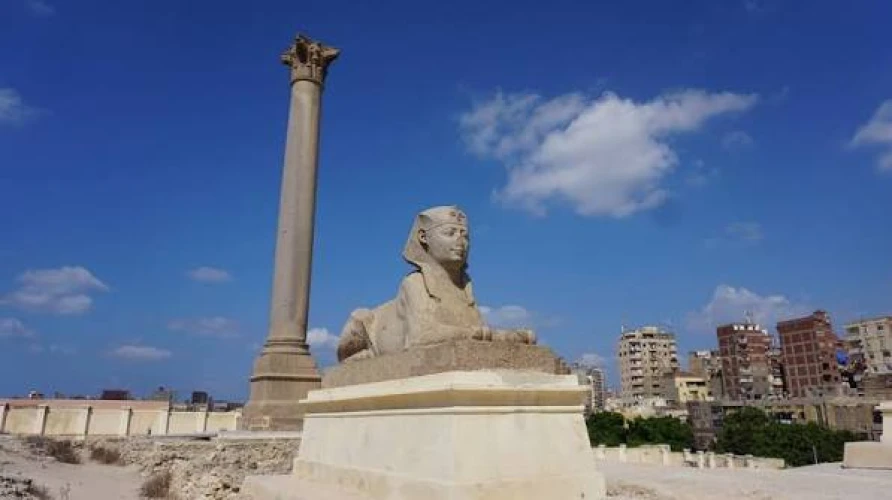
The Temple of Serapis: The Serapeum of Alexandria
The ancient city of Alexandria was famous for its beauty, architecture, culture, and religious sanctuaries. However, among the most renowned temples, the Serapeum or the Temple of Serapis was one of the most prominent. It was a cult place of the ancient world, attracting the attention of authorities and ordinary people.
1. Foundation and the invention of the god Serapis
The temple of Serapis was built when Ptolemy I Soter came to power on the throne of Egypt. He became the ruler after Alexander the Great, who managed to conquer a vast territory that stretched from Greece to India. However, Alexander faced the challenge of uniting the conquered people into one single community. His pupil and heir Ptolemy I faced a similar problem when he became the ruler of Egypt.
A. The invention of Serapis
When Ptolemy came to power, there was a need to create a new state god who would be dear to the people’s hearts. According to the ancient authors Plutarch and Tacitus, the ruler dreamed of bringing a sacred image from the Black Sea city of Sinope to Alexandria. The god’s name was Sarapis (or Serapis), and he was the perfect blend of ancient Egypt and Greece. The deity was created in the image of the ancient Egyptian god Osiris, the Apis bull (User-Hapi), and a Greek Zeus, Hades, Dionysus, and Asclepius.
Serapis was depicted as a bearded Greek king, wearing a measuring basket (modius) on his head. Thus, the god became a symbol of the Ptolemaic dynasty and their efforts to unite the diverse people of Egypt.
B. The construction of the grandiose temple
Ptolemy built the grandiose temple complex on the western hill of Alexandria to honor Serapis and his cult. The construction of Serapeum started soon after the founding of Alexandria by Alexander the Great and lasted until the reign of Ptolemy III Euergetes. During the reign of Roman emperors, the Serapeum was enlarged and enhanced several times.
2. Magnificent complex of Serapeum
Serapeum was a vast temple complex built on a scale that matched the wealth and power of the Ptolemaic rulers. The description of the Serapeum, based on the data of ancient authors, archaeological excavations, and architectural findings, shows the grandeur and luxury of this sacred place.
A. The Acropolis of Alexandria and the steps to its gates
Unlike the traditional Egyptian temples built along the banks of the Nile River, Serapeum was built on a high rocky ledge called the acropolis of Alexandria. When approaching the temple, one would see an impressive sight of one hundred marble steps cut out of the rock. At the top of the acropolis, there was a monumental gateway flanked by giant columns and adorned with statues and bronze.
B. The grand inner sanctuary and colossal statue of Serapis
The grand inner sanctuary of Serapis was located in the middle of the great courtyard at the center of the acropolis. This building, constructed from expensive stones and metals, housed the colossal cult statue of the god. Ancient writers described the statue as a work of art made of metals, woods, and precious stones. There was a special window in the wall from which sunlight shone on the statue’s face, creating the illusion of a glowing face.
C. Other sanctuaries and healing ports
Numerous other sanctuaries were located within the grounds of the Serapeum. They were dedicated to various gods of the ancient world, namely Isis, Anubis, Harpocrates, and others. The temple complex was also famous for healing ports (incubation), where sick people could stay overnight and try to heal under the protection of Serapis.
3. The Daughter Library at the Serapeum
The Serapeum was not only an architectural and religious structure but also a library. The temple complex’s libraries contained the most valuable manuscripts and texts of the ancient world. The large library of Alexandria (the capital of Egypt) was the center of the scientific and literary culture of Alexandria.
A. The problem of space at the royal library
It is said that when the library of the royal palace (Basileia) in Alexandria acquired more than four hundred thousand papyrus rolls, there was a problem of space. To solve this issue, the Ptolemaic rulers decided to create a second library called the Daughter Library ( θηκη or “subsidiary repository”). Thus, the Daughter Library was built in the courtyard of the grand Serapeum to hold part of the paper rolls, scrolls, and manuscripts.
B. The Daughter Library at the Serapeum and its role in Alexandria’s history
The Daughter Library was actively used by not only the scholars of the royal palace but also the priests and students who lived in the city’s western and southern districts. Thus, the library was well-visited and was an essential part of the cultural, scientific, and literary life of Alexandria. Its existence ensured the continuous development of science, literature, and art in ancient Alexandria.
4. Religious war and the destruction of the Serapeum temple
The ancient temple of Serapis was one of the most respected buildings in Alexandria until the fourth century AD. After Emperor Constantine the Great made Christianity the state religion of the Roman Empire, pagan temples began to be closed, and their treasures became the property of the state. In the late fourth century, the conflict between the Christian community and the pagan priests and philosophers broke out.
A. The late Roman Empire and the conflict with pagans
In the late Roman Empire, there was a strong and persistent persecution of pagans. The Roman emperor Theodosius I issued an edict on the closure of pagan temples and outlawed their festivals. In Alexandria, the Christian community, led by the extremely conservative Patriarch Theophilus, engaged in a violent religious war with the pagan philosophers and priests of the Serapeum.
B. The siege of the Serapeum and the destruction of its treasures
After days of fighting and destruction, the pagans and the defenders of the Serapeum fortress defended themselves against the armed forces of the Christian community, the city’s ordinary inhabitants, and the Roman army. On the orders of Emperor Theodosius I, the Serapeum was walled up in the capital of Egypt. In the battle, the Christian forces managed to break through the gates of the acropolis, which was a formidable defense. The statue of Serapis was pulled out and burned in the streets of Alexandria. Thus, the pagan temple and all its treasures have been dismantled and destroyed.
Conclusion
The Temple of Serapis (or Serapeum) was a majestic building that embodied the power and wealth of the Ptolemaic rulers. Serapeum was not only a religious sanctuary but also a library and a monument to the unity of the world cultures. Despite the destruction of the temple complex during the religious war in the late fourth century AD, the Serapeum continues to amaze the with its beauty, grandeur, and mystery.