
 English
 Italy
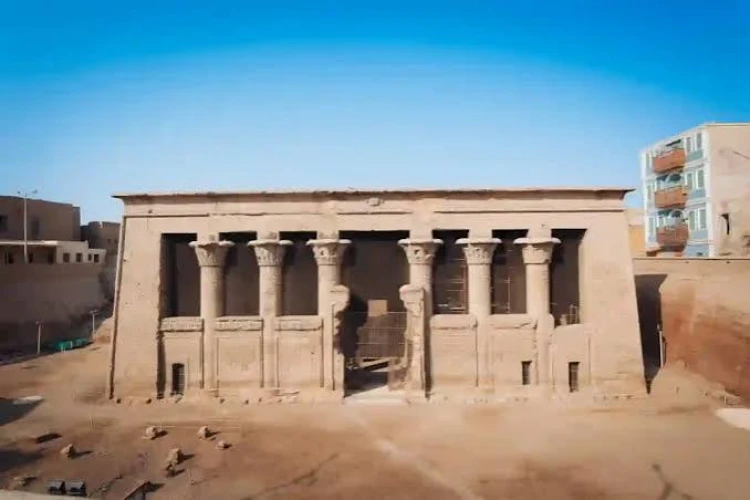
The Temple of Esna: Architectural Masterpiece of the Roman Period
The architectural heritage of Upper Egypt is famous for its monumental stone sanctuaries from the towering pylon gates of Karnak to the sunlit hypostyle halls of Edfu. However, tucked away quietly in the Esna modern town, some fifty-five kilometers South of Luxor, there stands a particularly well-preserved and intellectually interesting ancient monument – The Temple of Esna dedicated primarily to the creator god Khnum and his family. While the inner sanctuary and main temple buildings have been long lost to the ravages of time, the splendid pronaos (vestibule hall) has survived as a masterpiece of the Roman imperial period. Studying its design, astronomical ceilings, theological inscriptions, and recent cleaning restorations offers one an insight into the fascinating history of Egyptian sacred architecture.
1. Geographical Context and Historical Foundations
The city of Esna, known as Iunyt in ancient Egypt and Latopolis (probably from the sacred Lates fish worshipped there) in the Greek, has been a cultural and administrative center since Dynastic times.
A. The Sacred Cult of Khnum
The main deity of Esna is the ancient ram-headed creator god Khnum usually associated with the inundation of the Nile River. The local belief is that Khnum creates mankind and gods on a divine potter’s wheel out of the fertile silt of the river. Besides Khnum, the temple precinct was also dedicated to his consort Neith, the primordial warrior goddess of Sais associated with creation, weaving, and her magical power, as well as their son Heka (the personification of magical power) and the goddess Menhit.
B. Construction and Chronology
Although there existed a temple in Esna as early as the New Kingdom under Thutmose III, the current construction is entirely the result of the Greco-Roman period. The construction of the present Esna’s stone temple started during the Ptolemaic dynasty, but most of the surviving building, the grand pillared portico is a work of the first and second centuries AD, elaborated under the Roman emperors Tiberius, Claudius, the Vespasian, Domitian, and Trajan. On the exterior walls, even later Roman emperors such as Decius and Caracalla are depicted performing traditional Pharaonic rituals, thus illustrating the continued respect of the native religious practices within the Roman Empire.
2. Architectural Design of the Surviving Pronaos
The most outstanding feature of the Esna Temple is its enormous freestanding pronaos that was left undisturbed by the stone robbing that saw the destruction of the inner sanctuary behind it.
A. The Elevated Portico and Screen Walls
The pronaos is a large rectangular hall roughly thirty-three meters long, nineteen meters wide, and thirteen meters high, made from fine Egyptian sandstone blocks resting upon a solid foundation.
One of the special architectural features of this Roman temple is the lower screen wall (intercolumnar walls) connecting the lower parts of the front columns. This arrangement permits light and air to filter into the hall while at the same time shielding the interior from the onlookers’ view from the outside street level. The visitors accessed the portico through a monumental doorway decorated with winged sun disks and classical Egyptian cornices.
B. The Forest of Floral Columns
The amazing forest of twenty-four colossal columns supports the pronaos’ roof. The columns are grouped in four rows of six, and each stands nearly thirteen meters tall, surmounted by an exquisite floral capital.
Instead of following one design, the master builders depicted four different capitals to illustrate the various plant stages. The stone reliefs show the open papyrus umbels, the closed lotus buds, the palm fronds, and the composite floral clusters, representing the eternal fertility and the primeval marshland from which everything on Earth came. All over the shaft and the capital, there is an ample carving of deep precise reliefs illustrating Roman emperors doing offerings to the gods of Esna.
3. The Astronomical Ceilings and Astrological Science
Apart from the architectural perfection, the true excellence of the Esna Temple lies in its remarkable painted and carved ceilings, providing an invaluable source of ancient Egyptian astronomy, cosmology, and theology information.
A. Celestial Maps and Constellations
The ceiling of the pronaos is divided into administrative and astronomical panels, illustrating the sky. The first half depicts the night sky with detailed astronomical depictions of northern and southern groups of stars, the planets – Jupiter, Saturn, and Mars, the personified sun and moon traveling their hours barques up and down the sky.
B. The Zodiac and the Solar Processions
The other half portrays a series of sophisticated mythological writings about the hours of time, the sun god’s daytime and nightly journeys, and the elaborate astrological tables that illustrate how the hour signs were fixed on the horizon around the solstices and equinoxes. The astronomical interest of these painted ceilings in Esna is that they represent the synthesis of the ancient Egyptian stellar observations with the Hellenistic mathematical astronomy that flourished in Roman Egypt, thus showing that the temple priests were active scientific scholars well beyond the loss of their political independence.
4. Theological Inscriptions and Cryptographic Writing
The walls and ceilings of Esna are filled with thousands of hieroglyphic inscriptions representing the peak achievements of the late scribal Egyptian art and theology.
A. Enigmatic and Cryptographic Script
During the Roman times, the traditional hieroglyphs have increasingly been used by the elite priests not only for public display but as a cryptographic code. The script used in Esna saw the invention of new sign values, using sacred animals (crocodiles, rams, vultures, and cobras) as phonetic characters. The same one sign can carry several distinct sounds or meanings depending on the pose of the animal. These cryptographic praises of Khnum were dedicated to the creator god, praising his creative power and cosmic supremacy.
B. The Liturgical Hymns to Khnum and Neith
The texts carved on the interior walls of the temple include rich hymns, mythological stories about creation, and the detailed liturgy for the festivals. In particular, many inscriptions glorify Khnum as the divine potter who created the cosmic egg while others honor Neith as the mother of the sun god who established the laws of creation of the universe.
5. Modern Restoration and Conservation
For centuries, the inner beauty of the Esna Temple remained hidden and inaccessible to the viewer’s eyes. Thick layers of soot, bat guano, the dust, bird droppings, and the centuries-old pollution turned the once-magnificent painted ceilings and column reliefs to an unappealing pitch black shade.
A. The Landmark Restoration Project
Recently, an Egyptian and international archaeological conservation team has been working on the Esna temple to clean and restore its ancient splendor. Using modern chemical solvents and tissues, the conservators carefully stripped away the centuries-old crust of soot without damaging the underlying stone.
B. Discovering Vibrant Ancient Colors
The results of their hard work amazed the archaeological community as they unveiled a splendid palette of ancient colors ranging from the brilliant Egyptian blues, yellows, reds, greens, and whites all in immaculate condition. The freshly discovered vibrant hues of the Roman period transformed dramatically our perception of the temple as this sacred stone construction was designed to dazzle the eye with its dazzling polychrome brilliance.
Conclusion
The Temple of Esna is indeed one of the rare architectural, artistic, and scientific masterpieces of the Roman period in Egypt. Its forest of unique floral columns, intricate and detailed celestial maps carved on the ceilings, cryptographic hieroglyphic inscriptions, and the recent polychrome discoveries offer a glimpse into the fascinating world of the ancient priesthoods. Still surviving on the banks of the Nile River, The Temple of Esna continues to captivate and amaze every visitor and scholar that steps into its sunlit halls, celebrating an enduring legacy of creation, cosmology, and artistic genius.