
 English
 Italy
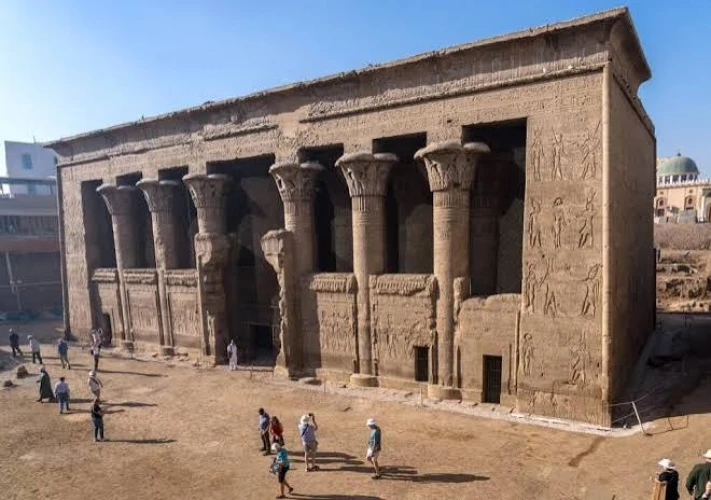
The Temple of Esna: Architectural Masterpiece of the Roman Period
The Archaeological Landscape of Upper Egypt boasts of its unique monuments of massive stone sanctuaries from the towering pylon gates of Karnak to the sunlit hypostyle halls of Edfu. Yet, tucked away in the modern town of Esna, about fifty-five kilometers south of Luxor, lies one of the most remarkably preserved and intellectually intriguing religious monuments of ancient times: the Temple of Esna, dedicated primarily to the creator god Khnum and his divine family. However, the inner sanctuary and main temple buildings have been largely lost to the urban sprawl of modern times. The magnificent pronaos (vestibule hall) of the temple complex that has survived to this day is an architectural achievement of the Roman imperial period. The structure of its architectural design, the exquisite astronomical ceilings, theological inscriptions, and recent cleaning and restoration efforts illuminate an extraordinary chapter in the history of Egyptian sacred architecture.
1. Background Information
The city of Esna, known also as Iunyt in ancient Egypt and Latopolis (or the city of Lates fish worshipped locally) in Greek, had been an administrative and religious center since the earliest dynasties.
A. The Sacred Cult of Khnum
The main deity of Esna was Khnum, the ancient ram-headed creator god who was traditionally associated with the inundation of the Nile River and the shaping of humanity on a divine potter’s wheel. According to local theology, Khnum fashioned mankind and the gods from the fertile silt of the Nile. Along with Khnum, the temple precinct worshipped his consort Neith, the primordial warrior goddess of Sais associated with creation and weaving, as well as their divine son Heka (the personification of magical power) and the goddess Menhit.
B. Construction and Chronology
While there is evidence that a temple was constructed at Esna as far back as the New Kingdom under Thutmose III, the structure that we see today dates entirely to the Greco-Roman period. The stone temple construction began under the Ptolemaic dynasty, but the vast majority of the surviving architectural features—mainly the grand pillared portico—were erected, carved, and decorated in the first and second centuries CE, and under the patronage of Roman emperors including Tiberius, Claudius, Vespasian, Domitian, and Trajan. On the exterior walls, even later Roman emperors such as Decius and Caracalla are depicted performing traditional Pharaonic rituals, which shows the enduring continuity of the native religious traditions under imperial rule.
2. Architectural Design of the Surviving Pronaos
The most striking feature of the Esna Temple is its massive, free-standing pronaos which survived because it was spared the fate of stone-robbing which dismantled the inner sanctuary behind.
A. The Elevated Portico and Screen Walls
The pronaos is a massive rectangular hall measuring approximately thirty-three meters (length) by nineteen meters (width) and thirteen meters (height). It is constructed entirely of fine Egyptian sandstone blocks resting on a solid foundation.
An architectural feature typical of this Roman-era temple is the lower screen wall (intercolumnar walls) that connects the lower portions of the front columns. This design allowed natural light and fresh air to enter into the interior while maintaining a sacred barrier to the view of uninitiated onlookers who peered out from the outside street level. The entrance to the portico was through a monumental doorway adorned with winged sun disks and classical Egyptian cornices.
B. The Forest of Floral Columns
The interior roof of the pronaos is supported by an awesome forest of twenty-four colossal columns, arranged in four rows of six. Each column stands nearly thirteen meters (height) and is topped with an exquisite, detailed floral capital.
Rather than repeating the same design, the master architects of Esna varied the capitals on each column to signify different stages of botanical growth and local flora. The stone-carvings depict open papyrus umbels, closed lotus buds, palm fronds, and composite floral clusters, symbolizing the eternal fertility and primeval marshland from which the universe was born. Every square inch of the shaft and capital is covered in deep, precise relief carvings depicting Roman emperors making offerings to the gods of Esna.
3. The Astronomical Ceilings and Astrological Science
In addition to the architectural symmetry, the true glory of the Esna Temple lies in its remarkable painted and carved ceiling which provides us with an invaluable archive of the ancient Egyptian astronomy, cosmology and theology.
A. Celestial Maps and Constellations
The ceiling of the pronaos is divided into distinct administrative and astronomical panels that map out the cosmos. One half of the ceiling portrays the night-sky, with detailed astronomical depictions of Northern and Southern constellations, including the decans (star groups used to denote hours at night), the planets Jupitor, Saturn, and Mars, and personified figures of the sun and moon navigating their celestial barques across the heavens.
B. The Zodiac and Solar Processions
The other half of the ceiling, however, presents complex mythological depictions about the passage of time, the daily journey of the sun-god Ra through the hours of the day and night and intricate astrological tables. These ceilings are a synthesis of ancient Egyptian stellar observation with Hellenistic mathematics astronomy that flourished in Roman Egypt. It demonstrates that temple priests were scientific scholars long after the loss of their native political sovereignty.
4. Theological Inscriptions and Cryptographic Writing
The walls and ceilings of Esna are covered with thousands of hieroglyphic inscriptions that epitomize the apogee of late Egyptian scribal art and theology.
A. Enigmatic and Cryptographic Script
During the Roman period, traditional hieroglyphs were widely used by the elite priests not only for reading purposes, but as a cryptographic code. At Esna, scribes invented new sign-values using sacred animals such as crocodiles, rams, vultures and cobras as phonetic characters. A single animal sign could represent several distinct sounds or philosophical concepts depending on the pose and context. These cryptographic hymns were composed in praise of Khnum, praising his creative power and cosmic supremacy.
B. The Liturgical Hymns to Khnum and Neith
The texts inscribed on the interior walls include rich mythological hymns, creation accounts, and liturgical instructions for seasonal festivals. Many inscriptions praise Khnum as the divine potter who formed the cosmic egg, while others honor Neith as the mother of the sun-god who set the primordial laws of the universe.
5. Modern Restoration
For centuries, the inner beauty of the Esna Temple was hidden from view. Thick layers of soot, bat guano, dust, bird droppings, and centuries of environmental pollution turned the magnificent painted ceilings and column reliefs an opaque uniform pitch black.
A. The Landmark Restoration Project
In recent years, a joint Egyptian and international archaeological conservation team embarked on a meticulous, multi-year cleaning and restoration project at the Esna Temple. Using chemical solvents, cleaning tissues and delicate mechanical tools, conservators painstaking removed the centuries-old crust of soot without damaging the underlying stone.
B. Rediscovering Vibrant Ancient Colors
The results of the restoration amazed the archaeological world. With a black grime of soot, conservators uncovered a breathtaking palette of vibrant ancient pigments—brilliant Egyptian blues, rich yellows, deep reds, vibrant greens and sparkling white highlights—in an immaculate state of preservation. The fresh bright colors of the restored temple transformed our understanding of the Roman-period temple art, proving that these sacred stone-structures were designed to glow with dazzling, polychrome brilliance!
Conclusion
The Temple of Esna is an extraordinary monument of the Roman period in Egypt that presents us with a chance to witness the intellectual prowess of the ancient priesthood. With its forest of unique floral columns, the meticulously mapped-out astronomical ceilings and cryptographic hieroglyphic inscriptions and the recently restored polychrome colors, the temple offers a glimpse into the rich world of ancient cosmology. Preserved along the banks of the Nile, the Temple of Esna holds our fascination and celebrates an enduring legacy of creation and cosmology.