
 EN
 IT
 ES
 FR
 ZH
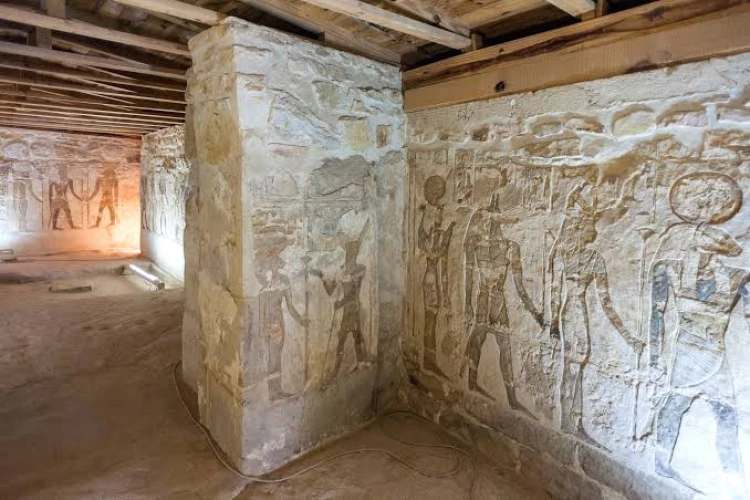
The Temple of El-Muftella: A Hidden Oasis Sanctuary in Bahariya
The Temple of El-Muftella in the centre of the Bahariya Oasis, Western Desert, is amongst the most informative temples from Egypt's Late Period. Dating back to the 6 th Century BCE, the temple was constructed during the Twenty-Sixth Dynasty and comprised a compound that was used for worshipping key Egyptian gods including Amun-Ra, Horus and the Theban triad. Significantly, the temple shows how religion, government and royalty all thrived in Egypt's desert oases and how these oases were successfully integrated with more distant trading routes and the royal court.
1. Background and Oasis Life
During the Twenty-sixth (Saite) Dynasty there was a period of great renaissance in Egypt. Pharaohs including Apries and Amasis recognised the significance of the Western Desert oases due to their agricultural, vinicultural and trans-Saharan trading activity. Particularly, the Bahariya Oasis prospered under the governance of affluent governors, who had strong connections with the royal administration in the Nile Delta region and were also greatly involved in religious life.
Bahariya Oasis governors, including notably Zed-Khonsu-ef-ankh who acted as high priest and administrator, oversaw development works on the Temple of El-Muftella. This illustrated not only the governors' religious commitment but also their allegiance to the current pharaoh. It therefore enabled native Egyptian temple practices to be successfully practised well away from the more familiar river valley region.
2. Structure and Four Chapels
Whilst much of the temple's original mudbrick construction has deteriorated over time, exploration has shown that the Temple of El-Muftella was in fact a group of four interrelated chapels, which were organised in a deliberately designed sacred orientation. Although constructed from mudbrick, the temple featured finely crafted sandstone elements, including doorways, columns and carvings.
Each chapel was dedicated to a particular god or to aspects of royal cult. Apart from Amun-Ra, god of the oases, the other principle gods worshipped were Khonsu, Mut and Horus. Additionally, there was a chapel devoted to Bes, a domestic guardian god particularly favoured by desert people. Columns divided the entrance halls which in turn opened onto open court areas. In these courts, priests undertook regular cleansing, incense burning and offering ceremonies in preparation for worshipping the various gods represented by statue.
3. Carvings and Religious Themes
The Temple of El-Muftella is particularly valuable due to the outstanding condition of its sandstone carvings and paintings. Despite being located in a desert environment, numerous sections of the temple still feature clear hieroglyphics together with colourful red, yellow, blue and green paint work.
An important theme within the temple carvings is the beneficial relationship between the monarchy, government and the gods. Images illustrate King Amasis and Governor Zed-Khonsu-ef-ankh, both dressed in religious garments and crowned, making offerings of wine, incense, lotus flowers and other sacred items to a line-up of seated and standing gods. This emphasised that just as in Memphis and Thebes, the concept of Ma'at; the fundamental principle of order in the universe, was successfully upheld in the desert. Moreover, the fact that various gods are shown within the same temple emphasises the eclectic nature of oasis religious life. Oasis temples thus merged state and popular gods, with the latter often being those considered to offer protection to traders and desert residents.
4. Exploration and Conservation
For many years, the Temple of El-Muftella was covered by sand in and around the modern town of El-Bawiti. This effectively concealed and so helped to preserve the temple's finely painted carvings from the destructive effects of the desert sun and wind. Exploration in the twentieth Century identified the temple's four chapels. It also highlighted the significant part played by the Bahariya Oasis governors of the Twenty-Sixth Dynasty. Their rock-cut tombs, situated at Qaret el-Subi, near the temple, further enrich our knowledge of this era.
As previously mentioned, mudbrick and comparatively fragile desert sandstone are easily affected by humidity, heat and wind. Consequently, conservators have taken steps to reinforce the temple's walls and prevent harm to the painted carvings.
5. Visitor Information
Visitors to the Western Desert have a unique chance to view non-Nile cruise pharaonic temples by visiting the Temple of El-Muftella.
Being situated in El-Bawiti, the central area of the Bahariya Oasis, the temple can be conveniently accessed by local transport as part of an oasis cultural itinerary. Ideally, tourists should visit the temple in the morning or late afternoon so that the low sun casts favourable lighting upon the sandstone carvings. Also, temperatures are most pleasant during these times. Throughout your visit to the four chapels, always keep a suitable distance away from the old mudbrick buildings. Never touch the temple's painted carvings and do not employ a camera flash. Adding a visit to the Temple of El-Muftella to a trip to the neighbouring Tombs of the Nobles at Qaret el-Subi and the Golden Mummies display, fully demonstrates how well developed ancient Egyptian religious and burial practices were right in the middle of the Sahara desert.