
 English
 Italy
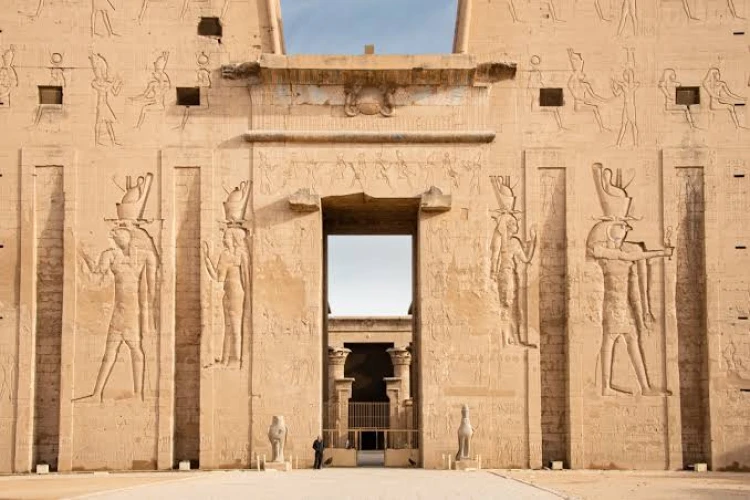
The Temple of Edfu: Sanctuary of Horus and Architectural Masterpiece
The ancient world knows many sanctuaries raised during the history of the Nile valley, but few are considered as complete, well-preserved, and well-decorated as one built on the west bank of the river in the province of Upper Egypt – the Temple of Edfu dedicated to the falcon god Horus. Belonging to the Ptolemaic period, this sacred building is an outstanding example of an ancient Egyptian temple that has been amazingly preserved and provides invaluable insights into the ancient architectural techniques and the ancient Egyptian beliefs of that time.
1. Location: the ancient Egyptian city of Edfu
The city of Edfu (or Apollonopolis Magna, as it was called in ancient Greece) has been an important religious center since the dawn of ancient Egypt. Its prime attraction is the Temple of Horus – the most well-preserved ancient Egyptian temple ever discovered.
A. Ancient History: the bird-headed god Horus the Old
The chief god of the city is Horus of Behdet, the falcon-headed god who fought and killed his uncle Seth for revenge over his father Osiris. According to legend, it was Horus who won the civil war between Seth and Osiris, which occurred on the territory of Edfu, thus establishing his power over the whole Nile valley.
B. Construction history
Despite the architectural simplicity of the ancient Egyptian temples built during the New Kingdom period, a modest temple dedicated to Horus was standing on the site of the present castle for many centuries before the construction of the current temple had started. The building described below was constructed in the period of the Greek rule under the dynasty of the Ptolemies. Ptolemy II Philadelphus laid its foundation in 237 BC, and its completion was declared by his son Ptolemy IX Soter nearly two centuries later, in 57 BC. Thus, this magnificent edifice has been raised in the territory of ancient Egypt during a relatively short historical period, which explains the apparent harmony and consistency of its architectural proportions and many other features.
2. Ground plan and general appearance
The Temple of Edfu is a prime example of an ancient Egyptian temple with its massive pylon gates, a wide peristyle courtyard, and a set of uniquely constructed hypostyle halls.
A. Towering pylon gateways
The first impressive structure that draws the attention of whoever approaches the temple is its monumental pylon nearly forty meters high. Built by Ptolemy XII, it was decorated with colossal sunk relief carvings depicting the ruling Greek king defeating barbarian nations in front of the god Horus and numerous channels with massive hanging cedar banners above. The two-storeyed pylon, surmounted by an obelisk, created an amazing impression on the ancient tourists visiting the temple even many years after its completion.
B. Peristyle courtyard and hypostyle halls
The large open court accessible to all visitors is located at the end of the pylon. It is surrounded on three sides by thirty-two huge papyrus-shaped columns and was probably used for festivals and open-air rituals.
The great open court is preceded by a great hypostyle hall (pronaos) and the next, even bigger hypostyle hall, the transverse offering colonnade, and a set of decreasing vestibule chambers leading to the temple’s heart – the inner sanctuary (or naos). At the back wall of the inner sanctuary, there is a niche with an outstanding grey granite temple built by the 30 th -Dynasty pharaoh Nectanebus II that previously housed the portable golden cult figure of Horus, which was an object of daily worship.
3. Unparalleled “building texts”
Among other marvels of the ancient world, the Temple of Edfu is famous for containing an incredible amount of historical information engraved or carved on the walls of its edifices and depicting extraordinary scenes from the life and biography of Horus.
A. Descriptions of architectural decorations
The texts describing the history and purpose of the temple, the building descriptions, and the dates of its construction and decoration have been engraved on the outer enclosure walls and the inner chambers’ walls.
This architectural composition was built on a mythical primeval mound, thus following the tradition of the first ancient Egyptian temples. The building texts describe in detail the events that occurred when the temple was dedicated and its architectural wonders that could be admired by thousands of visitors.
B. Mythological scenes and the fight between Horus and Seth
All interior walls, columns, and ceilings are covered with beautifully carved low-relief scenes. The most famous among them are the six-mile-long pictorial tales about Horus and the hippopotamus hunt depicted on the outer ambulatory walls.
In particular, one can see how Horus fought with Seth and how the latter took the form of a hippopotamus to battle his enemy, Horus. At the same time, the story told by these unique murals demonstrates its didactic purpose: another interpretation of the myth claims that the combat between Seth and Horus continued throughout the reign of the pharaohs’ dynasty, while the priests of Horus and the priests of Seth brought this fight to the walls of the city every year on the day of the summer solstice.
4. Other buildings peculiar to the temple complex
The Temple of Edfu complex comprises several constructions needed to perform all ritual activities prescribed by the priests and the ancient Egyptian beliefs about the life and death of Horus.
A. The birth-house (Mammisi)
Adorned with exquisite reliefs, the birth-house or Mammisi stood west of the main temple at a short distance from its entrance. Built during the reign of Ptolemy VIII, this peripteral building depicted the birth of the young god Harpocrates (the son of Horus and Hathor) and was surrounded by protective goddesses.
B. The Nilometer and the roof chapels
The Nilometer: A staircase carved into the rock below the enclosure wall is facing the temple’s western wall. This step-like structure was used to measure the level of the river and to predict the annual Nile flood that determined the harvest results and the taxes collected by the government.
The Roof Chapels: Decorated with beautiful carvings on large limestone blocks, accessed via an equally remarkable staircase, the open-air roof chapels and kiosks were actually associated with the New Year Festival. During this event, the statue of Horus was taken up the hill to be refreshed and renewed by the morning sun.
5. Preservation and excavation history
Unlike many other ancient Egyptian temples that have been subject to stone robbing, destruction, and urbanization, the Temple of Edfu has been considerably protected from these destructive forces.
A. Buried under the desert sediment
When the pagan sanctuaries were officially closed at the end of the 4 th century AD, the temple of Horus, Edfu, was gradually abandoned. The desert air and the annual floods of the Nile covered most of its walls with silt and sand, and a medieval village of mud-brick houses was built directly on top of the temple’s roof. This construction consumed the local inhabitants with the task of preserving their beloved ancient monument from erosion and weathering for centuries.
B. The excavation by Mariette in the 19 th century AD
In the middle of the 19 th century, many French historians and local farmers were digging the tunnels on the site of the ancient temple. Under the leadership of the famous French scholar Auguste Mariette, the workers were able to separate the temple’s large stone blocks from the overlying houses and excavate the monument, which barely survived the destructive Middle Ages.
Conclusion
From the descriptions of the wonderful temple of Horus at Edfu, one can see how this unique architectural structure amazed people of the ancient world. Surrounded by a high pylon and decorated with massive sunk relief carvings depicting the fights of the ancient Egyptian king against barbaric nations, the great hall of this temple could be a prototype of an ancient Persian palace. However, not only the lofty columns and wide peristyle courtyard, but also the rich collection of remarkable building texts carved on the stone walls of the temple attracted throngs of visitors. Indeed, the Temple of Edfu with its bizarre architectural shapes and captivating pictorial stories about Horus and Seth is an astonishing ancient monument both for its architectural and symbolic significance.