
 English
 Italy
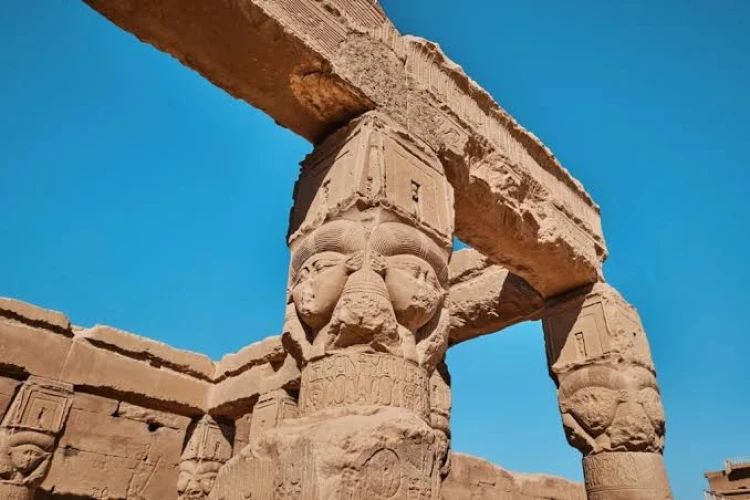
The Temple of Dendera: Sanctuary of Hathor and Astronomical Wonder
The archaeological heritage of Upper Egypt is associated with many outstanding ancient constructions, including the temple complexes of Karnak and Edfu. Still, one of the most well-preserved, architecturally advanced, and intellectually interesting ancient objects is the Temple of Dendera. This unique temple is located on the west bank of the Nile about 60 km north of Luxor. Its main goddess is Hathor, the goddess of joy, music, love, motherhood, and healing.
The temple was built at different times from the late Ptolemaic period to the Roman period and thus has an incredible historical and architectural significance. It represents an architectural model of sacred buildings, astrological knowledge, cryptic writing, and colorful images.
I. Geographical Location and Mythological Beliefs
Dendera as the city has played a significant role in ancient Egypt, as it was the religious center since the time of the First Dynasty.
A. The Main Goddess Hathor
The main goddess in Dendera is Hathor, who was one of the most worshiped goddesses in ancient Egypt. She was depicted as a woman with cow ears and horns with a sun disk between them or as a cow-headed goddess. Hathor was believed to be the mother goddess, the guardian of women, the mistress of foreign lands and mining, and the goddess of music and dance. In the temple, Hathor was worshiped together with her husband Horus of Edfu and their son Ihy, the god of music and sistrum.
B. The Temples’ Architecture History
There were ancient sanctuaries on this site dating back to the Old and New Kingdoms, reconstructed by Thutmose III and Ramesses II. However, today’s sandstone temple buildings were constructed under the late Ptolemaic rulers and completed by the Roman emperors. Ptolemy XII Auletes (Cleopatra’s father) initiated the construction, and the work was finished under the rule of Augustus and Tiberius. The construction and decoration of the temple complex was supported by the rulers of the Roman Empire, who wanted to gain the support of the local priesthood by honoring the ancient gods in their traditional temples.
II. The Main Temple’s Beautiful Architecture
Dendera temple is famous for its high-quality construction, architectural structures, and unique sculptures. The most spectacular building in the complex is the main Hathoric temple with a grand hypostyle hall.
A. The Main Hall with Grand Columns
The grand hypostyle hall of the main Hathoric temple can astound visitors. Its impressive monumental pronaos was built by the Roman emperor Tiberius. It has twenty-four massive columns at the front arranged in four rows of six.
Each column has a four-sided Hathoric capital on top made of painted limestone. On its four sides, the faces of Hathor with a calm smile are carved, surrounded by a model of an ancient temple gate. This architectural detail creates an opportunity to admire the view opening up under the columns, while the goddess looks at the visitors. The ceilings of the great hall are covered with intricate carvings that depict the hours of the night, the decans, and mythological scenes.
B. The Inner Enclosures and Crypts
After the majestic hall, there is a set of interconnected transverse vestibules, leading to private and communal chapels, the holiest of which is the inner sanctuary (naos). It is here that the cult statue of Hathor was kept, which was made of precious metals. The sanctuary is surrounded by eleven specialized chapels for the gods. Inside the main temple complex, on the level of the stone floor and inside the thick walls, there are mysterious crypts and underground hiding places. These spaces were probably used to store valuable gold plate treasures, jewelry, and the most revered sacred statues of gods and ancient Egyptian writing. Some of the crypts’ walls are decorated with beautiful low reliefs, among which there are mysterious cryptic inscriptions.
III. The Famous Dendera Zodiac and Ancient Science
One of the most famous scientific achievements of the temple complex is the mysterious Dendera zodiac. The zodiac was discovered on the ceiling of the small Osiris chapel built at the end of the temple on the roof.
A. The Zodiac Carved on Stone
The zodiac is a relief made of painted limestone plates, depicting the signs of the zodiac known to modern astronomy — Aries, Taurus, Gemini, Cancer, Leo, and other familiar constellations. At the same time, the relief also shows the signs specific to ancient Egypt — the decanal constellations, and the sun and moon barques.
B. The Zodiac in Paris and in Luxor
At the beginning of the 19th century, the large slab of stone with carved images was removed from the vault of the chapel and transported to France. This relic has become one of the stars of the Louvre Museum in Paris. Even though many scientists have asked the French government to return the artifact to Egypt, so far, it remains in Paris. However, a copy of the Dendera zodiac was made and returned to the temple complex, where it was displayed in the restored Osiris chapel.
IV. The Roof’s Chapels, Kiosks, and Other Constructions
The main Hathoric temple is surrounded by many other buildings, including fascinating roof chapels and kiosks.
A. The Kiosks and New Year’s Temple Ceremony
On the open-air roof, there is a set of elegant kiosks and stone chambers where priests used to perform significant rites during the New Year’s Festival. On this day, priests carried the cult statue of Hathor up the stone staircase to the roof. There, facing the glow of the summer sun rising over the eastern desert, the goddess was given back her energy and powers to replenish the life-giving Nile and ensure the fertility of the land.
B. The Birth-House and the Sanatorium
Flanking the main temple are two fascinating constructions. The first is the peripteral Mammisi (birth-house), built by Nectanebo II and later embellished by Augustus. It was dedicated to the goddess Hathor and her son Ihy, the youthful god, and the symbol of ancient Egyptian music and dance.
The second building is the sacred sanatorium, where the priests of Hathor used to heal the sick using temple resources. The sick people could also receive treatment at the temple: the curative waters of the holy wells, special medical care, and treatment using the sacred herbs known to the priests of Hathor.
V. Restoration and Colorful Paintings of the Ancient Walls
Since the temple has been used for centuries, its walls have long been covered with soot and dust. Thanks to the scientists who study ancient culture and history, the temple was recently restored, and its former beauty was partially restored.
A. Removing the Black Soot from Ancient Walls
Thanks to modern technology and the efforts of local and international scientists, the temple’s walls were cleaned from the black crust that formed over the centuries. Researchers used special equipment to remove the dirt without damaging the delicate paper-thin chips formed on the stone.
B. The Fascinating Colors of the Temples
As a result of the cleaning, a large number of bright colors, with which the temple was originally decorated, became visible: the vivid blue color, yellow, green, and white spots. Thus, the wonderful view of the ancient paintings survived until modern times and continues to surprise visitors.
Conclusion
Today, the Temple of Dendera remains an ancient architectural, artistic, and scientific achievement. Its impressive columns and fascinating zodiac relieve us of the feeling of the transience of everything human. At the same time, the discovery of ancient crypts with mysterious inscriptions and the recent unearthing of colorful wall paintings will probably provide new insights into Egypt’s ancient past. All of this makes the monument unique and invaluable.