
 English
 Italy
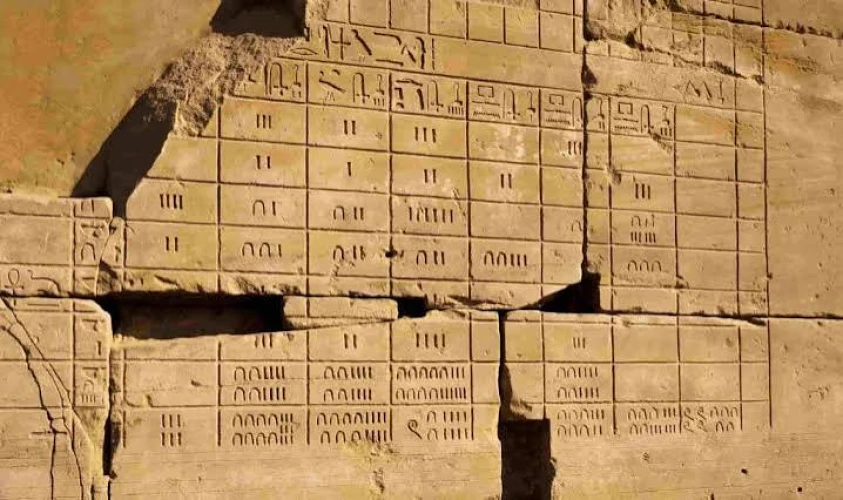
The Temple Festival Calendars of Ancient Egypt: Rhythms of the Cosmos and State
The ancient Egyptian civilization perceived time as a divine entity, and therefore sacred - in contrast to the modern abstract idea of time as a non-sacred, uniform flow. This is why many temple festival calendars, which constitute the focus of this paper, were created. The calendars were carved onto the sandstone walls, column shafts and pylon gateways of Egypt's monumental temples during the New Kingdom, Ptolemaic and Roman periods, and were a part of the master schedule of ancient Egypt, regulating the life of the country from a spiritual perspective.
1. The Concept of Sacred Time and the Egyptian Calendar
In order to understand the structure of temple festival calendars, some information concerning the ancient Egyptian understanding of time should perhaps be listed.
A. The Civil and Agricultural Calendars
Ancient Egyptians used the civil calendar, which consisted of 365 days a year. This year was divided into seasons which had four months each:
Akhet - the season of inundation and fertility
Peret - the season of growth
Shemu - the season of harvest and drought
The ancient Egyptians also had a sacred lunar and stellar calendar which revolved around the heliacal rising of the star Sirius (Sothis) which was associated with the annual inundation of the Nile. The civil year did not have leap years built into it, so it had a constant, but only approximate, relation to the solar year. This is why the priests were so invested into the process of recording the Sothic cycle - it was a part of tracking the passage of time in the universe.
B. The Architecture of Inscribed Time
The festival calendars were indeed carved into the stone in order to ensure the divine assistance of the gods. The ancient Egyptian priests knew, that although their actions were sacred and performed with utmost devotion, there was still a possibility of making mistakes. This was why the ancient inscriptions were of critical importance, for they ensured that the divine order would never cease in Egypt.
2. Structure and Content of Monumental Festival Lists
The calendar itself consisted of a yearly set of information which included month- and day-specific events that had to be performed.
A. The Granularity of Ritual Entries
The inscribed entries on the stone walls contained the data needed to prepare for and host the event in detail:
Name and Character of the Feast - information listed on the stone walls informed priests into what the feast day was supposed to represent. Some festivals were dedicated to specific mythological events, for example, Horus's coronation ceremony or Ra's birthday. Some were held to signify a particular agricultural process (the first grain harvest).
The Divine Recipients - the main gods on whose behalf the feast was held, along with their wives and children.
The Quotas of Offerings - the inventory of goods was also listed on the wall, which included the specific numbers of cattle, poultry, bread, beer, wine and incense that had to be presented to the gods.
The Procession Route - information, whether the cult statue was brought out of the naos (inner chamber of the temple) and into a barque procession around the lake and the town.
B. The Role of the Pharaoh and the Priesthood
The king of Egypt was the head priest of the land, which meant that he personally had to participate in every major spiritual event. In reality, the local priests served as intermediators between the pharaoh and the people. In addition to that, the calendar functioned as a contract between the king and the priests who actually did the work. The lands that were assigned by the king to the temples supported its daily operations and the festivals that were held with the dedication of the royal family.
3. Major Festivals of the Egyptian Year
The major festivals were celebrated throughout the course of the year, and these are listed below:
A. The Feast of Opet at Thebes
One of the most significant festivals of the ancient Egyptian year was the Opet Festival of Thebes. It was held in the second month of the season of inundation. It featured an intricate barque procession from the Karnak Temple to the Luxor Temple along the riverbank, to bring the statues of Amun-Re, Mut and Khonsu back to the gods' home temple.
B. The Beautiful Feast of the Valley
This festival that was celebrated in the capital city, Thebes, was a family-oriented one. The barque procession went from the east bank to the west bank of the Nile. It passed through the valley of the western desert, stopping at the mortuary temples and family tombs of every family, where the people ate and drank with the deceased.
C. The Festival of Drunkenness and the Mysteries of Osiris
Other festivals, such as the Festival of Drunkenness, where citizens used beer with red ochre as an offering to the lioness goddess Sekhmet, were devoted to the gods. The Mysteries of Osiris were celebrated during the month of Khoiak - a period dedicated to the story of the death and rebirth of Osiris.
4. Evolution Through the Ptolemaic and Roman Eras
The Ptolemaic rulers and the Roman emperors were both invested into preserving the ancient rites of Egypt, and thus the temple festival calendars continued to be used extensively. They were carved into the stone walls of Edfu, Dendera and other ancient cities. The process of carving the calendar was assisted by the increase of the building size and technical sophistication of the monumental temples during the Ptolemaic Period.
Even though the Roman emperors who ruled Egypt after the Ptolemaic dynasty fell were depicted in the temple decoration as traditional pharaohs, they still respected the calendar system which had been functioning for thousands of years prior. The Roman governors were aware of the importance of the festivals, for them it was crucial for the grain supply from the Nile region to be stable and for the people to be appeased through regular festivals.
Conclusion
The ancient Egyptians recorded the daily events of the monumental temples, which governed the everyday life of its people, on the stone walls of the temples. The festivals listed in the calendars varied from the major events of religious significance (such as the Opet Festival) to the more family-oriented occasions (such as the Feast of the Valley). The records carved into the ancient walls of monuments serve today as a reminder of how devotion and dedication can create an entire religion with a massive following that leaves traces of its existence for thousands of years after its initial appearance.