
 English
 Italy
Italy
The Sphinx of Giza and the Historical Evidence Behind Its Story
Standing silently on the Giza Plateau, emerging from the bedrock, the Great Sphinx of Giza is the most iconic and captivating figure of ancient Egypt. The giant sculpture with the body of a lion and the head of an Egyptian king wearing the traditional nemes headdress measures 73 meters in length and 20 meters in height. The monument was famous for centuries, inspiring legends about an ancient unknown civilization.
Modern Egyptology, geoarchaeology, epigraphy, and the study of ancient literature have done their part to establish the Sphinx’s history. A number of excavations at the Giza Plateau were conducted to determine the age of the monument and its relationship with the ancient pyramids. Today, researchers unanimously agree that the Great Sphinx is an ancient Egyptian sculpture. It was built during the Fourth Dynasty in the Old Kingdom as a part of the royal necropolis of the Pharaoh Khafre.
1. Geological context and construction process
To determine the age of the Sphinx, it is essential to study the rock formation and construction techniques used by ancient Egyptian builders.
A. U-shape excavation and tools
Unlike most ancient Egyptian monuments that were constructed from large stone blocks, the Great Sphinx was not built from blocks. When the Fourth Dynasty builders went to quarry the blocks for the Pyramids and the Sphinx, they left a natural limestone ridge or yardang. The master sculptors created the image of a winged lion within a giant U-shaped excavation. To make the body of the lion, large blocks of stone were removed. Stone blocks weighing several tons each were taken out of this trench, and these blocks were used to build the monumental walls of the Sphinx temple.
The builders of the monument transported the giant blocks of stone cut from the trench to the east of the ditch. The blocks were used to erect the massive walls of the adjacent valley temple. It is further supported by the fact that the stone blocks of the valley temple and the blocks of the Great Sphinx belong to the same series.
B. Weathering processes and dating the monument
Alternative researchers claim the Great Sphinx was built many centuries earlier and could not have been created by ancient Egyptians. In the 1990s, Egyptologists and geologists studied the weathering patterns on the blocks of the monument. Alternative theorists claimed that the deep fissures around the body of the Sphinx prove that it was built during the period of torrential rains that lasted for thousands of years. Professional geologists have identified two types of weathering affecting the rock. First, Haloclasty or salt weathering occurs when moisture flows up through the porous Member II limestone of the Sphinx enclosure. Evaporation of water and the growth of salt crystals in the joints exert pressure causing the rock to disintegrate. The second type of weathering that affected the stone body of the Sphinx is a result of the weak spots in the bedrock.
2. Archaeological context and art style
The Great Sphinx is a masterpiece of ancient Egyptian architecture. The architectural and artistic features of the monument are connected with the style of the Fourth Dynasty.
A. Architectural complex of the Great Sphinx
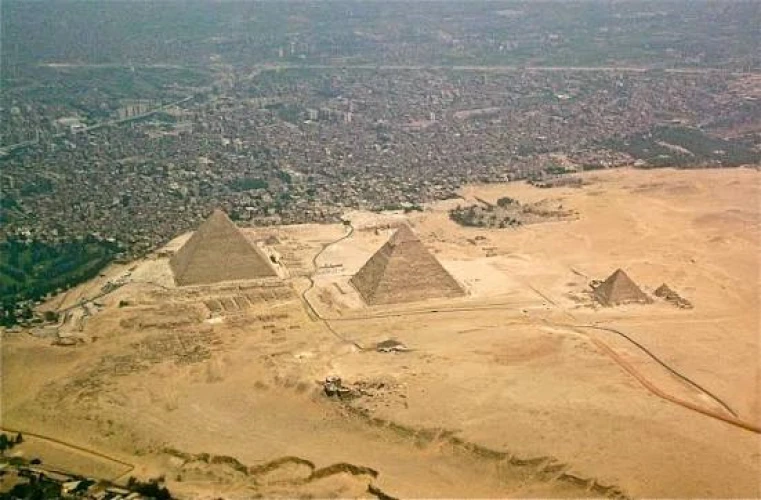
The Great Sphinx is part of the funerary complex of the Pharaoh Khufu. The architectural structure of the Sphinx is closely intertwined with the Valley Temple and the Second Pyramid belonging to Khafre.
A wide causeway leads from the foot of the Second Pyramid to the Valley Temple. Archaeologists discovered that the excavation for the Sphinx trench was located right next to the end of the Khafre causeway. Similar blocks of stone were used to erect the Sphinx and the Valley temples. The Great Sphinx lies at a distance of several meters from the Khafre Valley Temple. The Valley Temple and the Sphinx temple are built with the same stones.
B. The portrait of Egyptian Pharaoh
A careful examination of the stylistic features of the Sphinx’s portrait reveal intriguing details. According to the stylistic conventions of Egyptian art, the sculpture has typical facial features of the Pharaohs of the Fourth Dynasty. The style of facial hair curling back in a typical way and the shape of the headdress resemble other statues of Khafre.
The image of the lion is a popular motif in ancient art. The choice of the lion and the human face was not accidental. Ancient Egyptian artists used this motif to create images of the King as the strongest and smartest creature on earth. Thus, the lion’s body combined with the human head symbolizes the power and strength of the King.
3. Epigraphy and literary sources: Dream Stela
Ancient Egyptian texts do not mention the building of the Great Sphinx, probably because the ancient Egyptians of the Old Kingdom did not recognize non-funerary works of art. The Dream Stela was discovered in the Eighteenth Dynasty and provides information about the history of the monument.
A. The text of the Dream Stela
Between the massive front paws of the Great Sphinx, there is a granite slab covered with hieroglyphic text called the Dream Stela. During the Eighteenth Dynasty, Pharaoh Thutmose IV built a temple next to the Sphinx. The inscription on the Dream Stela describes the events that led to the construction of this temple. When the Pharaoh was a young prince, he went to hunt in the desert. He fell asleep near the Great Sphinx, which was partially buried in sand. While sleeping, Thutmose IV saw a dream in which the Sphinx promised him the throne of Egypt.
At the dawn, Pharaoh ordered people to clear the sand around the monument. The mummy of his father, the Pharaoh Amenhoro, was used to repair this ancient structure. In addition, small blocks of stone were used to repair the body of the Sphinx. After he became Pharaoh, Thutmose IV ordered the construction of a stone stela, which was erected between the paws of the Sphinx.
B. The New Kingdom inscription and the Sphinx cult
The New Kingdom texts prove that in the New Kingdom the Great Sphinx was regarded as an incarnation of the sun god Horemakhet. The New Kingdom builders erected brick temples near the Sphinx, and the local cult was renewed. New Kingdom pharaohs such as Amenhotep II paid tribute to the monument. They erected several stelae at the base of the monument praising the great power of the Great Sphinx.
4. Restoration history of the Great Sphinx
The Great Sphinx of Giza is a masterpiece of ancient Egyptian architecture and a symbol of ancient Egypt. The current state of the Sphinx is the result of extensive and ongoing restoration work. The monument has been considerably affected by weathering processes during its more than 4500 years. Researchers have determined the periods of active restoration of the monument.
A. The history of ancient restoration
The Great Sphinx was carved from the rock, which consisted of blocks of soft limestone alternated with harder limestone. Soon after it was built, the monument began to slowly crumble and deteriorate. The New Kingdom builders encased the lower part of the monument in limestone blocks and surrounded the monument with a fence of mudbrick walls.
The builders of the Late Period and the Ptolemies closed the paws of the Sphinx with small blocks of stone. During the Roman period, the masonry of the lower part of the monument was reinforced. A new pavement of stone blocks was laid on the bottom of the enclosure. The Roman builders enclosed the monument with additional stone blocks.
B. Modern excavations and restoration of the Great Sphinx
In early nineteenth century, explorers and Egyptologists, among them Giovanni Battista Caviglia and Auguste Mariette, were the first to excavate the area around the monument. In 1925-1936, the French Egyptologist Emil Baraize opened the of the Great Sphinx of Giza. The explorers cleared the site of thousands of cubic meters of sand, exposing the body of the lion. Modern researchers conduct regular excavations of the Great Sphinx. Today, the monument is subject to careful preservation and restoration. Scientists are trying to reduce the risks posed by rising groundwater to the body of the monument. A number of scientists are working on the removal of cement mortar from the cracks in the blocks. Modern scientists are developing methods for preserving this national treasure for the descendants.
Conclusion
The Great Sphinx of Giza is a unique monument of ancient Egyptian architecture. The Sphinx was built by the ancient Egyptians during the Old Kingdom as a part of the royal necropolis of the Pharaoh Khafre. The geological, archaeological, artistic, and epigraphy evidence presented in this essay confirm the historical authenticity of the Great Sphinx of Giza.





-webp.webp "Hilton")
-webp.webp "dusit")
-webp.webp "Marriott Hotels")
-webp.webp "Azimut Hotel")
-webp.webp "Golden Tulip")
-webp.webp "sheraton")
-webp.webp "westin hotel")
-webp.webp "Movenpick")
