
 English
 Italy
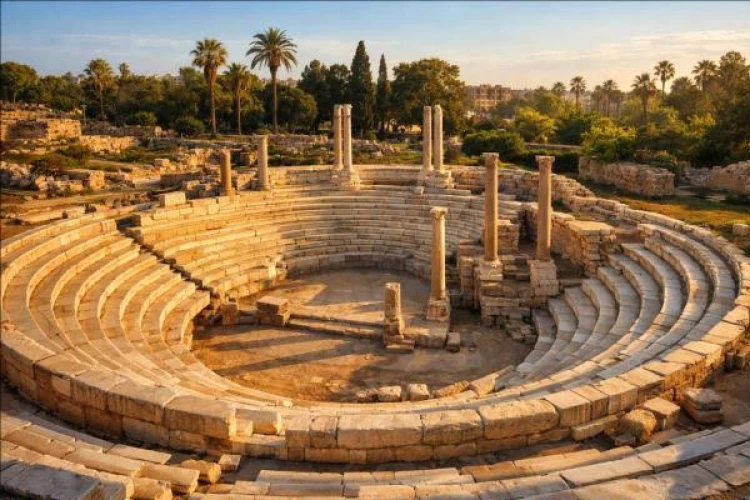
The Roman Theatre of Alexandria: Architecture, Entertainment, and Civic Life
The archaeological heritage of Ancient Alexandria witnessed the existence and prosperity of numerous legendary buildings, royal palaces, libraries, and catacombs. However, the Roman Theatre is considered one of the best-preserved constructions of its kind. This architectural monument is unique to Alexandria as the only Roman theatre found on Egyptian territory. The Roman Theatre at Kom El-Deka was accidentally discovered during the 20th century excavations, and it serves as an extraordinary source of information about Roman public life, urban development, and architecture. In this essay, the Roman Theatre will be discussed in detail focusing on its history of excavation, architecture, and significance.
1. Discovery, Location, and Excavation Context
The discovery of the only Roman theatre in Alexandria is one of the most notable findings in modern Egyptology.
A. The Unearthing of the Ancient Structure
Ancient authors have described that Alexandria was once an urban center with magnificent theatres, odeums, and hippodromes. However, the exact location of these structures was unknown and remained concealed under the historical Muslim necropolis and modern developments. In 1960s, Polish and Egyptian archaeologists excavated the Kom El-Deka mound that was previously used as a junkyard. Researchers hypothesized that this site might contain the remains of a late Roman fortress or medieval mosques. Nevertheless, the excavators uncovered a well-preserved example of a Roman theatre that had been buried beneath several decades of accumulated waste.
B. Development History
The territory of the Roman Theatre has seen different construction since the foundation of Alexandria. To begin with, during the early Ptolemaic period, the site was occupied by a wealthy neighborhood with mosaic-tiled private residences. Subsequently, during the Roman period, this area was transformed into a vast public building complex with an attached theatre. After the development of the city during the second or third centuries AD, the residential buildings were taken down to provide space for the construction of a large-scale theatre. In the following Byzantine and Islamic periods, the public building was adjusted, partially converted into a necropolis, and abandoned.
2. Architectural Description of the Roman Theatre
The Roman Theatre in Alexandria is a striking architectural jewel that perfectly represents the design, construction, and aesthetic values of the Roman World.
A. The Classic Roman Design of the Theatre
The architectural design of the Roman Theatre traditionally follows the semicircular shape of the ancient Greek theatre. Its cavea (auditorium seating) accommodated approximately eight hundred to one thousand seated viewers. The theatre used a substantial amount of white marble brought to Alexandria from Greek and Roman quarries.
The radiating seating arrangement was divided into seven cunei (concentric sectors) by means of staircases. In addition, the upper story of the theatre was complemented by a shaded and sheltered colonnade, which provided the audience with a comfortable resting area. The colonnade consisted of green cipolin marble and red granite columns.
B. The Orchestra and Proscenium Screen
The Roman Theatre also had an orchestra, which was the central element of the semicircular arrangement. It was a circular area, which was paved with colorful mosaics. Behind the orchestra, there was a proscenium (a stage) with an elaborate scaenae frons (a massive building screen). The scaenae frons was decorated with multiple niches, columns, and statues of mythological and imperial figures. Remarkably, the Roman Theatre’s architectural design ensured excellent sound quality throughout the structure.
The clever arrangement of the building and the use of marble allowed voices from the stage to carry effortlessly to the upper rows of the auditorium without echoing. In addition, the Roman theatre is believed to have employed bronze or terracotta echeia (acoustic vases) to amplify the sound of music and voices, cancel out unwanted echoes, and mute the noise of the audience.
3. Acoustics and Construction Technology of the Roman Theatre
The Roman Theatre at Kom El Deka incorporated ancient architectural constructions developed by Vitruvius and his contemporaries to enhance the acoustics of the structure.
A. Advanced Acoustic Technology
Roman architects experimented with architectural features that could amplify the sound of the actors’, singers’, and musicians’ voices in order to ensure the quality of performances heard by the audience. The Roman Theatre used a combination of natural geology, geometry, and construction materials to maximize the auditory effect. The steep slope of the seating area and its unique layout created a perfect balance between focusing the sound and spreading it along the length of the building. In addition, the hard surface of the marble seats prevented the audience’s voices from drowning out the actors’ voices.
4. The Archaeological Park at Kom El Deka Surrounding the Theatre
The Roman Theatre at Kom El Deka was not excavated in isolation but rather found as part of a larger complex containing various archaeological features.
A. The Terraced Bathhouses Attached to the Theatre
Attached to the Roman Theatre, there is an extensive system of ancient bathhouses. The Roman World was renowned for its luxurious thermal institutions, which served as centers for social and cultural events. It is believed that the construction of the bathhouses and the theatre were developed as a part of a larger public park for the city’s inhabitants. The Roman baths provided a space for people to engage in physical exercises, relaxing procedures, and attend public performances such as concerts and theatrical plays.
B. The Lecture Halls Found Close to the Theatre
Encircling the Roman theatre complex, one can see the remains of a series of small audience halls and lecture rooms. These structures are considered to be the late Roman and Byzantine Odeions. Their construction suggests that as the traditional theatre institutions in Alexandria started to decline, the lecture halls at the Kom El Deka became an academic center for delivering public lectures and hosting various performances. The buildings were furnished with stone benches arranged in a semicircle facing the speaker’s stand.
In conclusion, the Roman Theatre in Alexandria represents an architectural achievement and served as a central institution for public performances, socialization, and cultural and entertainment events in ancient Alexandria. Excavated in the 20th century, this marble construction has been providing valuable insights into the history and culture of Ancient Egypt and the broader Roman World. From its semicircular seating and mosaic-covered orchestra to bathhouses and lecture halls, the Roman Theatre at Kom El Deka continues to fascinate modern scholars and contribute to the cultural legacy of Alexandria.