
 English
 Italy
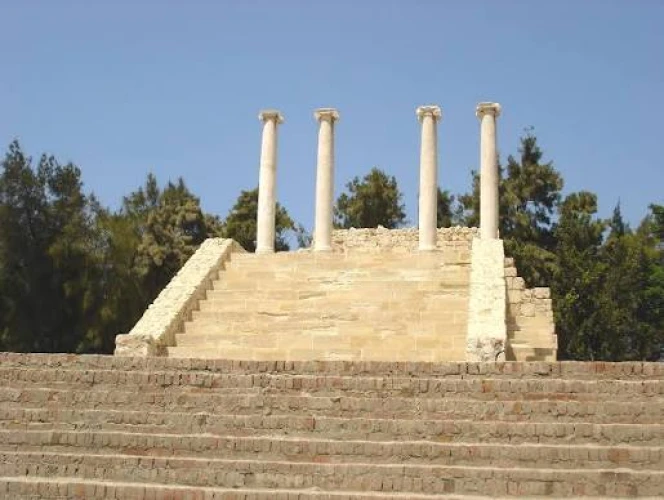
The Ras El-Soda Temple: A Greco-Roman Sanctuary of Alexandria
The archaeological legacy of Alexandria, Egypt, possesses a wide range of impressive monuments, from majestic palaces and large-scale catacombs to exquisite shrines to gods and goddesses. The Ras El-Soda Temple is one remarkable example of a small-scale ancient sanctuary, which survived in a comparatively good condition after being accidentally uncovered in the middle of the twentieth century. The Ras El-Soda Temple is a striking artifact that deserves further scientific and public scrutiny due to its potential to act as a source of information about the convergence of cultures and religions in Alexandria.
1. Discovery, Location, and Archaeological Context
The discovery of the Ras El-Soda Temple is a prime example of how the modern urban development of Alexandria may intersect with ancient sites.
A. The Accidental Discovery in the Twentieth Century
Unlike the large-scale ancient structures found near Alexandria’s harbor, the Ras El-Soda Temple was uncovered accidentally in the middle of the twentieth century. It was first excavated by the Graeco-Roman Museum of Alexandria, which had to hurry to the scene in order to prevent the large-scale modern construction from destroying the medieval temple.
To the surprise of the discoverers, the foundation, floor, and altars were found to have been surprisingly well-preserved under the layers of sand and alluvial deposits, alongside several large stone statues.
B. Relocation and Museum Preservation
Further archaeological investigations revealed that the continued development of the local suburb would entail the destruction of the temple. Hence, the authorities of the Graeco-Roman Museum of Alexandria decided to dismantle the Ras El-Soda Temple block by block and reinstall its edifice and statues in the museum’s courtyard. The disassembled temple and its artifacts were carefully studied and documented by the museum’s scholars before being permanently displayed in the museum.
2. Architectural Design and Structural Typology
The Ras El-Soda Temple is a unique architectural structure that combines the ancient Mediterranean architectural tradition with local Hellenistic construction practices.
A. The Elevated Podium and Staircase
The Ras El-Soda Temple was built on a large rectangular stone podium, which was typical of Roman architecture to signify the separation of the divine realm from the worldly one. A grand staircase led from an open courtyard to the temple’s pillared portico, which in turn gave the visitors access to the large central chamber.
Despite the relatively modest footprint of the sanctuary, its height and grand entrance staircase created an imposing image of the temple against the backdrop of the open desert.
B. The Pronaos and Cella
After the grand stairway, the temple visitors were met with a short portico, whose two columns sported classic architectural motifs. At the end of the portico, there was a large stone altar, behind which the priests of the temple conducted their daily rituals. Further inside the temple grounds, small Greek-style columns stood as the frame for the cella, where the cult figures of the goddesses were located. Notably, the craftsmanship of the local Alexandrian builders and stonecutters was of a very high quality, as seen in the precise shape of the limestone blocks, which were used to assemble the temple’s structure and staircases.
3. Religious Syncretism and the Pantheon of Ras El-Soda
The most remarkable feature of this ancient sanctuary lies in the collection of statues of gods and goddesses that embody the religious syncretism of late ancient Alexandria.
A. The Central Cult Statue of Isis-Pharia
The central statue in the Ras El-Soda Temple depicts the goddess Isis, who was especially revered in Alexandria for her role as the protector of ships and sailors. Interestingly, the features of the goddess are a blend of the classical Greek and indigenous Egyptian motifs. Her semi-transparent garment, usually worn by the ancient Mediterranean goddesses, is complemented by the imagery of a ship sail, which fills the wind. Hence, the statue of Isis, the goddess of navigation and sea serenity personified the maritime aspirations of the Alexandrians.
B. Associating Egyptian and Roman Deities
Next to the central cult statue of Isis, there were two other statues, depicting a variety of gods and goddesses, who were worshiped in Alexandria. First, there was a figure of Hermanubis, the syncretic deity embodying the wisdom of Hermes and the jackal-headed Anubis. Further, Harpocrates, the youthful form of the Egyptian god Horus, sports classical Hellenistic motifs of his curled finger touching his lips. To the right of the central Isis statue, there are two more figures of the deity, carved from the same stone block, which depict either Jupiter or the Alexandrian god Sarapis. Overall, the combination of these three statues personifies the cultural and religious convergence of the Alexandrian pantheon. Hence, it may be stated that the Ras El-Soda shrine served as a center of worship for the sailors and merchants of the city, who sought the protection of these gods and goddesses.
4. Historical Significance in the Roman Period
The construction of the Ras El-Soda Temple dates back to the late first century AD or the second century AD. This period was marked by the Roman Empire’s prosperity and territorial expansion, as Roman troops marched toward the borders of China. In late first century AD, Egypt became the breadbasket of the Empire, which further increased its wealth and urbanization. However, unlike the great Roman temples dedicated to Jupiter in the imperial capital and Alexandria, the Ras El-Soda Temple was a product of the provincial city.
A. Provincial Piety and Civic Identity
The construction of a temple in Alexandria was a highly expensive endeavor, which could have been undertaken by a rich civic merchant only. It is also possible that the local maritime guild donated to the construction of the Ras El-Soda Temple, which served the local sailors and merchants. The small size and the presence of a stone altar in the courtyard suggest that the Ras El-Soda Temple’s cult was local and followed the tradition of the Alexandrian suburb.
B. The Transition to Late Antiquity
Like many pagan sanctuaries in Egypt, the Ras El-Soda Temple was closed down and abandoned in the late fourth century AD, when emperor Theodosius I outlawed pagan rituals in favor of Christianity. The Ras El-Soda Temple was buried under the sand of the Alexandria coast, which in turn saved it from the stone robbers who plundered many ancient temples in the city.
Conclusion
The Ras El-Soda Temple is a remarkable artifact that combines architectural innovation and provincial religious devotion. This small-scale ancient sanctuary has a unique architectural design, which incorporates traditional Roman motifs of an elevated podium and a grand staircase. The Ras El-Soda Temple also possesses a collection of statues of gods and goddesses that are native to Alexandria. Interestingly, the cult figures combine indigenous Egyptian motifs with the classical Greek ones, thus, embodying the cultural and religious syncretism of late ancient Alexandria. After being accidentally discovered in the middle of the twentieth century, the Ras El-Soda Temple complex was relocated and displayed in the courtyard of the Graeco-Roman Museum of Alexandria.