
 English
 Italy
Italy
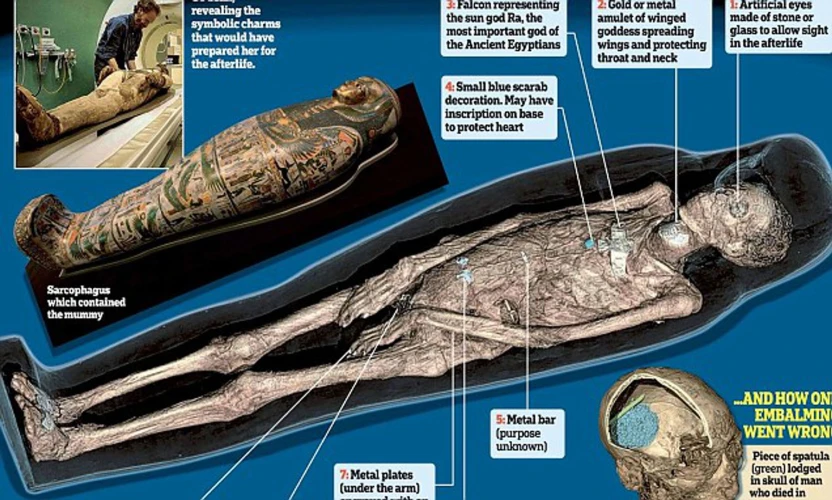
The Precision of the Hook: How Ancient Egyptians Removed the Brain
The brain extraction ritual represents the most modern concerning rituals which were practiced inside the "Per-Nefer" (the House of Beauty and the mummification workshop). The scene shows a combination of horror and fascination through its depiction of an embalmer wearing a mask who uses a long bronze hook to conduct a surgical procedure through the nostrils.
To understand this act we must remove all contemporary medical prejudices from our examination. The human brain functions as the central system which controls all aspects of human life because it contains our conscious thoughts and our personal identity and our stored memories. Ancient Egyptians viewed the brain as a mysterious body part which they considered to be useless after death.
The "Precision of the Hook" story presents an ancient surgical procedure which reveals how an entire civilization selected its permanent possessions.
1. The Great Misunderstanding: Why Discard the Brain?
The Egyptians dedicated themselves to body preservation for afterlife purposes but they treated brain matter as refuse.
Egyptians believed that the Ib (heart) functioned as the main organ which controlled human thought processes and emotional states and memory functions. They found that excitement or fear resulted in increased heartbeats. They believed that the heart performed all cognitive functions.
The "Radiator" Theory: Some scholars believe the Egyptians viewed the brain as a device which produced mucus and functioned as a blood cooling system. The object required no weighing at the Hall of Judgment because it lacked spiritual worth.
Human body function depends on brain function because brain structure consists of water and fat components. The brain represents one of the first organs which transforms into liquid form and initiates internal body decomposition. The body needed to discard brain matter because it needed to preserve both facial features and skull structure.
2. The Tool of the Trade: The Bronze Hook
The specialized kit which an embalmer uses contains all the tools necessary for their work. The main instrument of the room appeared as a long bronze rod which ended in a precisely designed hook or spiral element. The Design:These hooks functioned as more than basic wire components. The objects created "whisk-like" shapes which included a small spatula end. The materials needed to possess enough force to penetrate through bone yet they must remain fragile enough to protect the facial structure which requires safeguarding.
The Humanized Craft: In 2026 high-end surgical steel remains our preferred material. The Egyptians considered the bronze hook to be their most advanced technological instrument. Every embalmer had a "feel" for the tool which they learned through their family bonds that passed this knowledge through multiple generations.
3. The Procedure: A Step-by-Step Surgical Dance
Engineers need to keep both nasal structures and frontal bone structures intact during the procedure which requires them to extract a brain through a person's nostrils. The surgical procedure required complete spatial understanding because it operated without any visual guidance.
The Nasal Passage: The embalmer would insert the bronze hook through the nostril. The operator made exact movements to create an opening in the ethmoid bone which exists as a delicate structure behind the nasal bridge to separate the nasal area from the brain.
The hook started to rotate inside the skull after it entered the cranium. The process required scientists to change brain tissue into a liquid state instead of removing items from the human body through a process similar to the game of Operation.
The medical staff used body tilting methods with a long bronze spoon to extract liquefied brain material which would exit through the nasal passage.
The team used palm wine which served as an antiseptic and aromatic resins including myrrh and cedar oil to clean the skull until all residues disappeared.
4. The Human Touch: Protecting the Face
The embalmers demonstrated their strong dedication to their work by maintaining the natural looks of deceased individuals. The Egyptians wanted to make sure their soul could identify itself through its own facial features during nighttime returns from death.
The embalmer used a nasal passage to perform his work because it let him complete his task without creating any facial cuts. The workers filled the vacant areas in the skull with resin-soaked linen after they had removed its contents.
The Artistic Integrity: The person remains intact except for his mind which they have taken away from him. The artist creates permanent peaceful expressions for dead people because he feels deep compassion for others.
5. The Evolution of the Hook: From Pharaohs to the Public
The mummification process used to require brain extraction as an essential step. The ancient Egyptians practiced brain preservation by keeping the organ inside the skull during the drying process.
Ramses and Tutankhamun's New Kingdom period brought "nasal extraction" as a essential component of "Premium Package" mummification procedures. The work demonstrated extreme excellence through execution.
Middle class growth created a new practice which involved people removing their brains to achieve permanent preservation of their bodies. People gained access to "Precision of the Hook" after they paid for professional embalming services which included this service.
6. The 2026 Perspective: What We’ve Learned
The present day enables us to examine mummies through CT scans and 3D modeling because we can study them without unwrapping their bodies. The resin-coated skull which appears completely hollow demonstrates the abilities of a skilled artisan.
The "transnasal" route which Egyptians developed for their medical procedures has become a source of admiration for modern surgeons who perform medical procedures today. The Egyptians developed a surgical technique which modern doctors use to perform pituitary gland tumor removals through nasal passages.
The Philosophy of Value: The "discarded brain" reminds us that what we value today might be seen differently in the future. The Egyptians valued the Heart and the Name; we value the Brain and the Data. We must determine which aspects of our existence will continue forever.
7. The Mind vs. The Memory
The Egyptians employed brain extraction methods to create a "alien" and "macabre" appearance but the Hook's Precision demonstrates their human attributes. The culture conducted research on human anatomy while performing complex surgical procedures because they believed their "spirit" existed outside of their brain's physical limits.
He remained alive even after they threw away his brain. The team conducted a craniotomy procedure which allowed them to create room for the "Sahu"—the spiritual body that would exist among the stars. The ancient embalmer shows us that as we spend our time "in our heads" during 2026, our most vital parts exist beyond the bronze hook's ability to capture them.





-webp.webp "Hilton")
-webp.webp "dusit")
-webp.webp "Marriott Hotels")
-webp.webp "Azimut Hotel")
-webp.webp "Golden Tulip")
-webp.webp "sheraton")
-webp.webp "westin hotel")
-webp.webp "Movenpick")
