
 English
 Italy
Italy
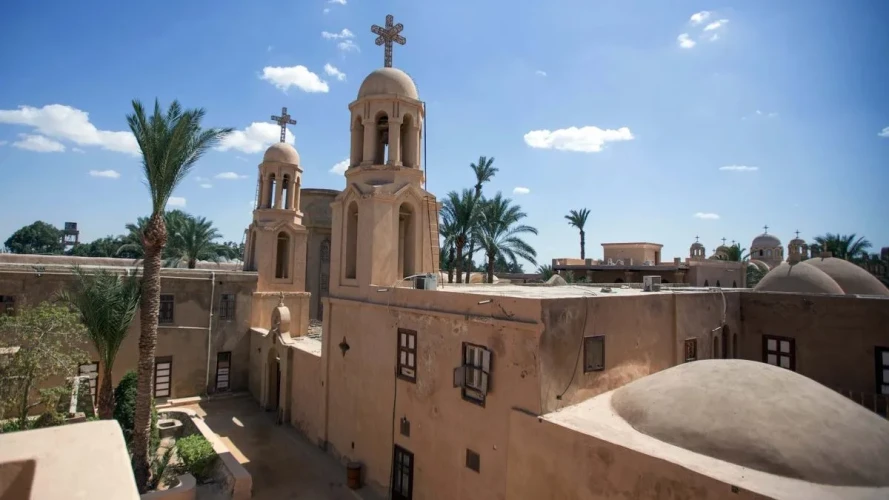
The Place of the Romans: Inside the Oldest Sanctuary of Scetis
The Monastery of Al-Baramus (Deir Al-Baramus): History, Solitude & Ancient Legacy
Deep in the northernmost reaches of Wadi El Natrun, set against that peaceful, stillness of Egypt’s Western Desert, stands Deir Al-Baramus, (The Monastery of Al-Baramus). Dedicated to the Virgin Mary, this historic sanctuary holds a kind of special distinction among the ancient monasteries of Scetis, it is often described as the oldest continuous physical site established in the valley.
And the name, Al-Baramus, comes from the Coptic phrase Pa-Romeos, which is usually rendered as “That of the Romans.” This uncommon naming is meant to honor two young Roman princes, Saints Maximus and Domitius, who left behind imperial riches ,to choose a life of quiet prayer, under the guidance of Saint Macarius the Great.
So from its 4th-century beginnings, past its ancient stone keeps , historic churches and calm gardens, here is the full account, the architectural inheritance, and the spiritual afterglow of the Monastery of Al-Baramus.
1. The Origins: The Two Roman Princes and Saint Macarius
The founding story of Deir Al-Baramus hangs together with the early golden time of desert monasticism, in the 4th century AD ,more or less.
As Church tradition tells it, Maximus and Domitius were sons of Roman Emperor Valentinian. They say the young brothers, being pulled in by reports about the holiness, and also the wisdom of Saint Macarius the Great, left their royal rooms in Rome. From there they crossed the Mediterranean and walked into the wilderness of Scetis about 340 AD.
Saint Macarius at first was unsure, not because he doubted their souls, but because two young men raised in royal comfort might not handle the extreme heat, the thin meals, and the stubborn difficulties of the Egyptian desert. Still, their steadfast faith and their very deep dedication to quiet prayer impressed him, so much so that he kept watching them.
Sadly, the brothers both passed away quite young, from natural reasons, not long after they had settled. In their memory, Saint Macarius built a small cell above their dwelling, and he called the place Pa-Romeos, meaning the Place of the Romans. Later disciples came and stayed near this sacred spot, and gradually it became the organized monastery that people know today as Deir Al-Baramus.
2. Historic Resilience Through the Centuries
Over a very long period, Deir Al-Baramus went through numerous trials because it was placed on a remote corner of the northern desert, far away from most things.
In the 5th and 6th centuries, Berber tribes started multiple destructive raids across Wadi El Natrun . For a while, the monks had to look for refuge, or temporarily split up, though they usually came back again to put the sanctuary back together , piece by piece.
Later on, in order to keep going for the long run , big defense structures were arranged under Byzantine patronage. Huge stone ramparts were raised, and in effect, they changed what had been a relatively open community into a sealed desert fortress. Then during medieval times the monastery became a lively hub for Coptic learning, generating respected theologians, notable scholars, and even a number of Popes of the Coptic Orthodox Church, like Pope Cyril V and Pope Cyril VI.
3. Key Architectural Features and Sacred Treasures
Sprawling out over a calm desert oasis, more or less tucked in between olive trees and palm groves, Deir Al-Baramus holds some of the oldest monastic buildings still standing in North Africa. It feels, at least at first glance, like it just kept quiet and waited for the visitor to notice it.
The Historic Church of the Virgin Mary (Al-Adra)
At the center, spiritually speaking, the monastery’s main Church of the Virgin Mary keeps architectural traces that go back to the 6th and 7th centuries, so you’re walking through layers that survived a long time.
Ancient Wall Paintings
More recently restoration work uncovered striking strata of old murals, with scenes from the Bible, patriarchs, and early desert saints. The paint is not just decoration, it’s like a record, carefully layered.
Intricate Woodwork
Inside, the church is known for traditional Coptic wooden screens (iconostases) , with ivory geometric inlays. They stand between the main congregation and the holy altar, kind of like a steady boundary made of ritual and craft.
The Church of Saint John the Baptist
Inside the monastery walls, this church protects sacred relics belonging to several important figures from desert monastic life. Among them is Saint Moses the Black (Anba Moses) , a former bandit who turned into one of the most well known examples of repentance and humility in Church history, and alongside him his mentor Saint Isidore.
The Fortified Keep (Al-Jawsaq)
Like the other monasteries in the valley, Deir Al-Baramus also has an impressive, multi story stone keep built in the 5th century. It was meant as a sanctuary during sieges, and the fortress tower could be reached only by a wooden drawbridge on its second level. Once you’re in , there’s a chapel dedicated to Saint Michael the Archangel, plus storage rooms for food , an internal water well and channels meant to gather rainwater.
4. The Monastic Tradition: Solitude and Prayer
While Deir Al-Baramus, welcomes visitors and pilgrims today, it has always kept this kind of strong reputation for solitude and a rather strict monastic discipline. Not like the others, it sits further north, past the other three active monasteries of Wadi El Natrun, and so for centuries it stayed pretty out of the way.
That natural seclusion helped the resident monks sink deeply into the familiar cadence of desert life, like it was their whole atmosphere. You could almost say their days are arranged by:
The Canonical Hours—daily cycles of psalmody that do not break, and midnight prayer vigils that keep returning, again and again.
Manual Labor: the monks work the land, bake bread, do bookbinding, and they maintain those long, extensive olive groves around the whole compound
Desert Hospitality: they welcome pilgrims who come for spiritual counsel, retreat, and a calm, still reflection that feels distant from city noise, even for a little while.
5. Modern Renewal and Living Legacy
In recent decades, Deir Al-Baramus has been through a kind of major renaissance, in both its agricultural and spiritual life… maybe more than one would expect.
Over time, new expansion projects that sit outside the old ancient fortress walls have brought spacious retreat centers, more modern library facilities, and even medical clinics, to serve people in the nearby communities. The monastery surrounding farms now use modern irrigation methods so they can grow crops, fruits and olives in desert soil, yet somehow keep the older monastic principle of self- sufficiency.
Even so, the ancient inner fortress still stays like a hushed protected sanctuary where the traditions that Saint Macarius and the Roman princes set in place almost seventeen centuries ago remain active, fully alive, as if nothing really ended.





-webp.webp "Hilton")
-webp.webp "dusit")
-webp.webp "Marriott Hotels")
-webp.webp "Azimut Hotel")
-webp.webp "Golden Tulip")
-webp.webp "sheraton")
-webp.webp "westin hotel")
-webp.webp "Movenpick")
