
 English
 Italy
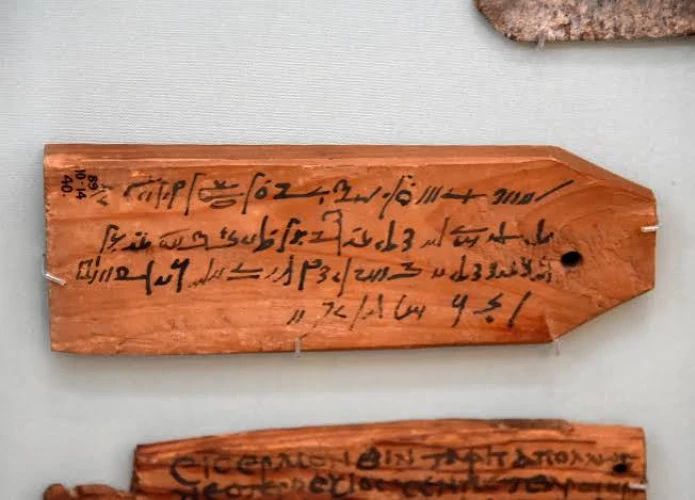
The Mummy Labels of Roman Egypt: Administrative Documents of the Afterlife
The Roman Egypt has produced numerous fascinating finds — from ancient monumental architecture and sprawling catacombs to papyrus manuscripts with philosophical writings. But the most unique and personal artifacts are the small, simple wooden tags, known to modern historians as "mummy labels."
Dating to the Roman period, these inscribed tags were tied to the linen bandages of mummified bodies before burial practices. They served as legal and religious documents for the deceased who were mummified according to the ancient rite. Mummy tags are an unprecedented source of information about the life and death of ordinary people who lived their lives in the Nile Valley during the Roman period.
1. Characteristics and Manufacture of Mummy Tags
Mummy tags were simple labels, made from local or imported cheap wood common for the ordinary households of ancient Egypt.
A. Tags Material and Shape
The wood used for mummy tags was of an inexpensive, quite tough variety, such as sycamore fig, acacia, tamarisk, and occasionally cedar or pine. Tags were cut from small pieces of wood in the shape of oblongs or tongues, 5-15 cm long. At one end, a small hole was drilled or a groove cut out to attach the tag to the bandages with a string or papyrus twine. Such a tag was inserted under the top layer of linen dressings, usually on the neck, chest, or legs, so as to be visible when the sarcophagus was opened.
B. Script and Language of the Inscriptions
After the wooden tag was cut and smoothed, it was handed to professional scribes or embalmers who carved the necessary text on it. Depending on the education level of the scriptor and the status of the deceased, the text was written in black or red ink with a reed pen or carved out with a knife.
The language in which the text was written is also of great interest. The mummy tags were bilingual or even trilingual, written in Greek (the administrative and literary language of Roman Egypt), Demotic Egyptian (the popular writing language in Egypt), or occasionally in Coptic (the Christian language written in Greek script).
2. Purpose: Why the Mummy Needed a Tag
Why did an ordinary person need a wooden tag with writing buried in linen bandages? To understand why mummy labels were necessary, it is helpful to consider the peculiarities of the embalming industry in Roman Egypt.
A. Logistics of the Embalming Industry
Mummification in ancient Egypt was a specialized and expensive procedure, and only the wealthy people could afford it. The families living in provincial farms, narrow urban neighborhoods, or garrisons had to bring the dead body to the capital or a city with an established embalming industry (wabet). There, specialized priests-embalmers purified and dried the body for seventy days using probing hooks and bandages of linen fabric.
After the embalming procedure, the body had to be returned to the village, town, or city where the deceased had previously lived to be buried in the family tomb or the local cemetery.
B. The Label Assured the Proper Burial of the Dead
The wooden tag served as kind of a shipping tag and an identity card; thus, it helped to prevent confusion between family members and friends of the living relatives, especially in large cities. The tag indicated specific information about the deceased, serving as a reminder for the warden of the appropriate burial grounds. Moreover, the local authorities needed this information to update the census data and release the property of the deceased from taxation.
3. Reading the Tag: Information Contained
The labels contained a brief formulaic message providing key pieces of information about the deceased in the fewest possible words. The exact composition of the tag depended on the scriptor, but usually, they contained several critical pieces of data:
A. The Name of the Deceased
It goes without saying that the personal name of the deceased was of great importance to the ancient Egyptians and their beliefs about the afterlife. Mummy labels are a unique source of information concerning the names used in Egypt at that time. Some tags contain Egyptian names (Pachomius, Petosiris, Senpachois), some tags have Greek (Dionysios, Alexandros, Eleni) or Roman (Marcus, Aurelius) names, and some names are combinations of different traditions.
B. Patronymic and the Place of Residence
In addition, to distinguish people with the same names, tags contain information about the father (patronymic) and sometimes the mother of the deceased, as well as the place of residence. An example of a label containing such information could be "Pachomius, the son of Horos, of the village of Karanis."
C. Age and Profession of the Deceased
Sometimes the age of the deceased at the time of death was indicated on the label. In addition, the tags contain information about the occupation and social status of the deceased or about their military service.
4. Religious Formulae and Safe Passage to the Underworld
Although mummy tags were intended to serve a utilitarian purpose of identification during the burial and subsequent interment of the body in the grave, these small wooden tablets could also have a religious significance.
A. Invocations and Prayers to Gods
Some labels contain religious invocations, prayers to gods, and protective formulae to ensure the protection of the deceased in the netherworld journey. A common formula used on mummy tags began with an invocation to the gods or a prayer.
B. The Passport to the Afterlife
When traveling to remote places in ancient Egypt, it was customary for travelers to carry a papyrus travel permit (Greek symbola ) and letters of introduction from local authorities. According to the same tradition, the deceased in the ancient Egyptian belief system needed a similar "passport" to gain access to the kingdom of Osiris beyond the grave. On the one hand, the label provided protection and invoked the protection of the gods. On the other hand, the tag acted as an official document certifying the identity of the deceased, as well as his ancestral home. Thus, the mummy label served as a kind of passport that gave the deceased the right to cross the threshold of the tomb and start a new life in the eternal world.