
 English
 Italy
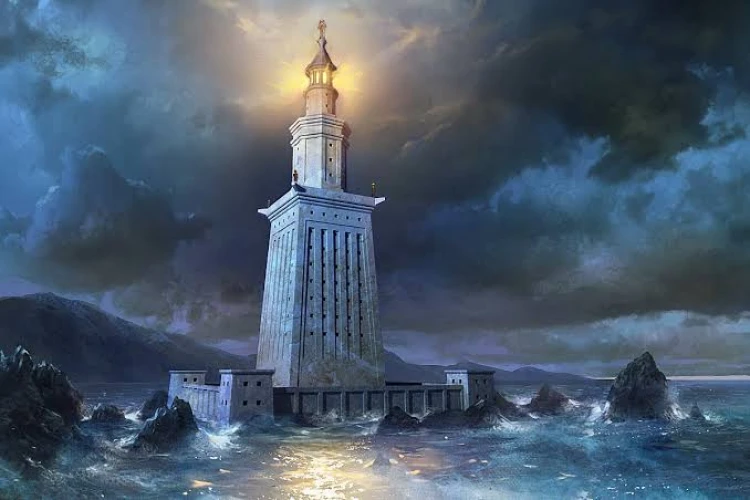
The Lighthouse of Pharos
The Lighthouse of Pharos is one of the most astounding ancient structures ever built, recognized as one of the Seven Wonders of the Ancient World. This impressive construction rose on the rocky promontory of the island of Pharos near Alexandria, guiding thousands of sailors, merchants, and travelers to the capital’s harbors, full of goods from different civilizations. The ancient building complex with its beacon on the top of the tower was a symbol of the wealth, education, and cultural development of the Hellenistic world and the early Ptolemaic dynasty.
1. Construction and Design
The Pharos lighthouse’s construction began during the reign of Ptolemy I and was finished at the rule of his son Ptolemy II, and it was opened to visitors at the dawn of the third century BC. The lighthouse tower, built within a large colonnade, extended to a height of 135 m, making it the tallest structure in the Hellenistic world at the time of its opening.
The lighthouse’s base was a massive square, 30 m per side, and was made of large limestone blocks. Nevertheless, the builders used numerous materials for constructing and finishing the lighthouse, including sandstone, marble, granite, alabaster, and lead, used for sealing the gaps between rocks and carving inscriptions. The total cost of the construction reached 800 talents of gold.
2. Four Storeys and Interior Layout
The ancient wonder had four-story massive construction, arranged in different shapes.
The First Storey – Square Base
The first story took the shape of a massive square. On the inside, the first story’s story had a lot of rooms, counting around 300, which were used as storage rooms for the lighthouse’s fuel and food supplies. In addition, there were rooms for guards and workers at the first level of the structure. Large underground cisterns, storing water drunk by the workers, were built at the first level’s base. On the outside of the first story, the builders placed an inscription made of lead plates praising the lighthouse’s benefactor. The inscription read: “Sastratos of Cnidos, the son of Dexiphanes built the Lighthouse for the savior gods.” The meaning of the phrase “the savior gods” remains unclear to modern researchers. Some believe that it refers to the heavenly twin Castor and Pollux, the protectors of Greek sailors and the patrons of maritime travel. Others assume that it refers to Ptolemy I and his wife Berenice who were later deified.
On top of the square base, the ancient builders constructed a wide platform with four tritons’ statues on the corners.
The Second Storey – Octagon
The second story took the shape of an octagon. It started right above the platform and reached 30 m in height.
The Third Storey – Circle
The third storey changed the shape to a circle and climbed another 15 m to the top of the fourth story.
The Fourth Storey and Lantern Room
The fourth story had eight slender columns made of different materials, including limestone, sandstone, marble, granite, alabaster, and capped with a dome. The height of the four-story lighthouse construction reached 23 m, adding to the 135 m of the overall height with the lantern room. On the top of the fourth storey, the sculptor made a 7 m bronze statue of the god Poseidon.
3. Light, Fuel, and Unique Technology of the Pharos Lighthouse
The most remarkable feature of the Pharos lighthouse included the optical equipment allowing to see the beacon’s light over long distances. On the first story, in front of the lantern room, stood a giant curved mirror, several meters in height, made of bronze or glass. The mirror reflected the lantern’s flame, throwing a narrow beam of light over the harbor and out to the open sea. The light of the Pharos lighthouse could be seen from a great distance, more than 50 km away from the island of Pharos. In addition, the ancient authors wrote that an observer, looking through the glass plates used in the mirrors on the fourth storey, could see small ships or objects invisible to the naked eye. Modern scientists suggest that the Pharos lighthouse might have had some rudimentary telescopes or lenses, allowing to see distant objects.
A. Fuel Storage and Lift
The fuel supply was a significant problem for the workers at the lighthouse since the lighthouse keepers had to carry tons of wood, straw, and other materials up the 135 m to the lantern room. On the inside of the first story, the workers could see a primitive lift, constructed to carry sacks of fuel and materials up to the top of the lighthouse.
4. The Collapse of the Pharos Lighthouse and Its Legacy
The Pharos Lighthouse has been a prominent building for centuries, serving as a guidepost for ships heading to Alexandria and attracting international acclaim. Even after the Arab conquers invaded Egypt, and the lighthouse belonged to the rulers of Islamic faith, the construction was maintained and functioning properly. Despite the lighthouse’s reliability and strength, several earthquakes undermined its foundation and damaged the structure. After a major earthquake in the 7th century, the upper levels of the lighthouse were destroyed, and the remains of the construction were repaired several times during the tenth and the twelfth century. Nevertheless, in the thirteenth century, a new earthquake destroyed the second story, and the square base was transformed into a watchtower with a small mosque on its top. Finally, in the fourteenth century, another earthquake destroyed the first square storey, leaving the ancient wonder as a rubble pile on the island of Pharos. In 1480 the Mameluke ruler Qaitbay built a Citadel on the site of the former Lighthouse of Pharos. The new ruler gathered the broken stone blocks, columns, and rocks from the ancient structure to build the Citadel’s walls. Even though the lighthouse as a construction wonder was gone, the legacy of the Pharos Lighthouse continued to live in the annals of history and archeological findings.
The Pharos Lighthouse was much more than an ancient guidepost for travelers and merchants as it represented the architectural, structural, and technological advances of its time. The ancient building complex with its beacon on the top of the tower reflected the wealth, power, and innovation of the Ptolemaic dynasty. Despite the damage to the structure and the destruction of the upper stories, the lower square base served as a model for numerous constructions later on. The legacy of the Pharos Lighthouse, one of the Seven Wonders of the Ancient World, was preserved in the annals of history and archeology and influenced centuries of architectural developments.