
 English
 Italy
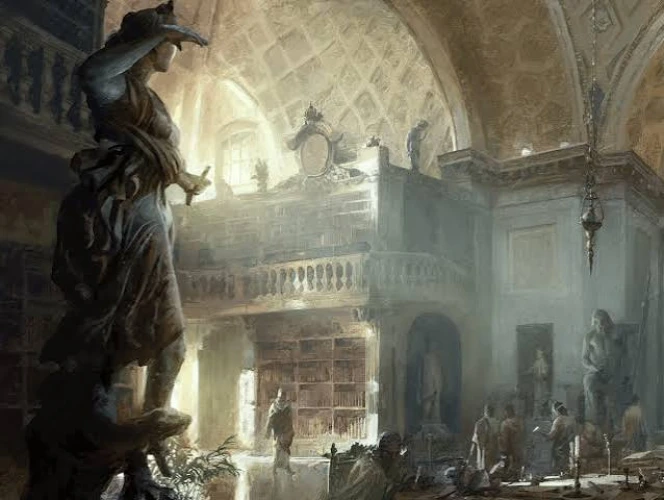
The Library and Mouseion of Alexandria
The ancient city of Alexandria is not only a center of trade and politics but also of intellectual culture. At the heart of this cultural and scientific flourishing is the legendary Mouseion and Great Library of Alexandria. These institutions were among the first research institutes and libraries of universal significance. They were conceived and created in an attempt to gather, translate, study, and preserve all the ancient world’s knowledge. For centuries, they have been gathering the scholars and their findings from all around the Mediterranean who flocked to the city to teach, learn, and find inspiration in the great Mouseion.
1. Foundation and the Early Ptolemies’ Vision
TheMouseion and Great Library of Alexandria were founded under the first Ptolemaic dynasty, during the reign of Ptolemy I Soter and completed by his son and heir, Ptolemy II Philadelphus. After Alexander the Great’s death and the Ptolemaic dynasty’s territorial acquisition, the young ruler understood that to establish his power in the region, he needed not only wealth and warships but also intellectual prestige.
A. The Arrival of Demetrius of Phalerum
Ptolemy I Soter invited the esteemed and clever Athenian philosopher and statesman, Demetrius of Phalerum, to come to Alexandria and develop the first Ptolemaic institutions of learning after his stay in the Lyceum, one of the most famous educational institutions of ancient Greece. Demetrius had also studied under Plato and was a follower of Aristotle. Under Demetrius’ guidance, the Ptolemaic court undertook to create a royal institution of learning that would contain all the known scientific literature and translate all the foreign language writings, including Egyptian, Persian, Jewish, and Indian scripts.
B. Royal Patronage and Large-Scale Funding
The early Ptolemaic rulers lavishly funded the institution to attract renowned scholars and ensure them with royal pensions so that they could pursue their studies without financial worries. Thus, the royal treasury allocated a significant part of the budget to the maintenance and feeding of the researchers employed at the Mouseion.
2. Mouseion: The Sanctuary of the Muses
Mouseion is the sanctuary or temple built over the Muses’ sacred tree. However, it is more than a temple; it is a complex of large-scale research halls, residential houses for scholars, shaded galleries, and lecture theaters. In addition, the Mouseion includes dining halls for the scholars, where they discuss the most pressing scientific, artistic, and philosophical questions of their time. There are also laboratories, lecture halls, and observatories attached to the temple, as well as gardens and a collection of exotic animals showcasing the achievements of the ancient natural history.
A. The Infrastructure and Internal Structure of the Mouseion
Mouseion was strategically located in the city’s royal district, the Basileia, which was surrounded by a wall. There were large residential buildings within the complex, where the scholars could live throughout their studies. Attached to the main temple, there were also gardens, shaded walkways, and public halls for banquets and theater performances. The Mouseion also had laboratories, teaching rooms, libraries, and even a small zoo.
B. The Life and Research Activities of the Mouseion Scholars
The residents of the Mouseion were appointed and hired directly by the Ptolemaic rulers. All the scholars who lived in the institute’s buildings received a substantial allowance from the royal treasury so that they could focus on their research without worrying about a livelihood. The Mouseion was governed by the chief priest assigned by the Ptolemaic dynasty. The academic staff consisted of mathematicians, astronomers, and medical doctors employed at the institute as well as esteemed poets and prose writers. Unlike the traditional academies in the Greek world, the Mouseion did not follow the canons of any particular philosophical school, and its scholars were free to explore and discuss various fields of science, ranging from biology and physics to literature.
3. Great Library of Alexandria: The Collection of the World’s Books
Great Library of Alexandria, which either belonged to the Mouseion complex or had its own buildings attached to the city’s temple of Serapis, possessed the largest collection of papyrus rolls in the ancient world. The library aimed to collect all the existing knowledge in the form of written documents. The Ptolemaic rulers used every conceivable method and means to achieve this goal, ranging from buying scrolls in the markets to stealing books from foreign temples and even bribing local authorities.
A. Aggressive Methods of Book Collecting
The Ptolemaic dynasty’s representatives developed a particular strategy concerning the book collectors and foreign merchants who visited Alexandria’s markets. Great Library of Alexandria has an infamous reputation for burning the unwanted scrolls. When it acquired the first few scrolls, a decree was issued that all the books brought by the merchants to Alexandria should be delivered to the care of theMouseion’s officials.
In order to obtain the manuscripts, the scribes of the Mouseion would make a copy of the document, leaving the original one with the royal library. Besides, Ptolemy III once borrowed the state-owned copies of the most beloved ancient Greek playwrights’ comedies and tragedies, Aeschylus’, Sophocles’, and Euripides’. The Ptolemaic ruler was requested to pay a considerable sum of money as a deposit, yet when the time came, he rejected to return the borrowed scrolls and reimbursed the deposit instead, keeping the masterpieces in Alexandria while returning their copies to the Athenian lenders.
B. Daughter Library at Serapeum
The Daughter Library was founded at the territory of the Serapeum, the temple of Serapis, in order to hold the enormous collection of scrolls, numbering in the hundreds of thousands. Great Library of Alexandria was moved to the western part of the city, making the research process more convenient for the scholars who could not reach the city’s center.
4. The Achievements of Alexandrian Scholarship
TheMouseion and Great Library of Alexandria were the centers of scientific and literary culture. The collection of the finest minds and critical literature review that took place in those institutions produced a list of remarkable achievements.
A. Great Advances in Ancient Literature
The famous scholars and librarians of Alexandria, including Zenodotus of Ephesus, Aristophanes of Byzantium, and Aristarchus of Samothrace, were the first in the history of ancient literature to systematize and collate all the literary works. They compiled the critical editions of the most notable ancient poets and playwrights, beginning with the Homeric songs, epics, and poetry, and the classical drama, including lyric verse and tragedy.
All the three scholars also made the first significant contributions to the developing field of bibliography, arranging the literature in chronological and alphabetical orders and creating lists of conventional topics.
B. The Scientific Discoveries of Alexandrian Scholars
Alexandria became the birthplace of scientific history and the cradle of scientific thought. The ancient natural history, medicine, and astronomy were also significantly advanced in the Ptolemaic dynasty’s capital, producing such remarkable minds as:
Euclid – the great scholar whose geometric treatises were used as the basic textbooks in geometry for more than two millennia;
Eratosthenes – the chief librarian of the Mouseion and the first person to calculate the Earth’s circumference;
Archimedes – the legendary mathematician, physicist, and engineer who invented the water screw in Alexandria;
Herophilus and Erasistratus – outstanding anatomists and physicians who were the first to investigate the human body and the brain’s structure.
5. The Great Library’s Destruction
The destruction and burning of the Great Library’s manuscripts and scrolls is one of the most tragic episodes of ancient history. The cause of the fire, which occurred in Alexandria several centuries ago, has not been established.
A. The Multiple Causes of the Great Library’s Destruction
According to some historians, the library was burned several times in the course of history, namely:
During the Alexandrian War (48 BCE), Julius Caesar’s army set fire to the ships in the harbor, which, according to Seneca and Plutarch’s surviving writings, contained thousands of scrolls;
When Aurelian’s Roman troops laid siege to Alexandria in 272 AD, most of the buildings belonging to the city’s royal quarter had been severely damaged;
When Christianity became the official religion of the Roman Empire, the Serapeum andMouseion temples were closed under the decree of Theophilus, Patriarch of Alexandria, putting an end to their scholarly activities in 391 AD.
Conclusion
The Mouseion and Great Library of Alexandria represent the ancient world’s ambition to learn and preserve the existing knowledge from all the corners of civilization. The Mouseion and Great Library of Alexandria have gathered the finest scholars of their time, who made countless contributions to modern literature, science, and medicine despite being burned by the relentless fires of time.