
 EN
 IT
 ES
 FR
 ZH
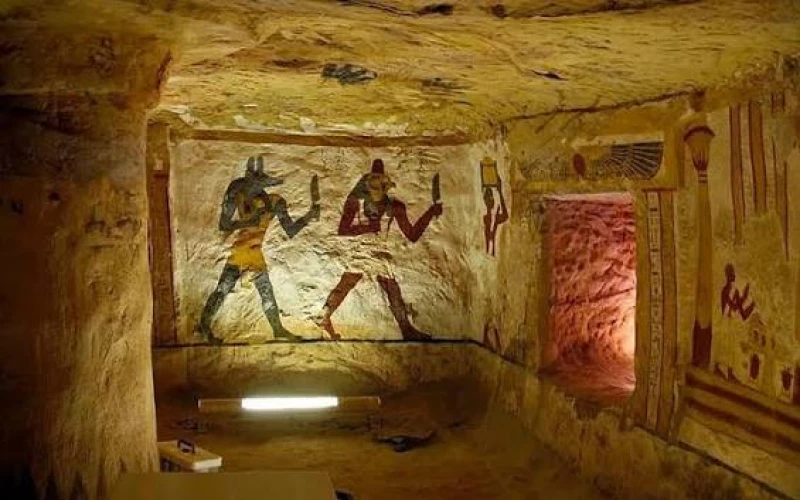
The Golden Mummies Hall in Bawiti: Eternal Splendor in Bahariya Oasis
Nestled in the town of El-Bawiti, which is the centre of government for the Bahariya Oasis in Egypt’s Western Desert, is the Golden Mummies Hall. In 1996 archaeologists discovered the Valley of the Golden Mummies, part of a large Greco-Roman cemetery. Most of the mummies date from the first and second century CE. Having been entombed for almost 2000 years under hot desert sands, the mummies in Bawiti reflect a fascinating fusion of ancient Egyptian religious beliefs alongside Hellenistic and Roman art styles.
1. Valley of the Golden Mummies
Whilst exploring an area around six kilometres south-west of El-Bawiti in 1996, archaeologists were alerted to a sand covered hole, which a donkey had fallen into. Further investigation uncovered a huge underground cemetery with hundreds of rock-cut tombs. Archaeologists then uncovered evidence of a flourishing oasis settlement which had prospered in the Roman Period. It had a successful economy based around farming, date palm growing and producing high quality oasis wine for export around the Mediterranean.
Contrary to previous eras where only pharaohs were allowed to be interred in tombs, individuals from various social classes including rich traders, property owners and members of the priesthood were laid to rest in this cemetery. Those who could afford to do so were dressed in sumptuous clothing. It is thought that there are in fact thousands of tombs in the whole valley, meaning that this is one of the biggest ancient cemeteries yet found in Egypt.
2. Gold and imagery
What is most striking about the mummies in the museum hall is their golden colour. This is created by a type of material called gilded cartonnage. Made from several layers of linen or papyrus strengthened with plaster, this is then adorned with a veneer of gold leaf. To the ancient Egyptians, gold was considered to be the flesh of the gods. As such, it was believed to be indestructible and everlasting. Wrapping a person’s head, torso and feet in gold was thought to transfigure them into a god-like figure able to live eternally with Osiris and Ra.
Alongside their golden colouring, each mummy possesses unique imagery, which represents the social standing and personality of the deceased. Masks include a delicately modelled human visage, with prominent eyes made either from glass or stone. These are often bordered by curly hair and/or the classic three sectioned Egyptian headdress. Furthermore, on the chests of the mummies, artists have illustrated numerous images of various deities. For example, Isis and Nephthys are shown with their wings outstretched, Anubis is depicted caring for the mummy on its bier and the Four Sons of Horus are illustrated watching over the mummy’s internal organs.
3. Roman Bahariya – a fusion of cultures
As you explore the Bawiti museum hall, you can observe a wonderful fusion of two ancient civilisations. Although the fundamental religious motivation behind mummification continued to be based on the ancient Egyptian concept of maintaining a persons body and ensuring their Ka and Ba could live on, there are prominent Greco-Roman visual elements.
As well as classic Egyptian amulets such as the sacred scarab and the Eye of Horus, some mummies are adorned with Roman clothing, jewellery and crowns. Moreover, some have highly naturalistic facial characteristics similar to those seen on the renowned Fayum mummy portraits. This highlights how the multi-cultural oasis society simultaneously recognised their Roman city status and continued to strongly believe in the ancient Egyptian conception of life after death. Apart from the Golden Mummies, the museum also has a range of artefacts such as terracotta statues, ceramics, jewellery and items which were buried with people so they could lead comfortable lives in the afterlife.
4. Preservation and exhibition
Given that mummies in desert tomb environments are highly susceptible to changes in temperature, humidity and light levels, the El-Bawiti mummies are stored in specialised glass display cabinets which provide a controlled environment. After appropriate conservation work had been performed on the mummies’ linen fabric, plaster and gold leaf, a selection of the Golden Mummies was then put on permanent exhibition. Thus, people are able to see the mummies in situ in and around their local area and within the correct geographical and historical context for Bahariya Oasis.
5. Visitor information
Exploring the Golden Mummies Hall in El-Bawiti is key to experiencing the culture of Bahariya Oasis. This can easily be combined with excursions to other popular attractions in the region, such as the Temple of El-Muftella and the Twenty-Sixth Dynasty Tombs of the Nobles at Qaret el-Subi.
The museum hall is centrally situated in El-Bawiti and is readily accessible in the morning or late afternoon. Within the museum, subdued lighting is deliberately used in the galleries to minimise harmful effects of light on ancient artwork and gold. Visitors must not use camera flashes and should not rest against the controlled environment display cabinets. Particular attention should be given to the beautifully painted depictions of deities on the mummies’ chest boards, which effectively link the multi-millennial ancient Egyptian religious practices surrounding mummification with the diverse culture of the Roman world.