
 English
 Italy
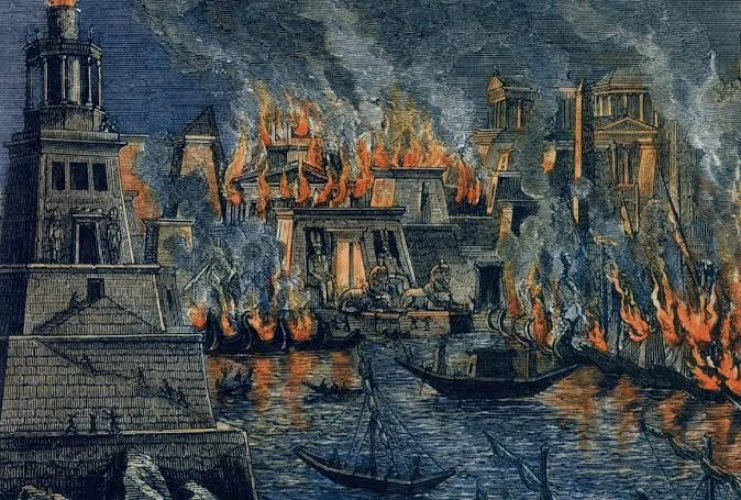
The Foundation of Alexandria
The founding of Alexandria (332 BCE) by Alexander the Great is without a doubt one of the most ambitious and successful projects in the history of humanity. Surrounded by the sea on the west and freshwater Lake Mareotis to the east, this former fishing village has become a center of culture, business, and politics. Alexander’s primary objective was to create a foothold for the Hellenistic culture in Egypt and provide his Empire with a safe maritime passage to the Mediterranean Sea.
While deciphering the origins of Alexandria, it is essential to focus on the specifics of the classical sources. Mainly, historians should pay attention to the real reasons for founding Alexandria, the significance of the Nile Delta for this project, as well as the topography of this city. There are multiple written accounts of this event, ranging from Arrian’s and Plutarch’s histories to the pseudo-historical Alexander Romance.
1. Geopolitical and Strategic Location of the Delta
Long before Alexander the Great conquered Egypt, the northern coast of the Nile Delta was the untouched territory that had the future potential to become an important center of trade and commerce. Yet, the ancient capital of Egypt was located in the heart of the desert along the banks of the River Nile. The cities of Memphis, Thebes, and later Sais or Tanis were the centers of commerce that fed the internal needs of the country, but none of them provided a safe harbor for foreign merchant ships.
A. The Natural Obstacles of the Western Nile Delta
At the time of Alexander’s arrival, the western mouth of the Delta was too shallow to build a deep-water port there. However, the stretch of land opposite to the rocky island of Pharos could provide a shelter for ships from the rough Mediterranean waves. Moreover, the city builders could obtain a steady supply of drinking water from the offsprings of the Canopic branch of the Nile and Lake Mareotis, located not far from the city’s territory.
B. Creating a Safe Passage for the Macedonian Fleet
When Alexander arrived at the western banks of the Nile at the end of 332 BCE, having just defeated the Persian king Darius III in the Levant, he realized that the territory of ancient Egypt was vast enough to be controlled by a single ruler. Yet, it was more important for him to secure a safe passage for his Macedonian fleet through the narrow straits of the western Delta. In doing so, the new city would become the center of commerce and military power for the entire eastern Mediterranean.
2. Legends and Myths About the Origin of Alexandria
It is interesting to note that the most ancient sources contain various myths and legends about the early days of Alexandria’s founding. According to Plutarch’s writings, Alexander was tormented by a nightmare when an old man was reciting Homer’s verse about the city of Pharos. Right after he woke up, he went to the island of Pharos and saw the place where the city could be built.
He also realized that the local village of Rhakotis was too small to become the capital of Egypt. And so, Alexander started marking the borders of the future city with the help of his soldiers. They used barley meal instead of chalk to draw the lines between the city’s district. It is said that the birds flew down to eat this snack food, and so the Alexandrian astrologers interpreted this sign as an omen of the city bringing food to the whole world.
A legend tells us that before leaving Egypt for the Persian Gulf, Alexander wanted to see the oracle of the God Amun. The priest of the God Amun (Ammon) declared that Alexander was not the son of Philip of Macedon, but Zeus Ammon himself. This prophecy cemented the young king’s liking for everything related to Egypt and contributed to his decision to found the city named Alexandria.
3. The Unique Architecture of Alexandria
Unlike the serpentine streets of the ancient Greek city-states, Alexandria’s architecture follows the Hippodamian grid-plan. The first general impression of the city is the regular division of streets at right angles, providing the city with excellent ventilation and drainage. The city was designed by Alexander’s chief architect Dinocrates of Rhodes.
A. The Divine Inspiration Behind the Plan of Alexandria
Dinocrates is famed not only for designing this ancient city but also for his part in the legend about the founding of Alexandria. When Alexander the Great was trying to see the horizon from the Pharos island, he saw the shape of the city, similar to the one described by Homer. Alexander saw how the city’s territory could be divided into districts and marked their boundaries with his soldiers.
B. Dividing the City into Separate Districts
According to Strabo’s description, the city was divided into two or three main parts – the Royal Quarter, the Greek Quarter, and the Native Quarter. The Royal Quarter (Basileia) comprised the largest section of the city (one-third or one-fourth), which housed the opulent palaces of the Ptolemaic dynasty, state institutions, schools, libraries, gymnasia, and temples. The city’s central part, the Greek Quarter or Brucheion, was the administrative and residential heart of Alexandria. The Native Quarter (Rhakotis) was located in the west of the city and accommodated the native village of the local lake-country people, the Serapeum, its native shrines, and later – large-scale commercial enterprises. Besides, there exists a legend about the Jewish Quarter that could be considered a separate division of Alexandria.
4. The Ptolemaic Dynasty and the Development of Alexandria
Right after Alexander the Great built the foundation for the new city, Alexandria started growing rapidly. It is estimated that more than 260,000 residents lived in the city during Ptolemy II Philadelphus’s reign. The early Ptolemaic rulers spent vast sums of money to construct the great Pharos Lighthouse, the harbor, and the City of the Muse. The capital of Egypt turned into a center of science, education, and trade.
To conclude, the foundation of Alexandria was a milestone in the history of the ancient world. Being the first planned city in the history of humanity, Alexandria connected the rich culture of the classical Mediterranean world with the ancient traditions of the Pharaonic kingdom. Thanks to Alexander the Great’s and his court’s efforts, this city has become the symbol of human knowledge and the achievements of the ancient architectural techniques.