
 English
 Italy
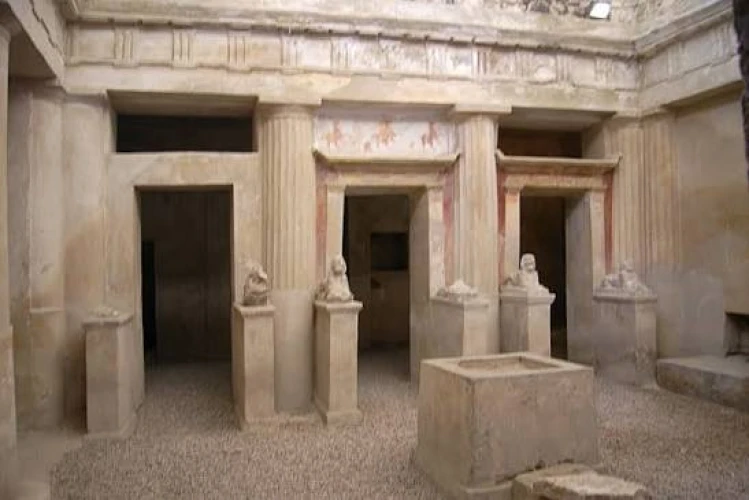
The Cemetery of Mostafa Kamel
The archaeological heritage of Alexandria has many intriguing excavations that throw light on the cultural interaction that characterized the Hellenistic period. However, among the burial sites uncovered in the modern city of Alexandria, the most famous discovery is the Cemetery of Mostafa Kamel. This necropolis was accidentally discovered by the local authorities in the winter of 1933-1934 when excavators were preparing the area to lay the sports football field. The cemetery dates back to around 250 BCE when Ptolemaic rulers were one of the most powerful leaders in Egypt.
1. Discovery and classification of the four rock-cut tombs
The excavation of Mostafa Kamel cemetery revealed four rock-cut tombs built by different architectural techniques. The archaeologists divided them into two main categories based on the location of their findings on the surface of the ground.
A. The first category: tombs partly built above and below the ground
The first four tombs were partly built above and partly cut below the surface. Unfortunately, these two tombs (3, 4) are poorly preserved due to the natural weathering effects and human activity.
B. The second category: completely subterranean chamber tombs
The last two tombs (1, 2) were found entirely below the surface of the ground after being excavated through the calcarenite limestone ridge of the Mostafa Kamel. These two tombs were exceptionally preserved due to the isolation of their location below the surface. Tomb Number 1 is most notable of all as it was discovered to possess an ancient system of water collection and rare painted frescoes.
2. Architectural structure and engineering design of Tomb Number 1
Tomb Number 1 was highly sophisticated as a building designed for both community members who laid their burials for collective mourning and priests who offered ritualistic practices over the dead.
A. Central courtyard surrounded by Doric columns
The entrance to this tomb was framed with a formal doorway that led to a steep staircase carved directly from the stone to the first chamber. In the middle of the chamber’s courtyard, there was a stone altar for the commemoration rituals. Surrounded by a beautiful Doric colonnade, the central courtyard created an open space for mourning rituals around the stone altar.
B. Subterranean burial rooms located around the courtyard
There were many subterranean rooms located around the courtyard that housed the interments:
The Left-hand rooms: located in the left of the courtyard, rooms 2, 3, and 4 were relatively large and honeycombed with several horizontal rectangular niches (loculi) cut out of the walls to hold the bodies and cinerary urns. The room 3 was small in size and only possessed a single loculus.
The Opposite Rooms: directly opposed to the main entrance, rooms 5, 6, and 7 were smaller in size and offered single loculi for the burial practices. Interestingly, the walls of these rooms were still covered with their original plaster decorations that recreated the patterns of different stones with red paint and black dots (simulated granite) and yellow marbling (mimicked alabaster).
The Rear Chambers: located at the back of the inner corridor (corridor number 8), there were also three more rooms: 9, 10, and 11. Rooms 9 and 11 contained multiple burial loculi, while the room 10 was once host to a stone funeral couch (kline).
3. The subterranean water system
One of the most astonishing engineering feats of Tomb Number 1 is its water collection system located in rooms 2 and 3.
A. The water-well and plumbing system
A deep water-well was excavated directly into the stone floor of room 2. On the opposite side of the wall to the water well, there was a carved water basin connected to two smaller holding tanks by baked pottery water pipes located inside the room 3.
B. The purpose of the water system
As soon as the smaller water tanks in the room 3 were filled to the brim, the overflowing water was redirected into a larger underground reservoir tank built directly into the floor of the main courtyard. Such a system helped to provide water under the ground for the drinking water supply for the visitors of the tomb who participated in the commemorative meal and to hold ritualistic water purification for the priests who attended the burial services.
4. Rare horseman fresco and epigraphic graffiti
The fame of the Mostafa Kamel cemetery is primarily due to the rare find of a rare and stunning mural painting discovered above the middle subsidiary entrance (entrance B) leading to the corridor 8.
A. Description of the painted fresco
The three men horsemen on horseback were painted in a brilliant red pigment. Between the horsemen stood two women, dressed in yellow Greek tunics, each having stretched their arm forward facing a nearby offering table. Furthermore, there was a light scratching of several Greek names carved into the wall plaster near the entrance of the room 11. Presumably, it marked either the visitors of the deceased or the interred themselves.
B. The significance of the painted horses in the tomb
The horses depicted are indeed rare finds as horses were not known to the native Pharaonic-Egyptian religious beliefs and iconography. Neither they could be native to the Nile Valley nor were they known to the ancient Egyptians prior to the invasion of foreign powers (the Hyksos). As such, they did not bear any traditional religious or funerary significance to the ancient Egyptian cultural customs prior to the Ptolemaic dynasty. Altogether, there are fewer than ten known ancient or modern Egyptian archaeological findings that depict funerary scenes involving horses.
However, the presence of equestrian imagery in the Mostafa Kamel tomb demonstrates the cultural affiliation of the Macedonian-Greek community who were interred in this cemetery following their military traditions and love for cavalry warfare.
Conclusion
The Cemetery of Mostafa Kamel is an architectural and artistic achievement of the early Ptolemaic Alexandria. Through its completely subterranean chamber constructions, as well as its exceptional engineering and plumbing capabilities, classical Doric colonnades, and rare equestrian frescoes, the necropolis of Mostafa Kamel is still captivating today’s archaeologists. Nevertheless, the ancient city of Alexandria has many intriguing excavations hidden beneath the modern streets as the unique cultural history of its early inhabitants remains a subject of scientific research.