 English
 Italy
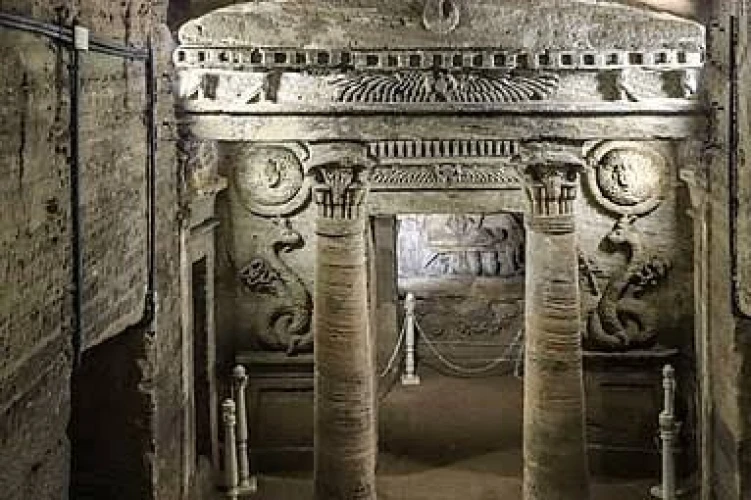
The Cemetery of Kom El-Shoqafa: The Catacombs of Alexandria
The burial grounds of Alexandria are replete with monumental structures, but among the most extraordinary and awe-inspiring finds are the Cemetery of Kom El-Shoqafa, otherwise known as the Catacombs of Kom El-Shoqafa. Situated in the Karmouz district of Alexandria, this subterranean necropolis is among the largest and most impressive Roman-era burial sites in Egypt. Dubbed as one of the Seven Wonders of the Middle Ages, the Kom El-Shoqafa is a breathtaking architectural achievement that encapsulates the convergence of Egypt’s, Greeks’, and Romans’ cultural and artistic legacy. The catacombs stretch out in numerous underground levels carved directly into the bedrock, offering a breathtaking insight into the ancient Alexandria’s religious syncretism, burial practices, and social life.
1. Discover and Etymology
The discovery of the catacombs in the late nineteenth century was accidental, revealing the forgotten ancient treasure buried under the modern-day streets of Alexandria.
A. The Accidental Discovery in the Year 1900
It was long speculated that Alexandria’s western district possessed vast underground burial chambers, but the precise locations remained undiscovered until the early twentieth century. Specifically, on September 28, 1900, a local cart driver’s donkey accidentally fell through a narrow opening in the ground and vanished underground. When the authorities and local archaeologists investigating the site of the fall, they stumbled upon the massive underground complex with hundreds of buried crypts, long inaccessible for the common people.
B. Meaning of the Name Kom El-Shoqafa
The Arabic name Kom El-Shoqafa translates as the “Mound of Shards” or “Mound of Potsherds,” referring to the vast amount of broken ceramics, discarded vessels, and terracotta jars buried under the surface of the underground burial site. During the ancient times, those attending the memorial meals in the tombs would bring their offerings of food and wine in the pottery containers. After partaking in the ritual banquet, it was customary to toss the broken vessels on the ground or even the surface of the catacombs, forming extensive ‘pottery mounds,’ the debris of which later gave the district its name.
2. Subterranean Architecture and Multiple Levels of Burial Chambers
Contrary to the Ptolemaic tombs of simple single-story courtyard and loculus design, the Catacombs of Kom El-Shoqafa were excavated dozens of feet below the surface, reaching numerous underground levels to accommodate hundreds of burials.
A. The Wide Spiral Staircase or Cochlea
The entrance to the catacombs is formed by a wide-spiraled staircase, otherwise known as the cochlea, which leads the visitors and/or mourners deep underground. The further the visitors go down the staircase, the darker the underground corridors and chambers become. This spiral structure was a masterpiece of its time, featuring wide, open windows or light shafts cut into the rock wall to let the sunlight beam deep into the underground corridors.
B. Three Levels of Burial Chambers
The excavators drilling downwards discovered three levels of vaulted burial chambers, interconnected by staircases, but the lowest one is currently flooded with water from the nearby Lake Mareotis and the Mediterranean Sea:
The Upper Level served as a rotunda and a reception area offering viewfinders of the central burial chambers and a grand banquet hall.
The Middle Level was the administrative and religious heart of the underground complex, housing the grand triclinium or banquet hall, the central burial chamber, and beautifully carved relief sculptures depicting Egyptian and Greco-Roman gods.
The Lower Level is currently inaccessible to visitors due to the water infiltration from the nearby saltwater lakes, but it is hypothesized that it accommodated the additional sarcophagus niches, water channels, and cisterns.
3. The Triclinium and the Funerary Banquet Hall
Perhaps one of the most unique and notable features of the Kom El-Shoqafa catacombs is the Triclinium or the banqueting hall.
A. Architecture of the Banquet Room
The triclinium is located on the middle level of the underground complex, near the rotunda and connected to the main central burial chamber by a rectangular doorway. The rock-cut banqueting hall features three long stone benches (klinai) along the three walls, decorated with cushions, and (presumed) mattresses made of stone. Three stone tables stood in front of the benches, offering foods and wines to the feasters.
B. Cultural Significance of the Feasting Hall
The funerary banqueting hall is a unique feature of the Roman-era necropolis, signifying the Roman belief that death did not mark the end of life or relationships. The family members and free men from the neighborhood would honor the burial of a dear one, as well as the life they shared together by organizing a public feast ( perideipnon or refrigerium). This commemorative meal, during which the mourners and guests at the table would lay down wine libations and talk to the deceased from the outside, was held in the triclinium, turned into an open-air subterranean banquet hall.
4. Religious Syncretism and Cultural Fusion
The artistic and religious motifs found in the catacombs depict the perfect synthesis of the Greco-Egyptian beliefs, which were further enhanced and adopted by the Romans.
A. Main Burial Chamber and Cultural Convergence
Upon entering the main burial chamber of the catacombs, one cannot help but notice the large-scale sarcophagi and beautifully carved wall reliefs. The architectural facades of the burial niches’ doorways feature typical Greek pediments, triglyphs, and metopes, but each of the three doors depicts distinct ancient Egyptian motifs such as the winged sun disk, sacredcobra (ureus), falcon, and lotus flowers.
B. Anubis, the Jackal-Headed God of the Underworld
The most famous motif of religious syncretism depicted in the Kom El-Shoqafa catacombs is the image of Anubis, the jackal-headed god and the guardian of the mummy of the dead. Anubis is shown wearing the typical Roman armor consisting of a leather cuirass and boots, standing on either side of the central burial chamber’s entrance, holding keys and symbols of eternity in his arms and legs. Anubis as a jackal-headed protector is a distinctly Egyptian motif, whereas Roman elements include the military-style clothing.
C. Serpent, the Medusa, and Other Cultural Motifs Depicted in the Catacombs
The Agathodemon serpent, a symbol of good fortune, protection, prosperity, and a plentiful harvest, is depicted in the catacombs of Kom El-Shoqafa as the guardian deity of the underground necropolis. The mythical serpent wears the double crown of the Upper and Lower Egypt (pschent) and is entwined with the thyrsus staff of Dionysus, typically associated with the Greek culture. The classical protective amulet, the head of the Medusa, was also commonly carved above the doorways to protect the buried dead or the living from the evil spirits.
Conclusion
The Cemetery of Kom El-Shoqafa serves as a primeval masterpiece of the funerary architecture and artistic achievements of the ancient civilizations. Discovered by an accidental fall of a donkey in the early twentieth century, the catacombs of Kom El-Shoqafa comprise numerous subterranean levels and burial chambers carved directly into the bedrock, offering the visitors a unique insight into the religious practices and cultural traditions of the ancient Egyptian, Greek, and Roman peoples. From the wide-spiraled staircases and subterranean banqueting halls to the unique jackal-headed Anubis and the protective serpents, the Kom El-Shoqafa catacombs are truly a sight to behold.