
 English
 Italy
Italy
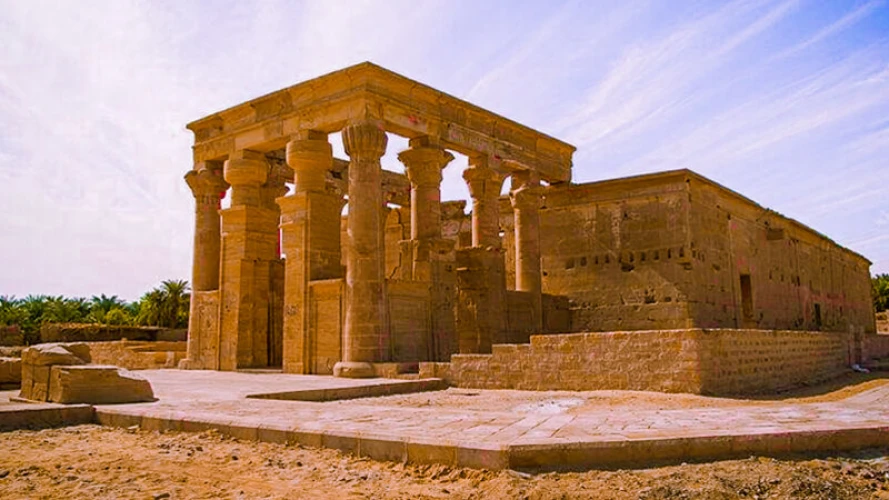
Temple of Hibis
The Temple of Hibis is ancient Egyptian temple, found in the Kharga Oasis, within the New Valley Governorate. It stands, as one of the most remarkable and historically weighty archaeological sites in Egypt’s Western Desert. But what makes it actually special is its survival— it is the only, relatively complete temple left in Egypt that goes back to the Persian Period, so it becomes an invaluable monument, which tells a rather distinct episode of cultural blending.
Geographical Location and Strategic Importance
This temple is, sort of, placed about two kilometers north of Al-Kharga city. Long ago, the Kharga Oasis was not simply some isolated desert stop, it was actually a useful junction, on the famed Darb el-Arbain, the so-called Forty Days' Road. That caravan trade route linked the Nile Valley with Darfur in Sudan, so it mattered more than people might assume, at first glance. Because of that strategic location, Egypt’s successive rulers—starting with native pharaohs and then later foreign conquerors—kept putting heavy attention on guarding and improving the oasis. The idea was to shield Egypt’s western frontiers and at the same time stimulate commerce, not just “survive” out there. Also, the name “Hibis” comes from the ancient Egyptian word “Hebet,” and it translates as “the plow,” which points toward how fertile and productive the area was in antiquity period.
History and Dynastic Origins
History and dynastic origins kinda—well, it starts at the Temple of Hibis being laid down, more or less, in the Saite Period, and that is during the reign of King Psamtik II of the 26th Dynasty ( around 590 BC). Still, most of the actual building , the architectural broadening, and those careful, intricate relief scenes were finished later, during the Persian time in Egypt. Then the Persian King Darius I, often called Darius the Great, took it upon himself to rebuild and then add decoration to the temple in the 27th Dynasty. And there was a deliberate political reasoning behind it too, basically to secure the goodwill of the Egyptian people. Darius I apparently decided to keep the local customs intact. On the temple walls he had himself shown wearing the traditional gear of an Egyptian Pharaoh, performing offerings and sacrifices to native divinities, in order to make his rule feel truly legitimate. After that, in later centuries, the Ptolemaic and Roman periods kept layering on extra changes. Different rulers added modifications , bigger ceremonial entrances, and the surrounding enclosures, so the whole site starts to look like an architectural ledger, a timeline of sorts, stretched across multiple historical epochs, yeah.
Architectural Design
Built wholely from local sandstone, the temple keeps to a kind of classic , linear plan you see in New Kingdom sanctuaries, stretched out on an east to west axis. The whole compound feels like it is made of a few main structural bits that connect in sequence, even if, at times, the order can look a little less neat. The Ancient Quay and Sacred Lake: The trip toward the temple would begin at a harbor quay perched on the border of an ancient lake (now dry and gone), and this spot functioned as the kickoff for ceremonial processions. The Avenue of Sphinxes: A ceremonial walkway about 100 meters long, lined on both sides with ram-headed sphinxes, all of them linked to the god Amun. It is one of those long processional routes that kind of sets the tone right away. The Outer Gateways: The temple includes three huge gateways, made across different periods: the Roman Gate, the Ptolemaic Gate, and the Persian Gate. On them you can read Greek and Roman inscriptions, recording administrative decrees, local regulations, and even the taxation system for the oasis. The Hypostyle Hall: Inside, there is a grand hall holding 12 massive circular columns. These columns support the roof, and people note that their composite floral capitals are especially varied, with carvings that recreate papyrus and lotus plants in a finely detailed way. The Sanctuary (Holy of Holies): The inner most and also most sacred corner, where the cult statue of the main deity was kept. The walls there are completely clad with miniature religious reliefs, hundreds of Egyptian divinities, all shown in dense and careful detail.
Religious meaning and pretty unique reliefs
The Temple of Hibis was mostly kept for the Theban Triad: Amun-Ra (the King of the Gods) , Mut his consort, and their son Khonsu (the Moon God). Still, even with this main purpose , the place sort of acted like a pantheon, honoring many deities, brought in from all over Egypt. Inside, the wall surfaces work like an illustrated encyclopedia of ancient Egyptian religion. One of the more well known and distinctive carvings is the depiction of the god Set: The Relief of Set: In many later times, people in the Nile Valley often treated Set as a force of chaos and ruination, but at Hibis he comes off as a heroic guardian. He is portrayed thrusting spears into the serpent Apep (the person of cosmic disorder) in order to safeguard the bark of the sun god Ra. This scene suggests that, for the desert oasis dwellers, Set was not just fierce but also kind, a protective power who kept them safe from the brutal dangers of the wild. Also, the temple includes uncommon scenes where the personified nomes, or provinces of Egypt , bring offerings. And there are long , rare liturgical hymns plus prayers carved right into the stone.
Preservation and Restoration Efforts
In the late 20th and early 21st centuries, the Temple of Hibis got hit with a serious danger, mostly because the water table was rising, due to agricultural runoff from nearby farms. That excess dampness then caused the whole place to shift , with walls cracking, columns starting to sink ,and salt crystallizing in places it shouldn’t ,all of which quietly began eating away at the old reliefs. Seeing just how huge the site’s global heritage value is, the Egyptian Ministry of Antiquities pushed forward a big engineering and rebuilding program. The rescue work basically involved a few main things, like Separating the temple from groundwater by injecting the ground with stabilizing materials, and setting up a newer drainage network. Taking apart the columns and walls that were no longer stable, strengthening their foundations, then putting them back together again using exact architectural methods and fit. Removing the salt residue from the walls, and also locking in the original pigments of the reliefs, so the colors could endure rather than fade. After years of careful, patient effort, the Temple of Hibis was finally brought back in terms of structural strength and it reopened to the public. Nowadays, the Temple of Hibis is still this breathtaking witness to how Egyptian civilization lasted , absorbed , remade, and protected history, even while it sat inside desert sands that never really stop changing.





-webp.webp "Hilton")
-webp.webp "dusit")
-webp.webp "Marriott Hotels")
-webp.webp "Azimut Hotel")
-webp.webp "Golden Tulip")
-webp.webp "sheraton")
-webp.webp "westin hotel")
-webp.webp "Movenpick")