
 English
 Italy
Italy
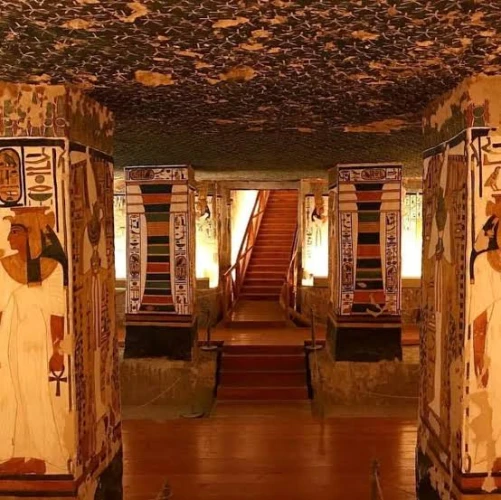
Ta-Set-Neferu: The Place of Beauty and Sacred Royal Tombs
The Valley of the Queens: The Sacred Sanctuary of Royal Women and Divine Children
Just a bit south of the well known Valley of the Kings, kind of tucked away in a calm, sun soaked desert ravine on the west bank of the Nile at Luxor, there sits The Valley of the Queens (Wadi el-Malekat). The ancient Egyptians called it Ta-Set-Neferu, which was basically “The Place of Beauty”, and it was this secluded burial ground that held the last resting places of the great royal wives, queens, princesses, princes and the higher status people from the New Kingdom royal line (about c. 1550–1069 BC).
Even if it often gets overshadowed by its bigger neighbor, the Valley of the Queens still contains some of the most emotionally moving, artistically polished, and honestly jaw dropping underground tombs ever made by people. It feels like a lasting monument to the deep influence, the spiritual function, and that always present elegance of ancient Egypt’s royal women.
Below is the full account of the Valley of the Queens, meaning its sacred geography, how it changed across dynasties, the architectural marvels inside it, and then of course the incomparable tomb of Queen Nefertari.
1. Sacred Landscape: Why the Valley Was Chosen
The choice of Ta-Set-Neferu for royal burials was basically driven by deep religious meaning, plus a few natural features that seemed to connect with rebirth and protection and so on.
About the Sacred Grotto and Hathor
That ravine has this pretty striking rock scene at the western end , with a natural cut or cleft in the mountain cliffs, kind of like it was waiting to be read.
Cosmic Womb: During those rare desert rains, water would come down through that natural cleft, then spill into the sacred grotto beneath. Ancient Egyptians seemed to read this as a real, physical sign of Hathor’s divine womb, and Hathor is usually described as the goddess of love, motherhood, and the western mountains, yes.
Maternal protection: Placing royal wives and small children inside a valley guided by Hathor meant, in their view, that the goddess would mother them in a tangible way, nourish them, and also escort their spirits safely into that eternal rebirth found in the afterlife.
2. Historical Evolution: From Princely Burials to Royal Queens
The valley was never used only for queens right from the beginning, in fact it sort of changed its job, over centuries, through the 18th 19th and 20th Dynasties.
The 18th Dynasty: A resting place for nobles and princes
In the early New Kingdom, the place was mainly chosen by important officials, people connected to the royal court, and also for young princes and princesses :
Simple Shaft Tombs: At first these graves had basic vertical entrances, that went down to small chambers cut in plain rock, no real decoration on the walls.
Child Princes: A few young royal children who passed away too early from sickness or infection were placed here, with toys, personal jewelry , and little miniature furniture around them.
The 19th and 20th Dynasties: The golden era of queens
Later, around the time of Pharaoh Seti I and Ramesses II, the valley turned into the official burial ground, and yes it was basically reserved for the Great Royal Wives (Hemet Nesut Weret). The architects took those earlier simple shafts and turned them into impressive underground complexes with many chambers, covered in beautiful wall scenes, religious writings in careful detail, and also heavy stone sarcophagi.
3. The Crown Jewel: The Tomb of Queen Nefertari (QV66)
No digression about ancient Egyptian art or archaeology really feels complete without QV66, that so called legendary tomb of Queen Nefertari, the beloved Great Royal Wife of Ramesses II (“Ramesses the Great”) .
It was found in 1904 by the Italian archaeologist Ernesto Schiaparelli and Nefertari’s tomb is generally treated as the topmost summit of ancient Egyptian tomb painting, sometimes described as the “Sistine Chapel of Ancient Egypt” even though people keep talking about it like it’s something totally unbeatable.
Words of Love Cut in Stone
Ramesses II was genuinely devoted to Nefertari, he built her a magnificent temple at Abu Simbel next to his own, and then he carved a sorrowful dedication into her tomb walls, basically saying: “My love is unique—no one can rival her, for she is the most beautiful woman alive. Just by passing, she has stolen my heart.”





-webp.webp "Hilton")
-webp.webp "dusit")
-webp.webp "Marriott Hotels")
-webp.webp "Azimut Hotel")
-webp.webp "Golden Tulip")
-webp.webp "sheraton")
-webp.webp "westin hotel")
-webp.webp "Movenpick")