
 English
 Italy
Italy
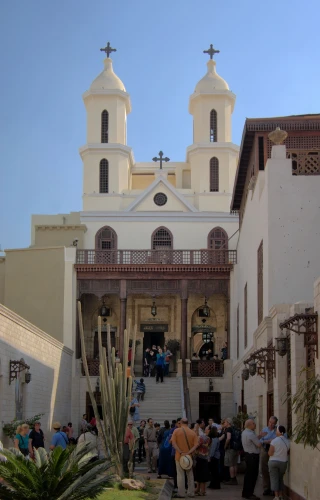
Suspended in Time: Inside Cairo’s Famous Hanging Church
The Hanging Church of Cairo: History, Architecture & Visitor Guide
Hidden, in the tight cobblestone alley ways of Old Cairo, sits one of the more remarkable sacred stops in the Middle East: the Hanging Church , or Al-Mu'allaqa. It is dedicated to the Virgin Mary, and this ancient Coptic sanctuary has held on through more than fifteen centuries of political shifts, imperial collapses and the usual city reworking.
What really makes it stand out isn’t only the spiritual gravity, or its collection of rare Christian art—it is the engineering thing that you feel literally under your feet. Instead of the usual heavy stone churches that are sunk deep into the earth, the Hanging Church is, in a manner of speaking, suspended, and hangs above the ground level.
Below you’ll find the full background, the unusual architectural story, and a practical travel guide for visiting Cairo’s well known “floating” sanctuary.
1. Why Is It Called the "Hanging" Church?
The Arabic name Al-Mu'allaqa kind of means “The Suspended” or maybe “The Hanging,” it’s a direct translation, sort of.
During the late Roman period, Emperor Diocletian expanded this huge stone citadel, it’s called the Babylon Fortress, and it sat along the eastern bank of the Nile. Much later, when Coptic builders went to create the church, they didn’t exactly clear away the fortress rubble. Instead they used the very top of the Roman gatehouse towers as a sort of base, or foundation, if you will.
The church’s main nave goes across the gap between two old stone bastion towers, it sits about 6 meters, (20 feet) above ground. So when you walk down the nave now, you’re essentially passing over open space that once was guarded by Roman legionnaires. In the 19th century, a glass panel was placed in the floor, so visitors could look straight down into the hollow fortress passage that runs beneath the altar.
2. A Timeline of History: When Was It Built?
Pinpointing an exact year for the origin of the Hanging Church is tricky, since it kind of grew by stages across multiple centuries, more or less. In other words, there isn’t one clean “start date” you can point at and be done with it.
Early beginnings (late 3rd to 4th century AD): A local Coptic tradition says that a small chapel first existed on this site as early as the late 3rd or the early 4th century. The place was treated as sacred because, according to Christian belief, the Holy Family (Mary, Joseph, and the infant Jesus) looked for shelter in this same part of Old Cairo during their flight into Egypt.
7th century rebuilding: The first structural form that we can actually document for the current basilica is from the late 7th century, tied to Patriarch Isaac (690–692 AD). So, it’s not just a legend at that point, there’s a more concrete timeline.
11th century papal seat: For centuries the seat of the Coptic Orthodox Pope stayed in Alexandria. But as Cairo became the political center of Egypt during the Fatimid Dynasty, Pope Christodoulos (1046–1077) transferred the papal seat to Cairo. After that move, the Hanging Church became the main residence and also the ceremonial hub of the Coptic Pope.
3. Architectural Highlights You Can't Miss
Inside, the Hanging Church kind of, diverges sharply from what you usually see in typical European stone cathedrals. It mixes the usual Early Christian basilican plan with quite distinct Coptic and Islamic visual arts, not in a neat way but in a blended sort of manner.
The Noah’s Ark Ceiling
When you enter and you can look straight up, do it. In the central nave the high wooden roof is built with dark timber beams that are curved so they look like the inverted hull of Noah’s Ark, and it acts like a symbolic reminder of safety, and salvation, floating above the waters of life.
The Marble Pulpit (Ambon)
Near the middle of the nave there is a bold 11th-century marble pulpit, held up by 13 slender columns. Each column stands for someone from the New Testament. One column represents Jesus Christ, carved in clear white marble, twelve columns for the Apostles, and one darker column stands for Judas Iscariot.
The Ebony and Ivory Iconostasis
Between the congregational nave and the main altar there are three detailed wooden screens, basically iconostasis. They’re made from dark ebony with carved geometric patterns set in ivory inlay. These screens go back to the 12th and 13th centuries, and they show master-level Coptic craftsmanship, the kind that looks careful even when you only glance at it.
Rare Religious Icons
In the church there are more than 110 historic icons. The best known is an 8th-century icon nicknamed the “Coptic Mona Lisa,” showing the Virgin Mary holding the infant Jesus, alongside Saint John the Baptist. Her eyes seem like they follow you no matter which angle you pick, like you’re not really escaping her notice.
4. How to Visit: Practical Travel Info
Going to the Hanging Church is pretty easy, calm, and it can be slipped into almost any Cairo travel plan without too much thought
1. Getting there by metro: Cairo Metro Line 1
Take the Cairo Metro until Mar Girgis Station (Coptic Cairo). Once you come out of the station platform, you will see the entrance courtyard of the Hanging Church complex right across the street
2. Up the entry stairs: 29 steps to reach the doorway
Go through the outer courtyard gate, then climb the grand staircase of 29 steps. You’ll be walking along an elevated path, and it takes you by mosaics that show events from the Holy Family’s stay and travels in Egypt
3. A respectful entry, and what to wear : Etiquette & Attire
Admission is totally free. Since it’s a living house of worship, modest clothing is welcomed (covered shoulders and knees). Inside, you can photograph without flash , and that’s basically it






-webp.webp "Hilton")
-webp.webp "dusit")
-webp.webp "Marriott Hotels")
-webp.webp "Azimut Hotel")
-webp.webp "Golden Tulip")
-webp.webp "sheraton")
-webp.webp "westin hotel")
-webp.webp "Movenpick")