
 English
 Italy
Italy
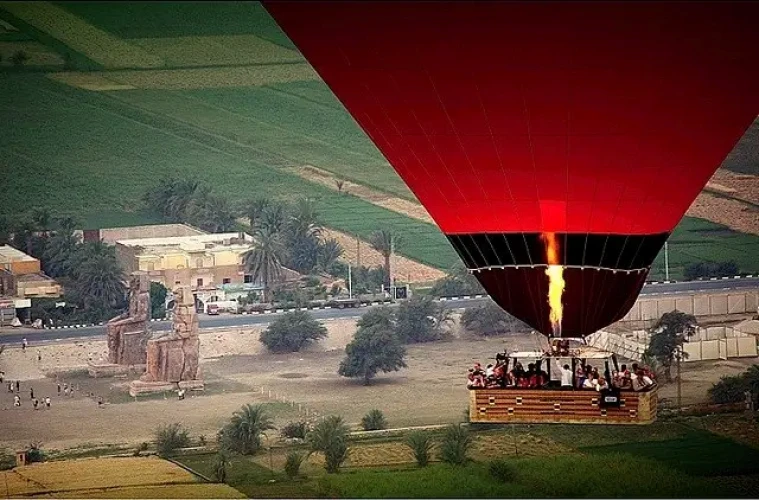
Sunrise Over the Valley of the Kings: The Best Views From the Sky
Sunrise Over the Valley of the Kings: The Best Views From the Sky
There is a magic in watching the sun come up over a place that has seen thousands of years of people living and working. When you go up in an air balloon in Luxor you are not just seeing a beautiful view of the land—you are flying above the open-air museum of ancient Egypt.
The East Bank of Luxor is known for its town and big temples that are still used today like Karnak. The West Bank is the place of forever of kings and of places where people were buried. As your balloon moves softly over the sand and the fields where people grow food you see a view from high above that most people who walk on the ground never get to see.
Here is a look, at the places and the beautiful views you will see when you fly over the Valley of the Kings and the famous West Bank of Luxor at sunrise.
1. The Valley of the Kings and Surrounding Mountains
The thing that really excites people who love history is getting a look at the limestone mountain area that covers the Valley of the Kings.
From Above: When you are thousands of feet up in the air you can clearly see the pyramid-shaped mountain called Al-Qurn (The Horn) which ancient Egyptians picked as the natural protector over the royal burial places.
The Perspective: Even though you can't see inside the tombs from, up high looking down at the wide desert valleys where Tutankhamun, Ramses the Great and other pharaohs were placed gives you a strong sense of why this hidden empty place was selected as their secret forever homes.
2. The Mortuary Temple of Queen Hatshepsut
One of the architecturally stunning sights in all of Egypt is the Mortuary Temple of Queen Hatshepsut at Deir el-Bahari.
From Above: Carved directly into sheer limestone cliffs this multi-tiered colonnaded temple looks majestic and surreal from a hot air balloon.
The Perspective: Seeing the contrast between the pale golden cliffs and the clean geometric lines of the ancient terraces is a photographers dream. From the air you can truly appreciate how the temple mimics the horizontal lines of the desert landscape, around it.
3. The Colossi of Memnon
Guarding the approach to the ancient necropolis stand the Colossi of Memnon—two massive stone statues of Pharaoh Amenhotep III that have stood sentinel for over 3,400 years.
From Above: from high, in the sky these towering twin statues command your attention rising boldly out of the surrounding flat fields.
The Perspective: Spotting them from above helps you realize how massive they truly are and how much the surrounding landscape has changed around them over the millennia.
4. The Ramesseum and Ancient Temple Ruins
Across the West Bank many mortuary temples stand. These mortuary temples were built by pharaohs. They were made to honor the legacies of those pharaohs.
From Above: You will glide past the remains of the Ramesseum, which's the grand memorial temple of Ramesses II. You will also see archaeological digs.
The Perspective: From the air you can see fallen statues. You can also spot mud-brick storerooms. You will notice the excavation grids. These grids look like a jigsaw puzzle, from above. This view gives you a sense of how vast ancient Thebes really was.
5. The Golden Contrast: Green Fields vs. Endless Desert
Beyond the monuments one of the most striking visual highlights of a Luxor balloon flight is the natural geography itself.
The Nile’s Lifeline: As the sun breaks over the horizon it hits the emerald- strip of agricultural land fed by the Nile River. Farmers can often be seen working their fields or tending to animals just as their ancestors did thousands of years ago.
The Desert Transition: In a matter of seconds your eyes travel from vibrant green crops directly into the endless golden wind-swept sand dunes of the Western Desert. This sharp line between life and barren desert is uniquely breathtaking, from the sky.
Tips for Getting the Best Photos of the Landscape
Wait for the Golden Hour: The 15 minutes after takeoff provide the softest and warmest light. This is when the desert sands and limestone cliffs glow orange and pink.
Look Down: Don't just look at the horizon! Looking down into the rural villages, palm groves and narrow irrigation canals gives a wonderful glimpse into everyday modern Egyptian life.
Use a Wide-Angle Lens: If you are using a DSLR or a smartphone, with a -wide lens use it to capture the vast expanse where the green valley meets the desert mountains.
Final Thoughts
Drifting quietly above the Valley of the Kings at sunrise connects you to the past in a way that walking through a museum simply cannot match. I have found that the Valley of the Kings, at sunrise shows the scale of ancient civilization and the timeless beauty of the Egyptian landscape.
If you are heading to Luxor make sure your camera is charged and your eyes are peeled for the wonders waiting below you in the morning light!





-webp.webp "Hilton")
-webp.webp "dusit")
-webp.webp "Marriott Hotels")
-webp.webp "Azimut Hotel")
-webp.webp "Golden Tulip")
-webp.webp "sheraton")
-webp.webp "westin hotel")
-webp.webp "Movenpick")