
 English
 Italy
Italy
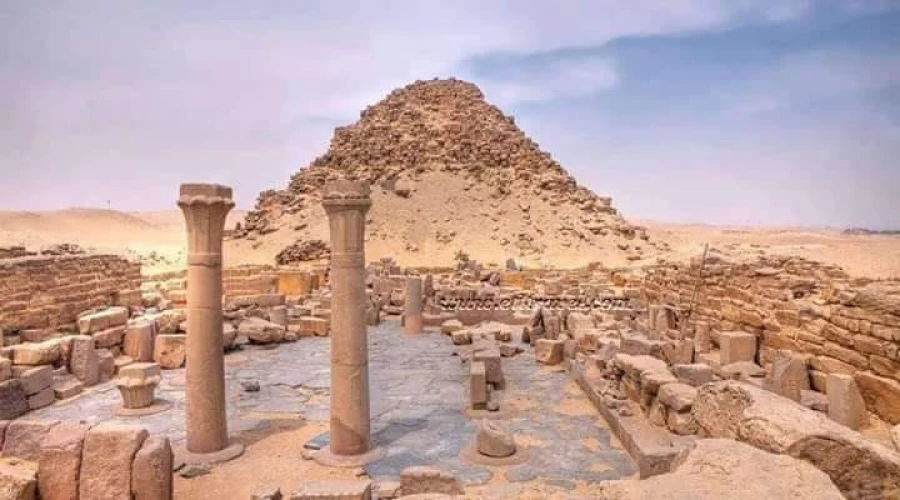
Solar Theology, Papyrus, and Bas-Reliefs: Inside Egypt’s Fifth Dynasty at Abusir
Abusir: The Forgotten Pyramid Complex of the Sun Kings
When people think about ancient Egypt’s royal pyramids, the mind pretty much goes right away to the towering , polished sights of the Giza Plateau. Still, just a few kilometers south of Giza, tucked quietly between the bustling Saqqara site and the palm groves of Northern Egypt, there is this unusual and much less mentioned royal necropolis: Abusir.
“ The House or Temple of Osiris ”, in ancient Egyptian (Per-Osir), Abusir became the official royal burial ground for the pharaohs of the Fifth Dynasty in the Old Kingdom (c. 2494–2345 BC).
Now, the Fifth Dynasty rulers could not really match the huge stone mass , or the sheer physical magnitude of Khufu or Khafre’s Fourth Dynasty pyramids. But they did something else, and honestly it matters a lot. They led a kind of deep artistic, architectural, and spiritual shift. Egypt’s national attention moved away from raw volume of stone, toward better sculpted relief scenes, unusual building materials, intricate temple arrangements, and, above all, the intense, almost obsession level worship of the sun god Ra.
So this is the full account of Abusir, its bold sun kings, the refined pyramid complexes, the sun temples, and why this calm archaeological treasure really should hold a central place in Egypt’s royal story line.
1. The Dawn of the Fifth Dynasty: A Theological Shift
To understand why Abusir was built, you kind of have to notice the religious transformation that swept Ancient Egypt around 2494 BC, near the end of the Fourth Dynasty, not just the politics.
In the time of Khufu and Khafre, the pharaoh was seen almost entirely as a living god on Earth, a huge guiding power, who could organize the nation’s whole economy to raise a private stone mountain. But then, by the rise of the Fifth Dynasty, the theological weight started moving, toward the priesthood of Heliopolis, the old cult-place of the sun god Ra.
So the pharaoh was not only a god in a human body, he also took on formal language and identity. They added the title “Son of Ra” (Sa-Ra), a royal designation that stayed permanently inside the names of Egyptian pharaohs for the next two thousand years or so.
And because of that new solar focus, Pharaoh Sahure looked for a place that matched the shift, and he left the crowded Giza Plateau behind, choosing instead a scenic limestone ridge above a natural lake at Abusir, like it just fit better.
2. The Royal Pyramids of Abusir
Unlike the solid limestone cores of Giza, the pyramids at Abusir were made using a slightly different engineering approach, kinda— and the whole idea is that it wasn’t the same construction logic. The inner cores were assembled with rough, locally quarried limestone blocks, they were bound together with mud mortar, and then later encased in an outer shell of fine, smooth, white Tura limestone.
Since local quarrymen, and later medieval builders, stripped away that high quality outer casing for building materials, the internal mud and rough stone cores slowly collapsed over the centuries. That’s why the Abusir pyramids have that distinct, mound like look you can see today. Even so, their surrounding temples are still among the best ever built, really.
The Major Royal Monuments
The Pyramid of Sahure: the pioneer of Abusir, you know. Back when his pyramid stood it had a modest original height around 47 meters, (154 feet) but still his mortuary and valley temples were richly decorated with more than 10,000 square meters of carefully carved painted bas-reliefs, showing royal fleets , foreign trade expeditions and divine rituals.
The Pyramid of Neferirkare Kakai: the largest monument at Abusir maybe, it was first planned a kind of step pyramid and later reshaped into a true pyramid that originally reached 72 meters (236 feet). It is widely known among archaeologists because it produced the Abusir Papyri—these are the oldest surviving administrative documents from the Old Kingdom Egypt, somehow.
The Pyramid of Niuserre Ini: the ruler who finished the big architectural alignment at Abusir. Niuserre linked his own complex to the older causeways and temples from earlier kings, so everything felt tightly unified, like one royal necropolis instead of separate parts.
The Pyramid of Neferefre: left unfinished , because the young king died suddenly. The remains were reworked into a square mound like mastaba tomb, and that is why it became a solid treasure cache for archaeologists who later found royal statues and wooden artifacts.
3. The Sun Temples: Sanctuaries of Golden Light
Maybe the most standout contribution of the Fifth Dynasty pharaohs in Abusir is that they introduced something almost brand-new in stone and layout, kind of an architectural idea really : the Sun Temple.
Now, regular mortuary temples were basically built for the king’s afterlife ceremonies only, y’know strictly that. Sun Temples though were huge open air places, sanctuaries in a way, meant for the everyday veneration of Ra. Some historical records say six kings of the Fifth Dynasty set up Sun Temples. Yet, only two have actually been found by today’s archaeologists. So, there is that gap, and it’s not a small one.
The Sun Temple of Niuserre at Abu Ghurab
Just north of the main Abusir pyramid zone, at Abu Ghurab, stands the astonishing Sun Temple of Niuserre.
The Squat Obelisk: Rather than the usual tall and skinny needle shaped obelisk, the highlight here was a massive, squat stone obelisk set on top of a high but truncated pedestal, sort of like a built-in focus point to catch and direct the sun’s rays.
Open-Air Altar: Facing the pedestal there was a large carved alabaster altar. It is made from four stylized versions of the hieroglyph for “peace” or “offering” (Hetep), arranged around a central circular disk that stands for Ra.
Solar Boats: In the same spirit as the Great Pyramid at Giza, these Sun Temples also carried big mudbrick representations of solar boats, symbolizing Ra’s routine passage across the sky each day.





-webp.webp "Hilton")
-webp.webp "dusit")
-webp.webp "Marriott Hotels")
-webp.webp "Azimut Hotel")
-webp.webp "Golden Tulip")
-webp.webp "sheraton")
-webp.webp "westin hotel")
-webp.webp "Movenpick")
