
 English
 Italy
Italy
Sohag’s Hidden Treasures: A Guide to the White and Red Monasteries of Upper Egypt
The White Monastery and Red Monastery: Egypt’s Forgotten Christian Wonders
When people map out a historical trip through Egypt, their routes tend to turn into this same sort of well-known thing. You know, stare at the Great Pyramids of Giza, drift along the massive pylons of Luxor, and then wander around the island sanctuaries of Aswan. Still, tucked near Sohag in Upper Egypt, way off the usual stream of tour buses there are two monuments that feel both unusual and hard to forget, almost like they were waiting quietly in the shade.
They’re called the White Monastery, Deir al-Abyad, and the Red Monastery, Deir al-Ahmar. These paired 5th-century sanctuaries are often described as a high point for early Egyptian Christianity. Even though thousands of travelers pass not far from Sohag every single day, mostly on the way between Cairo and Luxor, very few stop to realize that these complexes still hold monumental ancient structures and, yes, the most lively, completely restored early Byzantine wall paintings that are still known to survive anywhere in the world today.
So if you’re into history, you care about architecture, or you just want Egypt’s quieter side, here’s a deeper, no shortcuts kind of look at these overlooked Christian marvels.
1. The White Monastery: Ancient Pharaonic Grandeur Meets Desert Faith
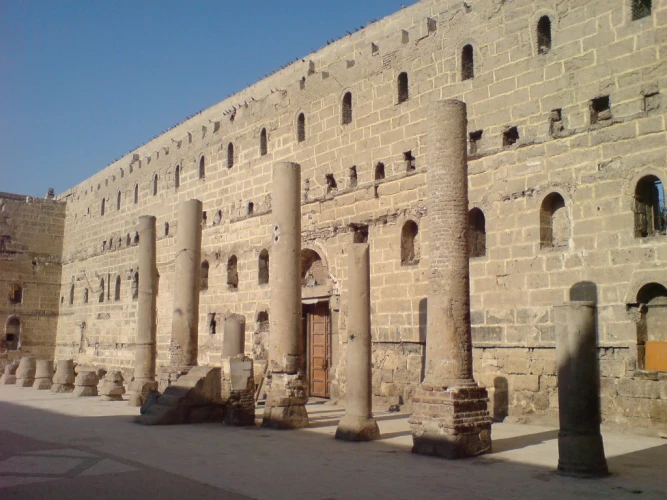
Some eight kilometers to the west of Sohag, the White Monastery comes up starkly out of the desert like it was set there. It was founded around 400 CE by Saint Pigol, then later expanded by his nephew, the well known Coptic reformer Saint Shenouda the Archimandrite. Altogether, the complex served for a time as an administrative center for a huge monastic network, one that supported thousands of monks and nuns, more or less like a small city.
Why it feels a bit like a Pharaonic temple
What hits you first is the exterior wall, and yeah it really looks heavy, almost like a declaration. The enclosure was built with bright white limestone blocks, many of which were reused from nearby ancient Pharaonic structures. Its angled outer walls, plus the weighty stone cornices, give the whole place the same visual idea as a dynastic temple, at least from the outside.
And honestly, that choice wasn’t only practical. A thick fortress like boundary kept the community safer from desert raids, but the sheer scale also carried a message, too. It signaled the growing strength of Coptic monasticism in Late Antiquity, as if the monastery was announcing itself without saying a word.
The Legacy of Saint Shenouda
Inside these stone walls, Saint Shenouda helped make Coptic into a major literary language, and somehow even more than that. He wrote long rules , sermons, and administrative letters, which shaped what became one of the largest libraries in the Christian East. Even if a lot of the original, sprawling city-like complex has crumbled with time, the magnificent central church sanctuary is still there, still used as a living place of worship.
2. The Red Monastery: A Mind-Blowing Explosion of Ancient Color
Just three kilometers north of the White Monastery there is its sister sanctuary, the Red Monastery. It was named for the burnt red bricks used during its construction, and it was founded by Saint Pshoi in the 5th century, more or less.
While the White Monastery tends to impress visitors mostly with its exterior scale, the Red Monastery kinda hits you from the inside. It gives an inward experience that leaves (almost) every historian and art restorer speechless , like they forgot how to speak.
The “Sistine Chapel” of Late Antiquity
Inside the main church you’ll find a three-lobed (tri-conch) sanctuary, covered from floor to ceiling in brilliant, multi-layered Late Antique paint. For a long time, those walls were darkened by soot from cooking fires, candle wax residue, and desert dust. Basically, the masterpieces were hidden, all quietly underneath.
Then, thanks to a multi-year, careful conservation effort led by the American Research Center in Egypt (ARCE), working alongside Coptic restoration specialists, centuries of grime were lifted away. What shows up underneath is hard to describe, it feels like a miracle:
Complete Architectural Painting: every column, niche, arch, and dome is dressed in vivid geometric patterns, floral bands, and architectural trompe l’œil ideas.
Sacred Imagery: the apses hold astonishing depictions of Christ in Majesty, the Virgin Mary nursing the infant Jesus, angels, and early church fathers, with glowing golden halos that almost seem to breathe.
Unmatched Preservation: unlike many European churches where early medieval frescoes were repainted, or damaged beyond recognition, the Red Monastery preserves the only nearly complete interior paint scheme of a Late Antique church across the entire Mediterranean basin.
3. Why These Wonders Were Forgotten (and Why That’s Changing)
Given their impressive, historical weight and that kind of artistic aura, why dont the White and Red Monasteries get the same buzz as Saint Catherine’s or the Valley of the Kings?
For quite a few decades, in the late 20th century, Middle Egypt kind of slipped past most international tour operators. Not because people never heard of it, but mostly because of logistical issues and not enough tourism infrastructure. Meanwhile, Luxor and Aswan kept growing , with river ports that could handle the world and luxury hotels that attracted everyone. Sohag, on the other hand, stayed sort of out of the main tourist loop.
Still, things are changing now. There is a clear revival in motion: better highways, improved security, the opening of the new Sohag National Museum, plus international acclaim for the Red Monastery restoration. So these places are slowly coming back into focus for travelers who are picky , historians, and art lovers alike.
Practical Tips for Visiting Sohag's Monasteries
Getting There, sort of: Sohag is pretty reachable by train from Luxor, about 2.5 to 3 hours north, or from Cairo. If you want it easier, you can also set up a private day excursion with a driver plus a guide, and start it from Luxor.
Pairing it with the Sohag National Museum: Try to merge your monastery time with a visit to the recently opened Sohag National Museum along the Nile shore. It keeps rare pieces from the Pharaonic, Coptic, and Islamic periods, so it kinda makes the whole experience connect.
Dress code and manners: These places are living worship sites, and there are Coptic monks who actually live there. Go with modest clothing, like covering shoulders and knees, and before you take photos inside any active prayer chapel, just ask permission first, ok?





-webp.webp "Hilton")
-webp.webp "dusit")
-webp.webp "Marriott Hotels")
-webp.webp "Azimut Hotel")
-webp.webp "Golden Tulip")
-webp.webp "sheraton")
-webp.webp "westin hotel")
-webp.webp "Movenpick")
