
 English
 Italy
Italy
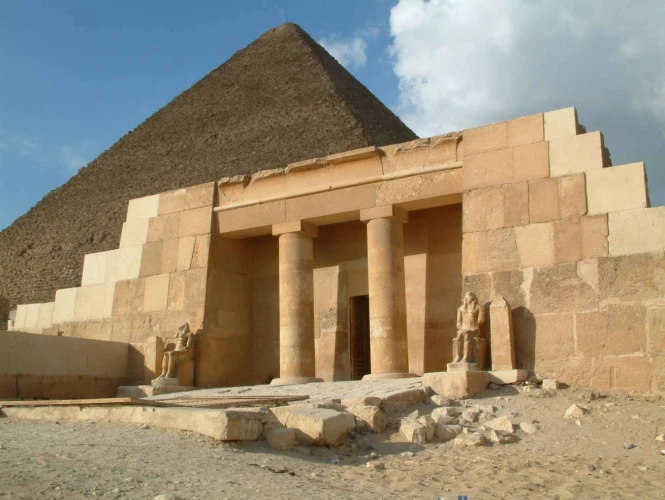
Purification, Granite, and Genius: Inside Khafre’s Valley Temple at Giza
The Valley Temple of Khafre: Ancient Egypt’s Unsung Architectural Miracle
When travelers step onto the wind-swept sands of the Giza Plateau, their eyes naturally soar up toward the sky, drawn to the looming peaks of the Great Pyramids and the majestic outline of the Sphinx. But tucked quietly at the base of the plateau, right beside the paws of the Great Sphinx, there sits a building that holds some of the most jaw-dropping masonry work ever done by people: The Valley Temple of Khafre.
Built in Egypt’s Fourth Dynasty of the Old Kingdom (c. 2558–2532 BC) for Pharaoh Khafre, who is also linked with building Giza’s Second Pyramid, this Valley Temple had a sacred, almost hard-to-pin-down purpose. It acted like a ceremonial gateway into the wider pyramid complex— the sacred place where the king’s body was refined, embalmed, and readied for his long journey into eternity.
Sure, the pyramids grab attention with sheer scale, yet the Valley Temple still steals the moment with refined luxury, raw engineering power, and a kind of architectural balance that feels impossibly precise. So here is the whole story of this silent granite fortress, its sacred purpose, the astonishing construction methods, and the timeless treasures uncovered inside its walls.
1. The Gateway to Eternity: What Was a Valley Temple?
To really appreciate the Valley Temple, you kinda have to get a feel for how an Old Kingdom pyramid complex worked in practice. A pharaoh’s tomb wasn’t just one pile of stone, it was a thoughtfully arranged, connected ceremonial space with four main parts that all did different work, but still felt like one whole thing :
The Pyramid : the final tomb and the spot for resurrection, sitting up on the plateau.
The Mortuary Temple : a temple placed right against the eastern side of the pyramid, where daily offerings could happen.
The Causeway : a long covered stone passage , basically a ramp linking the high mortuary temple down toward the valley.
The Valley Temple : the starting point, located at the edge of the Nile’s old flood plain.
The Sacred Rituals
When Pharaoh Khafre passed away, his royal funeral procession went down the Nile by boat, and it docked at a harbor straight in front of the Valley Temple.
Then, within that shaded , cool stone sanctuary, priests carried out older sacred practices that mattered a lot :
Purification : the king’s body was washed with sacred Nile water, and also treated with natron salt.
Mummification : the careful preserving process stretched out for more than 70 days, give or take.
The Opening of the Mouth : a sacred ceremony done on the mummy, sometimes on royal statues too , meant to bring the pharaoh’s perceptions back in a way , so his Ka could eat, drink , breathe, and speak in the afterlife.
2. Cyclopean Architecture: Engineering with Giant Granite Blocks
Walking into the Valley Temple today feels a bit, remarkably different, honestly from visiting most other monuments in Egypt. The architecture comes across as almost too modern for its age, with minimalist design everywhere—clean lines, square pillars, polished stone and, no carved hieroglyphs on the interior walls either.
And yet what really leaves modern architects and engineers speechless, is not only how it looks, but the sheer size and weight of the stones that were used to make it all happen.
The Megalithic Core
The core walls of the Valley Temple are built from huge blocks of local Giza limestone. These aren’t ordinary building pieces—many of them land somewhere between 50 and over 100 tons each. Just to make it feel real, one 100-ton block is roughly the same mass as 60 modern automobiles.
The Aswan Red Granite Casing
For protection and also for the visual finish, ancient masons lined both the interior and the outside walls with polished red granite blocks. These heavy slabs were quarried near Aswan, then moved more than 800 kilometers down the Nile River, using large wooden barges.
Precision in a puzzle- like way
The granite blocks weren’t treated like simple square units. Instead, the builders planned multi-angled, interlocking joints, with stone wrapping around corners like jigsaw pieces. This locked-in technique made the temple close to earthquake-resistant, so it could remain largely whole for over 4,500 years.
Joints that barely admit air
The seams between those giant granite blocks are fitted so tightly, that even a razor blade, or a thin strip of paper can’t really slide into the gap, not in any meaningful way.
3. Light, Shadows, and Alabaster: Inside the Inner Sanctuary
Stepping out of that bright Egyptian desert sun and slipping into the Valley Temple is this odd , transformative kind of moment. Inside, there’s a T-shaped main hall, held up by 16 huge square pillars, all made of red granite, standing in this grand colonnade, like they’re quietly posing for centuries.
Playing with Light and Shadow
The builders made the roof from heavy granite slabs, but they left those narrow slant slots near the top edges of the walls. Then as the sun kept drifting across the sky, thin strips of golden sunlight would slice through the deeper dark. For a while the polished floor lights up , while the rest of the hall stays in this atmospheric twilight, somewhat like a restrained dream.
The Alabaster Floor
The whole floor in that T-shaped hall was paved with smooth polished slabs of creamy white calcite alabaster. Put side by side, the dark reddish-pink granite pillars, the pale alabaster ground, and those dramatic rays of sun all combine into something breathtaking, almost heavenly. It was meant to bring to mind the primeval mound of creation, you know, that first rise from the beginning of things.





-webp.webp "Hilton")
-webp.webp "dusit")
-webp.webp "Marriott Hotels")
-webp.webp "Azimut Hotel")
-webp.webp "Golden Tulip")
-webp.webp "sheraton")
-webp.webp "westin hotel")
-webp.webp "Movenpick")