
 English
 Italy
Italy
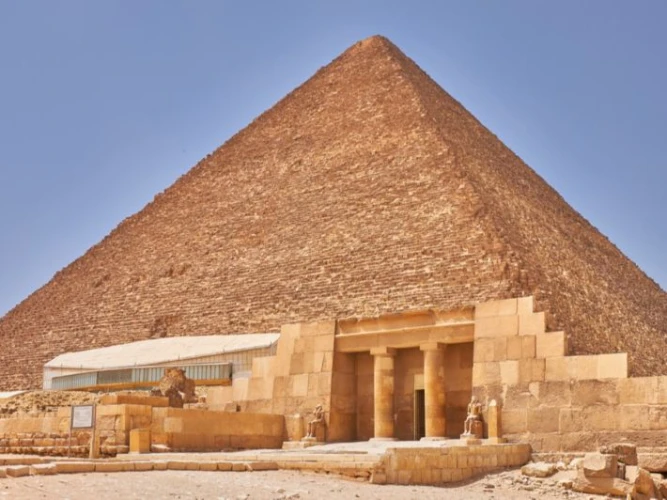
Precision, Granite, and Genius: How the Great Pyramid of Giza Was Built
The Great Pyramid of Giza: Humanity’s Greatest Architectural Marvel
Of all the magnificent wonders left behind by the ancient world, somehow only one is still here after the test of thousands of years, virtually intact: The Great Pyramid of Giza.
It rises, pretty dramatically above the Giza Plateau on the western bank of the Nile, as this towering mass of stone was commissioned around 2560 BC by Pharaoh Khufu (to the ancient Greeks he was known as Cheops), the second ruler of the Fourth Dynasty in Egypt’s Old Kingdom.
For more than 3,800 years, the Great Pyramid carried the undisputed title of the tallest human-made structure on Earth— a claim it held on to until the Lincoln Cathedral spire was completed in England in 1311 AD. Beyond its staggering height, the monument stays like an eternal emblem of human ambition, mathematical exactness, and engineering virtuosity.
Here’s the full account of the Great Pyramid, including its royal builder, the staggering construction logistics, its sacred internal chambers, and the mysteries that still keep scientists looking and wondering even now.
1. The Heir to a Golden Legacy: Pharaoh Khufu
To grasp how the Great Pyramid could happen , you sort of have to zoom in on Khufu’s background. Khufu was the son of Pharaoh Sneferu, that famed master builder who raised the Meidum, Bent , and Red Pyramids at Dahshur.
Over many decades, with trial runs, structural missteps, and steady invention, Sneferu’s people got really good at quarry work , moving, and stacking massive stone blocks with a dependable 43-degree tilt. So when Khufu took the throne, he didn’t come empty handed. He inherited an extremely wealthy realm, a pretty stable political order, and a seasoned crew of master architects, stone cutters, plus logisticians who actually planned everything.
Khufu basically poured the whole kingdom’s strength into one jaw-dropping mission: he took his father’s hard-won architectural breakthroughs and scaled them up, turning them into a monument that was unmatched in showing royal authority and divine resurrection.
2. Engineering by Numbers: Mind-Boggling Statistics
Honestly, the sheer scale of the Great Pyramid feels hard to grasp unless you actually look at the raw architectural data, or you try to picture all those numbers in your head even a little:
Massive weight: the whole thing is believed to be made from about 2.3 million limestone and granite blocks, and together they come out to something like 6 million tons total.
Individual block weight: on average, each limestone block is around 2.5 tons, but the heavy granite beams that cover the King’s Chamber clock in at roughly 25 to 80 tons each—these were hauled over 800 kilometers from Aswan, which is honestly wild.
Original height: it originally stood about 146.6 meters tall (481 feet), yet wind erosion and the loss of the top capstone, the pyramidion, have brought the height down to around 138.5 meters (454 feet).
Base footprint: the base sprawls across an enormous footprint of roughly 13 acres (53,000 square meters), with each side measuring approximately 230 meters (755 feet) ,so yeah, it’s not “small” in any normal sense.
Unmatched geometrical precision
What really trips up modern architects is the math-level accuracy that was achieved without modern computers, laser levels, or steel machinery:
True cardinal alignment: the four main sides line up almost exactly with True North, South, East, and West, with a microscopic margin of error of under 1/15th of a degree.
Level base: the four corners of the gigantic base are level to within less than 2.5 centimeters (1 inch) across the entire 13-acre site.
Golden ratio and pi: the pyramid’s proportions naturally reflect major mathematical constants, like Pi and the Golden Ratio, and that points to a pretty deep ancient Egyptian geometric know-how, not just rough guessing or simple trial and error.
3. Debunking the Myth: Who Built the Pyramid?
For generations, popular culture, and Hollywood films sort of promoted the myth that the Great Pyramid was erected by hundreds of thousands of brutalized slaves, working under a whip, like it was some kind of moving theater scene.
Then archaeological excavations, led by Dr. Zahi Hawass and Dr. Mark Lehner at the Lost City of the Pyramid Builders near the Giza site, have basically managed to knock down that story, entirely, or at least in a very clear way.
A Paid, Honored Workforce
The Great Pyramid was built by a skilled group of roughly 20,000 to 30,000 paid Egyptian craftsmen, stonemasons , carpenters, and seasonal agricultural workers who provided effort during the yearly Nile inundation, not something forced, or random
Royal Provisioning: Animal bone remains show that the workers ate high-quality meat (beef, sheep, and goat) day after day, and also received solid medical care for injuries, rather than being left to just suffer.
Permanent Tombs: Workers who died while construction was still underway were granted honorable burials in stone tombs directly next to the royal pyramid a privilege that was strictly forbidden for slaves, not just “unusual” but genuinely off limits.
National Pride: Building the king's tomb was treated like a sacred civic duty, it was seen as ensuring national wellbeing, plus spiritual support from the gods, in other words it was pride, not punishment.





-webp.webp "Hilton")
-webp.webp "dusit")
-webp.webp "Marriott Hotels")
-webp.webp "Azimut Hotel")
-webp.webp "Golden Tulip")
-webp.webp "sheraton")
-webp.webp "westin hotel")
-webp.webp "Movenpick")