
 English
 Italy
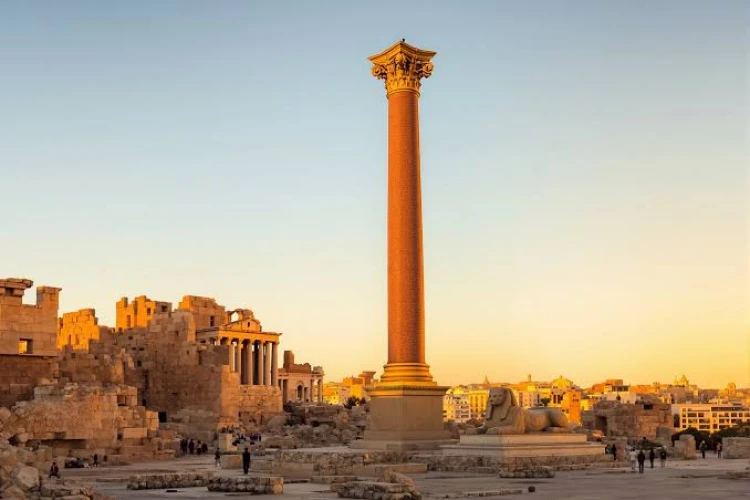
Pompey's Pillar: The Monumental Monolith of Alexandria
Standing proudly on the rock-hewn site of the ancient Serapeum in Alexandria, Pompey’s Pillar is one of the best-preserved and most recognizable ancient Roman edifices in Egypt. This immense monolithic column rises over twenty-five meters high from a rocky promontory in the modern Karmouz district, dwarfing everything around it. While the medieval pilgrims and knights who first laid eyes on it mistakenly attributed it to Pompey the Great, the general of Caesar’s republican legions, it was actually built as a monument celebrating Emperor Diocletian’s victory by his eponymous prefect at the end of the 3rd century AD. The pillar’s striking dimensions, the intriguing history of its discoveries, the Latin inscriptions on its base, and the monumental Roman-Egyptian complex in which it once stood are all worthy of further discussion.
1. The Pillar’s Dimensions and Architectural Techniques
Pompey’s Pillar is not only historically precious but also remarkable in its architectural features. Namely, it is the largest triumphal monolithic column built outside the capital cities of Rome and Constantinople.
A. Shaft
The most notable feature of this ancient construction is its large, single block of pink-red granite serving as the central core of the monument. The pillar’s height is 20.46 m, while the bottom diameter is 2.71 m. With the addition of the base and the capital, the overall height of Pompey’s Pillar reaches 26.85 m. According to researchers, the weight of the massive granite shaft alone is estimated at 285 tons.
The transportation of this large block of granite from Aswan down the river Nile to Alexandria and its further installation on top of a large foundation using ancient cranes, scaffolds, and ropes is hard to be imagined.
B. Foundation, Base, and Capital
The pillar was constructed on a stepped foundation and a cube-shaped block and surmounted by a magnificent capital decorated with acanthus leaves. The total height of the foundation, the base, the granite shaft, and the capital together amount to 26.85 m. According to some historical sources, the top of the pillar was crowned with a colossal bronze statue of Emperor Diocletian, which was later stolen and disappeared.
2. Uncovering the Origins of Pompey’s Pillar
It is not surprising that until the middle of the 19th century, the origins of this large monolith were unclear to many researchers. Scholars used to believe that Pompey’s Pillar was built either by Pompey the Great himself or by Julius Caesar or even King Solomon. However, a greek inscription discovered on the western side of the lower base of the pillar changed the assumptions about the origins of this ancient construction. This inscription was made by the Roman prefect of Egypt at the time and revealed the true purpose of the monument.
A. Greek Inscription
This inscription was directed to the most revered emperor of the late Roman state, Diocletian. It is stated that the pillar was built in honor of him as the “most just Emperor, the bestower of Alexandria” and that it was donated by Postumus, the Roman prefect of Egypt:
“To the most just Emperor, the tutelary deity of Alexandria, Diocletian the invincible,
Postumus the prefect of Egypt [dedicates this].”
B. The Siege of Alexandria and Postumus’s Edicts
The date of the construction of Pompey’s Pillar may also be associated with the events of the Siege of Alexandria that occurred in 296 AD. According to some scholars, this military campaign led by the Roman emperor Diocletian ended victoriously in 297 AD. After that, the emperor enforced several decrees aimed at re-establishing order in the Alexandrian province, which had witnessed a severe revolt led by Domitius Domitianus.
In particular, to mark his victory and the re-establishment of Roman authority in this rebellious city, as well as to address the urgent needs of the starving Roman capital, Diocletian authorized the Roman prefect of Alexandria, Postumus, to build a large-scale triumphal monument within the sacred Serapeum grounds and to resume the export of Egypt’s surplus grain to the capital.
3. How Did Pompey’s Pillar Get Its Name?
As mentioned above, Pompey’s Pillar takes its name from Pompey the Great, the Roman general and politician of the late republic period. However, there is no connection between this ancient monument and Pompey, the rival of Julius Caesar, who was murdered in Egypt in 48 BC.
A. Medieval Myths and Legends
It was not until the Middle Ages that the ancient pillar acquired its current name. At that time, the region was periodically visited by European crusaders and merchants who were familiar with the local historical sites. However, they were unable to find the simple rock-hewn tomb in which Pompey’s severed head was buried after he was killed in Egypt. After seeing the isolated monumental pillar on the outskirts of Alexandria, medieval tourists assumed that this large monolith was actually the Alexandrian mausoleum of Pompey the Great.
B. Late 19th Century Discoveries
Nevertheless, the correct identification of this ancient construction was made much later, in the 19th century, when the Greek inscription on the lower base of the pillar was discovered. Despite the provenance of this inscription, which indicates that Pompey’s Pillar was actually built in the 3rd century AD in honor of Emperor Diocletian, the name of the medieval founder stuck to the monument. Thus, it continued to be popular in the 20th century among not only scholars but also ordinary travelers who visited this ancient wonder.
4. The Serapeum Monastery Surroundings and the Pillar’s Discoveries
Pompey’s Pillar is not a solitary wonder; it is the largest edifice of a large temple complex, whose remains can still be seen in Alexandria.
A. The Temple of Serapis
In the Roman period, the pillar stood within a large peristyle courtyard of the Temple of Serapis, facing the huge staircase leading to the temple. When the Serapeum was dismantled and burnt by the Christian zealots and Roman authorities in 391 AD, this immense monument could not be destroyed due to its sheer size and stability. It has survived the wrath of the early Christians simply because the ordinary locals lacked the equipment and the effort to dismantle such a large structure in their narrow streets. Therefore, it continued to rise proudly above the skyline of Alexandria for centuries.
B. Excavations and Other Monuments
Several interesting finds made by modern archaeologists in the vicinity of the pillar further confirm the grandeur of this ancient construction. In particular, two enormous cisterns, two underground vaults, and a large number of other Roman-Egyptian artifacts were found built into the complex around the pillar. In addition, two pink granite sphinxes with Pharaonic cartouches sculpted on them were discovered in the tunnels. These ancient statues were brought to Alexandria from Heliopolis to decorate the Ptolemaic and Roman Serapeum.
Conclusion
This ancient marvel of the world rises proudly over the modern skyline of Alexandria, being a symbol of the city. Despite being mistakenly associated with Pompey the Great, this large monolith was built in the late 3rd century AD in honor of Emperor Diocletian, who managed to re-establish order in the rebellious Alexandria. Built from a single block of granite, this large pillar complex reaches over twenty-six meters in height and serves as a reminder of the ancient Roman splendor.