
 English
 Italy
Italy
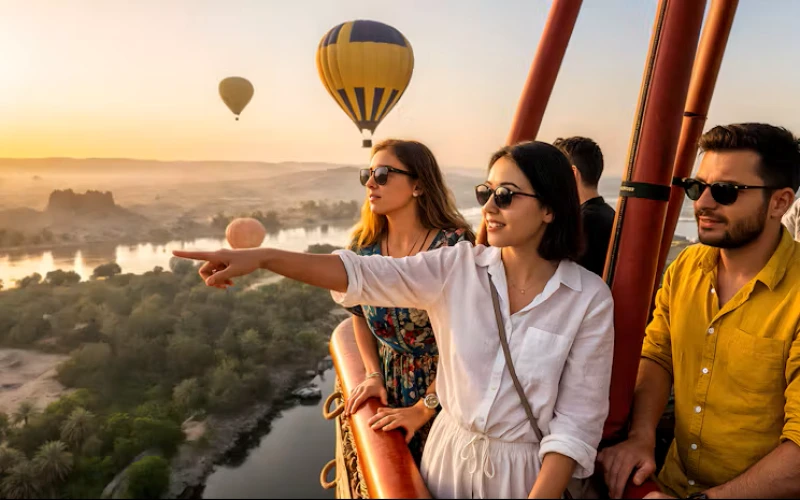
Photography Guide: How to Snap Epic Photos from a Luxor Balloon
Photography Guide: How to Snap Epic Photos from a Luxor Balloon
Rising thousands of feet above the ancient sites of Luxor at dawn is truly the ultimate dream of a photographer. You have lighting for golden hour, breathtaking desert scenery, the snake-like Nile river, and the colorful sight of hot air balloons flying across the skies at dawn.
But shooting pictures from a swaying basket while it is still pre-dawn presents its own set of hurdles. How do you prevent your photos from being blurry despite the poor lighting conditions? How do you frame an ancient monument without having several other baskets in your shot? And how do you secure your camera and equipment at such a great height?
The following is your step-by-step guide to taking amazing photographs while aboard the Luxor hot air balloon ride.
1. Pre-Flight Preparation: Gear and Settings
Even before getting into the basket, a tiny amount of equipment preparation will give you much less to worry about during the actual flight.
Do Not Overpack (Keep It Light): Avoid bringing a bulky camera backpack with five various lenses. The space in the shared basket is limited, and mid-flight lens changes are hazardous (drop a lens – it will never come back). Choose either one flexible zoom lens (for example, 24-70mm or 24-105mm), or simply use a smartphone.
Rule #1 (No Exceptions) (Use a Strap): No matter what camera or smartphone you use, put on a wrist strap or neck lanyard. Trying to find a good angle for the picture while leaning over the basket edge with your hands can be rather slippery, and the phone falling down will not survive the desert landing.
Camera Settings Preparation: In case you decide to take photos with the camera, set up a relatively high shutter speed (not less than 1/250s) to deal with the natural sway of the basket. Be attentive to the ISO setting while the sun rises.
2. Mastering the Pre-Dawn and Blue Hour Shots
The adventure kicks off before sunrise, and some of your most atmospheric pictures will be taken on the launch site.
Take the Inflation Glow Picture: As the crew inflates the balloons using the loud blasts of fire from the propane blowers into the giant nylon balloons, position yourself away and take a picture looking upwards. The balloons glow from within like large glowing lanterns against the dark indigo sky. Take the photo in portrait mode or night mode because of the contrast between the bright fire and dark ground.
The Boat Ride Over the Nile: Stay prepared with your camera during the boat ride over the Nile. The reflection of the dark sky in the still water, along with the faint glow of the pre-dawn city lights, provides a good landscape shot.
3. Composition Tips for Aerial Photography
After takeoff and sunrise, everything is all about composition. Here are some shots to try out using different angles:
Inclusion of Foreground Objects: For your photos to feel more three-dimensional and add a sense of scale, compose your pictures so that the edges of the basket and the colorful balloons surrounding you are in one of the corners. Landscape photographs taken directly overhead may not be so good because they will lack something.
The Contrast Between Green and Gold: Find the point where the emerald green agricultural land ends and the hard yellow cliffs begin. You will get the most dramatic view by taking a photo straight down or with just an angle.
Shadow and Texture: While the sun rises above the Eastern mountains, the sun creates long shadows on the canyons and old monuments such as Hatshepsut’s Temple and Colossi of Memnon. Be ready to capture the texture of the limestone cliffs.
4. Dealing with Smartphone Challenges
Travelers take everything on their phone cameras, which is ideal for this type of journey because of multi-lenses.
Lenses Switching: Use your ultra-wide lens (0.5x) if you would like to capture the incredible size of the horizon, the curvy Nile, and a few balloons hovering above. Use your main lens or 2x/3x zoom if you want to focus on certain landmarks down below, such as village roads or ancient temple ruins.
Focus by Tapping and Decrease Exposure: It may be very difficult to focus on the bright sky during sunrise while taking pictures, but tapping on the picture will help adjust the exposure correctly. The sky will be too bright, and the earth too dark; therefore, you need to tap on the bright desert or horizon, and decrease exposure a little bit to get that beautiful gold and orange tone.
Reflections Warning: If you shoot through a tiny gap in the basket or plastic parts of it (but mostly baskets are woven open), be careful about possible reflections from your clothes.
5. Managing the Heat and Movement
Watch Out for the Burner: When the guide pulls the ignition cord on the propane burner, it sends out an enormous burst of heat directly over you. Not to worry; it won't harm your cellphone or camera, but keep in mind that it may affect any glasses and hat you are wearing and might blow them off.
Just Be There, Too: It is so easy to look at your glass screen or even your viewfinder throughout the 45-minute ride. After taking some photos of your wide shots and landmarks, put down your camera and gaze up with your naked eyes.
The Bottom Line
Taking breathtaking pictures in a hot air balloon at Luxor does not need professional equipment; all that is required is a steady hand, a good wrist strap, and the ability to see the beauty in the contrasting green valley of the Nile and golden desert. Charge your batteries the previous night, delete everything on your phone, and get ready for the best travel pictures ever!





-webp.webp "Hilton")
-webp.webp "dusit")
-webp.webp "Marriott Hotels")
-webp.webp "Azimut Hotel")
-webp.webp "Golden Tulip")
-webp.webp "sheraton")
-webp.webp "westin hotel")
-webp.webp "Movenpick")