
 English
 Italy
Italy
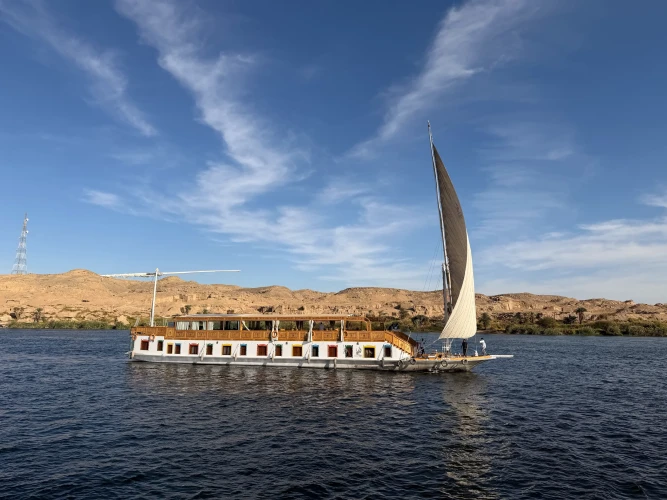
Philae to Karnak: A Day-by-Day Itinerary for Sailing from Aswan to Luxor
Aswan to Luxor Nile Cruise: What You’ll See Each Day
Going sailing downstream along the Nile River from Aswan to Luxor is kinda one of those super iconic travel moments in the whole world. As your boat glides along northward with the river doing most of the work, you end up watching Egypt’s magnificent scenery change, like between lush green palm groves and those stark sun soaked desert hills.
And yeah, compared to riding by bus or train, a Nile cruise feels like you get a front row view, or maybe front seat to five thousand years of living history. You sort out your things just once in your floating cabin, then you step up onto the open-air sun deck and suddenly ancient temples, rural villages, and that timeless river atmosphere are just passing you by.
The downstream trip from Aswan to Luxor usually takes 3 nights and 4 days. Since you are traveling with the river’s current, it tends to move a bit quicker than the upstream route. That makes it a smart pick for travelers who want to see all the main monuments in Upper Egypt without losing even a minute, or maybe without wasting any time at all.
Below you’ll find a full day-by-day breakdown of what you will experience on this classic journey down the river.
Day 1: The Magic of Aswan and the Island of Isis
Your journey kicks off in Aswan, Egypt’s southernmost city. It’s known for a really distinct Nubian culture, massive granite boulders, and golden desert sand dunes that tumble right into the blue water. So somehow Aswan just feels totally different from the noisy, nonstop streets of Cairo
Morning, Island Sanctuary of Philae
After you check into your ship and meet your local guide, your first big historical stop is Philae Temple. It sits on Agilkia Island, right in the middle of the Nile. Getting there is a short, scenic ride on a traditional wooden motorboat, not too long but enough to get that river-air feeling
Philae is devoted to Isis, the ancient goddess of magic, healing, and motherhood, and it’s often said to be among the most scenic temples in the country. As you step through the grand pylons, you notice delicate floral carvings across soaring columns. There are also very detailed wall reliefs that bring to life the myth of Osiris. Your guide will likely add this wild detail too, UNESCO rescued the entire complex in the 1970s, moving it block by block from an island that had been underwater, to higher ground
Afternoon, Ancient Quarries and Modern Engineering
Next you’ll go toward the ancient granite quarries of Aswan, to see the Unfinished Obelisk. It’s basically left mid-process, resting in the bedrock after a massive crack showed up during carving. That huge stone shaft gives you a sharp glimpse of how stonemasons worked thousands of years ago , with almost none of the modern heavy machinery we take for granted. If it had ever been finished, it would’ve become the largest single piece of stone ever lifted by the pharaohs, estimated at over 1,000 tons
Before heading back to your cruise ship for dinner that’s properly delicious, you’ll also pause at the Aswan High Dam, an engineering marvel built in the 1960s. It created Lake Nasser, and it reshaped modern Egypt’s agricultural future, in ways people still feel today
Day 2: The Temples of the Crocodile and Falcon Gods
Early on the second morning, your ship does that slow pull away from the docks in Aswan and then it starts its pretty steady journey north down the river. You can spend the early morning just sipping hot Egyptian tea on the top deck, while the ship keeps moving toward the first riverbank stop.
Morning: The Dual Temple of Kom Ombo
Your ship docks right at the base of the Kom Ombo Temple, it sits kind of dramatically on a high bend overlooking the water. What makes Kom Ombo feel so unique is that complete symmetry, like it was measured twice. It’s a dual temple, built to honor two totally different gods at the same time.
Sobek: the powerful crocodile god tied to fertility and the creation of the Nile.
Haroeris (Horus the Elder): the heroic falcon headed sky god.
Every hall, doorway, and sanctuary is mirrored almost perfectly along the middle of the whole building. Inside, you can inspect ancient stone reliefs that show medical tools in a surprisingly modern way, with scalpels, forceps, and birthing chairs. Right beside the ruins, you then step into the Crocodile Museum, to see real mummified crocodiles that were discovered in nearby underground tombs.
Afternoon: The Incredible Temple of Edfu
Once you’re back on the vessel for a laid back buffet lunch the ship keeps moving downstream toward Edfu. When you arrive, there is a brief transfer that drops you off at the Temple of Horus in Edfu.
Edfu was built in the Ptolemaic period and it is well known for being the most exceptionally preserved cult temple throughout Egypt. Since it stayed buried under layers of river silt, and desert sand for so many centuries, its huge outer pylon towers, covered stone halls, and the sacred inner sanctuaries are still almost fully in place. Just standing there in front of the giant black granite statue of Horus, the falcon at the main entrance, is one of those moments you don’t really forget.
Come evening, your ship heads through the renowned Esna Lock, which is a clever engineering pause, where the boat is lowered to line up with the river level before it carries on toward Luxor.
Day 3: Crossing Over to the Realm of the Dead in Luxor
You’ll wake up on the third morning, docked in Luxor which is often described as the world’s greatest open-air museum. And today is basically all about roaming the famous West Bank of the river, that ancient place where the sun eases down and the dead were laid away.
Morning: The Valley of the Kings
This morning starts deep in the limestone hills at the Valley of the Kings. To keep their mummies and sacred treasures safe from tomb robbers, the New Kingdom pharaohs ditched giant pyramids and chose to bury their resting places far underground, like really far.
As you walk down the brightly painted corridors in tombs such as Ramses III or King Tutankhamun, you’ll find yourself oddly amazed by how well everything has held up. The pigments—made from crushed lapis lazuli, ochre, and malachite—still look fresh and bright today, like they did three thousand years ago.
Midday: Hatshepsut and the Colossi of Memnon
A short drive later, you’ll reach the Mortuary Temple of Queen Hatshepsut at Deir el-Bahari. It was planned by her talented architect Senenmut, and the whole multi-tiered, colonnaded layout rises out of the steep cliff face behind it. Somehow it forms one of those stunning architectural sights that still feels unreal, even in person.
Then on your way back toward the East Bank, you’ll pause for a bit at the Colossi of Memnon. They’re two huge, 18-meter-tall stone statues of Amenhotep III, and they’ve been standing there guarding the green farming lands for thousands of years.
Evening: Luxor Temple Under the Stars
In the evening, go and have a look at Luxor Temple, is kind of right in the middle of the modern town. Going there around dusk is like, magical—warm yellow floodlights wash over the immense statues of Ramses II and the very tall entry obelisk against the dark night sky. You can also wander along a stretch of the freshly restored Avenue of Sphinxes, which is an ancient processional road, it once linked Luxor Temple all the way to Karnak.
Day 4: The Monumental Karnak Temple and Farewell
On your last morning, you will check out of your cabin after you have had one final breakfast on board.
Morning The Great Karnak Temple Complex.
Before you go off to the airport or your hotel, you will stop at Karnak Temple, which is the biggest religious complex ever built by humans. It was made over around two thousand years, by dozens of different pharaohs, so Karnak feels completely unreal, mostly because of how enormous it is.
The best part of Karnak is the Great Hypostyle Hall, a huge grove of 134 stone columns, they rise up and almost disappear into the blue above. When you stand under those towering pillars, you feel a little wonderfully small, and it gives you this deep respect for the idea, and craftsmanship of the ancient Egyptian builders.
Essential Tips for a Smooth River Voyage
To make your downstream cruise feel as easy as possible, try to keep a few practical things in mind, you know, ahead of time.
Pacing and early starts: Most temple excursions run super early, not just because of the desert heat but also to avoid the biggest crowds. So you can expect a pretty firm wake up routine, then later on you can just chill with a mellow afternoon rest on the sun deck while you’re sailing along.
Packing right: Bring airy breathable clothing, plus a broad brimmed sun hat, and enough high SPF sunscreen. Also pack a pair of walking shoes that are already broken in, with solid support for the uneven stone floors at the temples.
Booking comfort: For getting the most from these historic places, it’s best to explore with a certified local guide. And when you’re choosing your cruise plan from home, use secure booking channels powered by services like Stripe or WeTravel. These gateways run advanced level encryption to guard your payment info, while also locking in your itinerary for the trip.





-webp.webp "Hilton")
-webp.webp "dusit")
-webp.webp "Marriott Hotels")
-webp.webp "Azimut Hotel")
-webp.webp "Golden Tulip")
-webp.webp "sheraton")
-webp.webp "westin hotel")
-webp.webp "Movenpick")
