
 English
 Italy
Italy
Obsession, Luck, and Genius: The True Story Behind the Discovery of KV62
Howard Carter and the Golden Triumph: The Epic Quest for Tutankhamun’s Tomb
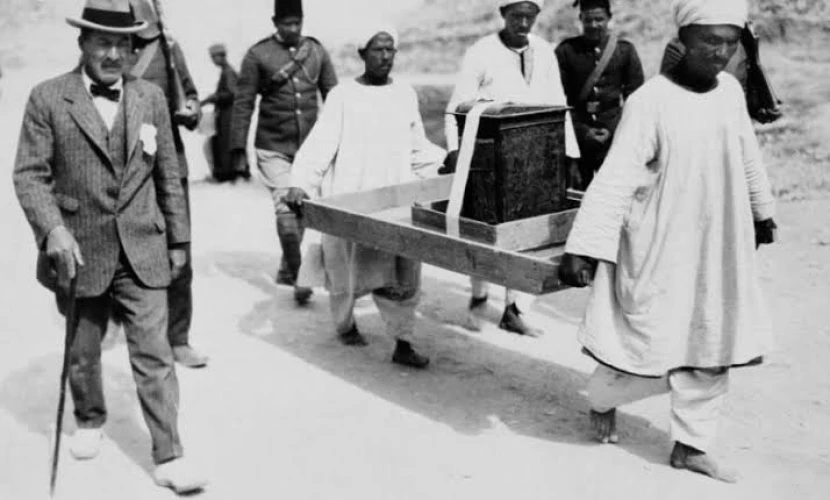
On that bitter, freezing morning of November 26, 1922, one lone English archaeologist stood there, facing a sealed mud-plastered doorway, deep in those rock-cut under passages of the Valley of the Kings. He had hardly anything, or at least it looked that way—an iron chisel, a small hammer, and a candle that kept stuttering like it was afraid. Howard Carter then tapped a thin little hole through the ancient barrier. A thick, hot, stagnant breath of air—kept in darkness for more than three thousand years—finally slipped out, and his candle flame jumped about in a wild, uneven way.
Once his eyes began to settle, adjusting to that dim, golden light, what he saw didn’t just surprise him, it sort of refused to fit into anyone’s imagination. There were gilded chariots knocked and piled together, carved lions staring sternly, odd animal shaped couches, and wooden chests stacked in layers, all of it rising from the floor right up to the roofline. He stood in that tight corridor, and beside him his anxious benefactor Lord Carnarvon hovered and asked in a strained voice, “Can you see anything?”
Carter, famously, gave that calm, short answer, “Yes, wonderful things.”
And the whole Tomb KV62 discovery, meaning the almost unbroken final resting place of the young pharaoh Tutankhamun, wasn’t just a sudden flare of luck. It was the end point of a stubborn, relentless decade, powered by Carter’s fixed belief that a neglected boy-king still lay under the hot sands around Luxor, waiting for the right hands to find him.
This is the dramatic story of Howard Carter—his lifelong obsession, the grueling pursuit, and the historical discovery that shifted Egyptology forever, even after all those years.
1. The Artist turned Archaeologist: Who Was Howard Carter?
Born in Norfolk, England, in 1874, Howard Carter was kind of an unlikely choice to become the world’s most talked about archaeologist. He was the son of an animal painter, and in his younger years Carter did not have a formal university education, not really any solid classical groundwork in ancient languages either. Still, he had two rare gifts that turned out, more useful than people expected: the precision of an artist and a stubbornly exacting way of looking at things, like detail for detail.
Early Days in Egypt
When Carter was only seventeen, he came to Egypt as a draughtsman, hired to copy wall paintings, and inscriptions. He worked at places such as Beni Hasan and Deir el-Bahari, and he kept doing that sort of careful tracing until it became more than just a job.
Under the guidance of famous archaeologists, including Flinders Petrie, Carter shifted from pure artistry to real fieldwork, almost like it happened by itself, bit by bit:
Mastering the Field: he picked up fluent Arabic, learned preservation methods for ancient finds, and built a quiet but firm respect for Egyptian culture.
Chief Inspector of Antiquities: By the time he was about twenty-five, he was named Chief Inspector of Antiquities for Upper Egypt. From there he directed major restoration work around Luxor, and also across the West Bank.
That said, Carter was famously stubborn , proud, and quick to anger. After an international diplomatic mess in 1905, involving French tourists, and Egyptian site guards at Saqqara, Carter would not offer an apology. He resigned from the Antiquities Service, and that decision kind of threw his career into a period of doubt, and moving forward without any clear footing.
2. The Unlikely Partnership: Carter and Lord Carnarvon
For a few years Carter made do in Luxor by selling watercolors to wealthy tourists, and also by leading private visits for them. Then his life kinda shifted in a fateful way, when he got introduced to George Herbert , the 5th Earl of Carnarvon.
Now Lord Carnarvon was an extremely wealthy British aristocrat. His doctors had basically told him to spend winters in Egypt because the climate there is warm, after a serious automobile accident. On top of that, he was deeply into collecting old antiquities. But to actually run his digs he needed a skilled, licensed archaeologist, someone to handle the excavation in a proper way.
So in 1907, the two men formed an almost historic partnership:
Carnarvon brought the funding: endless financial backing plus a good deal of political influence in Cairo.
Carter brought the momentum and the thinking: professional know-how, relentless work habits, and that obsessive way of managing everything in the field.
3. The Forgotten King: The Quest for the Missing Tomb
By 1914, most of the world-renowned archaeologists kinda thought the Valley of the Kings was already well and truly spent. After all, decades of digging by researchers such as Theodore Davis turned up dozens of empty, looted tombs. Davis, in a rather sweeping moment, said, " I fear the Valley of the Tombs is exhausted." And well, everybody basically nodded along.
Howard Carter though… he didn’t. He pushed back, hard. Like, fiercely.
So he went looking, not with brute force exactly but more with this stubborn attention to odd little things.
The missing clues, at least as Carter saw them, were there all along, kind of just lying around:
Faience cups : Small faience cups, with the name of Tutankhamun on them, found near a water pit.
Funerary embalming cache : A burial-style pit holding jars stuffed with linen bandages, floral collars, and pottery stamped with Tutankhamun’s cartouche.
Gold leaf fragments : Pieces that showed Tutankhamun, and his wife too, coming from a small pit tomb, KV54.
Most people took these as proof that Tutankhamun’s tomb had already been picked clean, ruined, and done with. Carter looked at the same scraps and thought differently. In his mind, those were not the “end” of anything, but residues, leftover burial materials from a royal setting that had never been found in the first place, and never properly located.
Years of Failure and the Final Chance
Interrupted by World War I, Carter began his methodical search of the Valley in 1917. Year after year, his team cleared hundreds of thousands of tons of heavy limestone rubble, mapping the valley grid by grid, down to bedrock a bit like a careful ritual, even when no one said it out loud.
By the spring of 1922, after five steady seasons of digging up only dust and barren stone, Lord Carnarvon called Carter to his English estate, Highclere Castle. Still, Carnarvon was furious about the massive financial loss and told Carter he was canceling the funding, plain and final.
Carter pleaded for one final season. He even offered to bankroll the expedition out of his own modest savings, if Carnarvon would let him keep the excavation license. In a moment of uneasy respect for Carter’s absolute passion, Carnarvon relented and agreed to back one last winter campaign.





-webp.webp "Hilton")
-webp.webp "dusit")
-webp.webp "Marriott Hotels")
-webp.webp "Azimut Hotel")
-webp.webp "Golden Tulip")
-webp.webp "sheraton")
-webp.webp "westin hotel")
-webp.webp "Movenpick")