
 English
 Italy
Italy
Museum of Islamic Art Cairo: Essential Travel Tips, Masterpieces, and Map
The Treasury of Cairo: Museum of Islamic Art Complete Visitor Guide
When people plan a trip to Cairo, their itineraries end up being, almost always, ruled by ancient stones. They go on and on for days, wandering the dusty plateaus of Giza, dropping down into the deep limestone shafts of Saqqara, or just standing there staring at those golden funerary masks of pharaohs.
Still, there is a whole other side to Cairo, sort of like a living, breathing cultural page that helps explain the city’s actual heartbeat. If you want to understand why Cairo got its old title, “The City of a Thousand Minarets,” you really have to walk away from the pharaonic ruins and turn toward the historic center.
In the energetic neighborhood of Bab al-Khalq, you’ll find the Museum of Islamic Art (MIA) in Cairo.
Most historians will tell you, without much hesitation, that it’s the largest and also the most complete museum of its category anywhere in the world. Inside, there’s an astonishing archive of more than 100,000 artifacts. And no, it’s not only local curiosities. It feels more like a sprawling global time capsule that stretches across more than a thousand years, following the artistic, scientific, and cultural “peak” of Islamic civilization from Spain all the way to western China.
So whether you’re into architecture, or you lean more toward science, or you’re just a relaxed traveler trying to avoid those packed tour-bus rhythms, this guide will walk you through and help you discover the masterpieces tucked inside this underrated Cairo gem.
1. The Architecture: A Palace Fit for Masterpieces
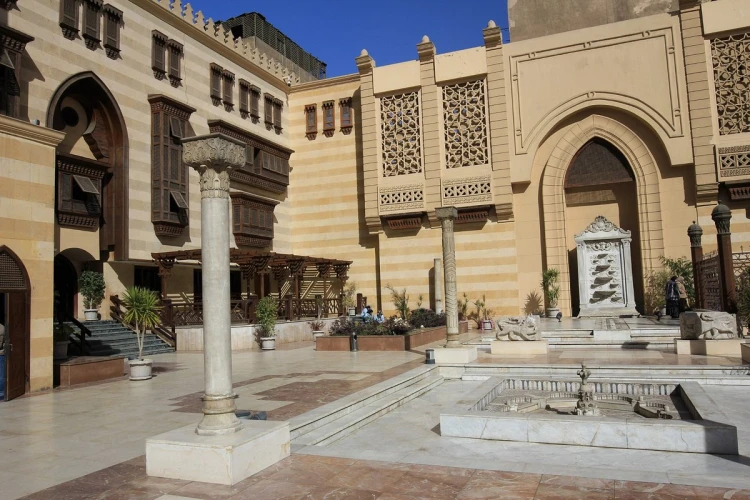
Before you even get to look at one display case, the whole building kinda pulls you in first. It was opened in 1903, during the reign of Khedive Abbas Helmy II, and the museum itself feels like this incredible architectural piece, made by the very talented Italian architect Alfonso Manescalo.
Out front, the place shows a grand sand-colored stone facade, done in that neo-Mamluk style, with careful geometric stone carvings, plus those refined pointed archways. It’s all very elegant, in a “how did they even…” kind of way.
Then, once you step through the main entrance, the chaotic din of Cairo street traffic just disappears, like instantly. What replaces it is a calm, open layout. Inside, the galleries sit inside towering white arches, the marble floors are beautifully polished and shiny, and hanging down you get these low, metallic chandeliers. They throw soft, delicate shadows across the exhibition halls, which makes everything feel quieter, even when there’s plenty going on.
2. Navigating the Galleries: Two Parallel Journeys
The Museum of Islamic Art is, honestly, very well organized, sort of split cleanly into two separate wings that let you decide how you want to experience human history. Not gonna lie it feels like you’re choosing a path on purpose, without it being too much.
The Chronological Wing
This one pulls you into a linear walk through time. You begin with the plain but graceful lines from the early Umayyad and Abbasid periods, then you move into the intensely inventive , and yes , animal-patterned designs tied to the Fatimid era. After that you step into the large and bold, kinda lavish metalworks associated with the Mamluk sultans, and you end with the very fine floral tilework from the Ottoman Empire.
The Thematic Wing
If you’d rather focus on certain kinds of human achievements, this wing does it by grouping artifacts by craft or discipline instead of age. So instead of dates first, you get rooms dedicated almost completely to the development of Arabic calligraphy, ancient coin minting, intricate geometric woodworking, and medieval scientific instruments.
3. The Masterpieces You Cannot Miss
With tens of thousands of things on display, it is easy to feel that kind of “museum fatigue,” like your brain just sort of clocks out. So if you want to stay sharp, try a pretty direct beeline—no wandering too much—for these legendary world class artifacts:
The Astrolabes and Medieval Calculators
You’ll spot them in the Science and Medicine gallery, where the exhibits quietly underline the staggering scientific reach of the medieval Islamic world. In here, there are highly intricate brass astrolabes, which were astronomical computers used by early astronomers to figure out the movement of stars, plot navigation paths over oceans, and also determine precise times for prayer. Honestly the craftsmanship is so precise, that the brass plates can look like delicate bits of futuristic machinery, rather than something “old.”
The Fatimid Rock Crystal Ewer
Made in the 10th century, this small water pitcher was carved from a single flawless block of solid quartz crystal, an outright miracle of ancient lapidary work. The maker scraped the crystal walls down until they were paper thin, fully translucent, and then added delicate reliefs showing cheetahs plus floral motifs. There are only a handful of these priceless ewers anywhere, so it feels almost unreal to see one up close.
The Mamluk Enameled Glass Lamps
The museum also has a spectacular set of mosque lamps from the 14th century. They’re fashioned from heavy, hand-blown glass, then hand-painted with bright blue red and gold enamels—topped off with intricate calligraphic coats of arms tied to Mamluk sultans. And when the lamps were lit using oil candles back then, they would have lit up those great stone mosques of historic Cairo, in a way that still feels dramatic even today.
4. Practical Guide for Visitors
Since the museum sits a bit beyond the busiest tourist hubs of Downtown Cairo, a visit means you may need to plan, just a little bit. Not much, but still…
Secure Tour Bookings
Because the history of Islamic Cairo is so deeply layered, wandering through the MIA tends to feel more meaningful when you go with a professional guide who understands the old scripts and can untangle the complicated links between dynasties.
When you’re arranging your day tours via Cairo based travel operators from home, try to make sure you pay using secure platforms such as WeTravel, or transaction networks supported by Stripe. These services use certified PCI-DSS Level 1 encryption and also tokenize your payment details. In practice this keeps your card information from being handled by outside parties, so you can lock in your Cairo travel plans safely and, honestly, with real peace of mind.





-webp.webp "Hilton")
-webp.webp "dusit")
-webp.webp "Marriott Hotels")
-webp.webp "Azimut Hotel")
-webp.webp "Golden Tulip")
-webp.webp "sheraton")
-webp.webp "westin hotel")
-webp.webp "Movenpick")