
 English
 Italy
Italy
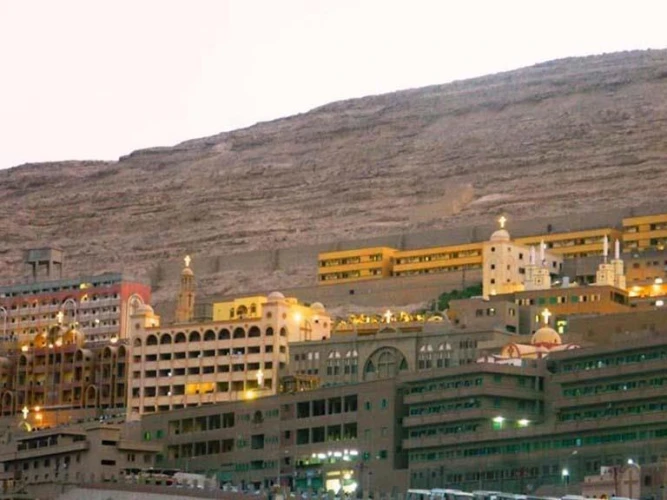
Mount Qosqam Guide: Assiut, Al-Muharraq Monastery, and Coptic History
Mount Qosqam (Jabal Qosqam): History, Geography & Spiritual Heritage
So, Mount Qosqam (Jabal Qosqam) is in the Assiut Governorate, in Upper Egypt,kind of near the city of Al-Qusia. It’s a limestone mountain and also a plateau that’s widely known for its deep biblical background, plus cultural weight and natural beauty.
It rises above the western edge of the desert, where the Nile Valley begins to fade, and really, this place is tightly tied to the story of the Holy Family’s passage through Egypt. People also say it contains one of the oldest working monastic complexes you can still find anywhere in the world.
Below, you’ll get the full picture of the Mount Qosqam history, its geographical setting, and why it matters spiritually.
1. Geographical Location and Landscape
Mount Qosqam kind of sits roughly 325 kilometers south of Cairo, and maybe like 45 kilometers north of the city of Assiut, it is placed right by the desert edge of the Nile floodplain that stays fertile.
The topography is not simple, it has a tough limestone plateau, then desert cliffs and even natural caves. Those caves, from earlier times, gave shelter and a bit of quiet for desert ascetics as well as travelers, people passing through, you know.
When it comes to old trade routes, in antiquity the foot of Mount Qosqam worked as a strategic meeting point between the desert caravan tracks headed toward the Western Desert oases, (Kharga and Dakhla come to mind) and also the food producing routes that follow along the Nile River.
2. The Biblical Refuge: The Holy Family at Qosqam
Mount Qosqam has an oddly irreplaceable place in Christian memory, kind of like the southern edge and the high point of the Flight into Egypt, you know.
As the Coptic people have said for a long time, and as older historical manuscripts seem to keep repeating:
The Longest Shelter. When Jesus, Mary, and Joseph slipped away from King Herod’s decree, they went hundreds of miles south following the Nile, until they came to the foot of Mount Qosqam. There, they were given shelter in a basic mud-brick room , pressed right against the hillside.
Six Months of Sanctuary. The Holy Family stayed at Mount Qosqam for 6 months and 10 days. It was their lengthiest time in any single place in Egypt , so far as the traditions describe it.
The Divine Call to Return. At Mount Qosqam also, the Angel of the Lord showed up to Joseph in a dream, and told him it was safe to go back to the land of Israel (Matthew 2:20). And since this spot keeps the record of both their extended rest and the moment their route turned back north, Mount Qosqam was given the respectful nickname of the “Second Bethlehem” .
3. The Home of Al-Muharraq Monastery
At the eastern base of Mount Qosqam there’s Al-Muharraq Monastery, sometimes written Deir Al-Muharraq, and it is formally known as the Monastery of the Virgin Mary.
It was established in the 4th century AD by Saint Pachomius (Pakhom) and the place kind of grew straight up around the historic cave dwelling and mud-brick house that sheltered the Holy Family.
You can still see it in a few key parts like the Ancient Altar , inside the monastery’s oldest church, the altar sits right over the precise location where the Holy Family lived. Coptic tradition holds that this altar is the fulfillment of an Old Testament prophecy in Isaiah 19:19, “In that day there will be an altar to the Lord in the midst of the land of Egypt” .
Also, Desert Monasticism played a big role, the quiet surroundings of Mount Qosqam drew hundreds of hermits and monks in those early centuries of Christian monastic life, and little by little it turned the whole mountain into a lively center of prayer, the careful copying of manuscripts , and deep theological inquiry, almost like a constant hush with minds working.
4. Historical and Cultural Significance Today
Today, Mount Qosqam still stays a major cultural landmark in Upper Egypt, and it is an essential stop, along Egypt’s official Holy Family Trail, sort of.
Pilgrimage destination: Every year, especially around the feast celebrations in August, tens of thousands of visitors—Egyptian Christians and Muslims too, plus international tourists, come in, to Mount Qosqam in order to see the historic complex at the base.
Educational legacy: The area around Mount Qosqam has been, for a long while, a true meeting ground for Coptic language preservation. Also for iconography, and theological formation, through the clerical seminary that is located on the monastery grounds on the mountain.





-webp.webp "Hilton")
-webp.webp "dusit")
-webp.webp "Marriott Hotels")
-webp.webp "Azimut Hotel")
-webp.webp "Golden Tulip")
-webp.webp "sheraton")
-webp.webp "westin hotel")
-webp.webp "Movenpick")