
 English
 Italy
Italy
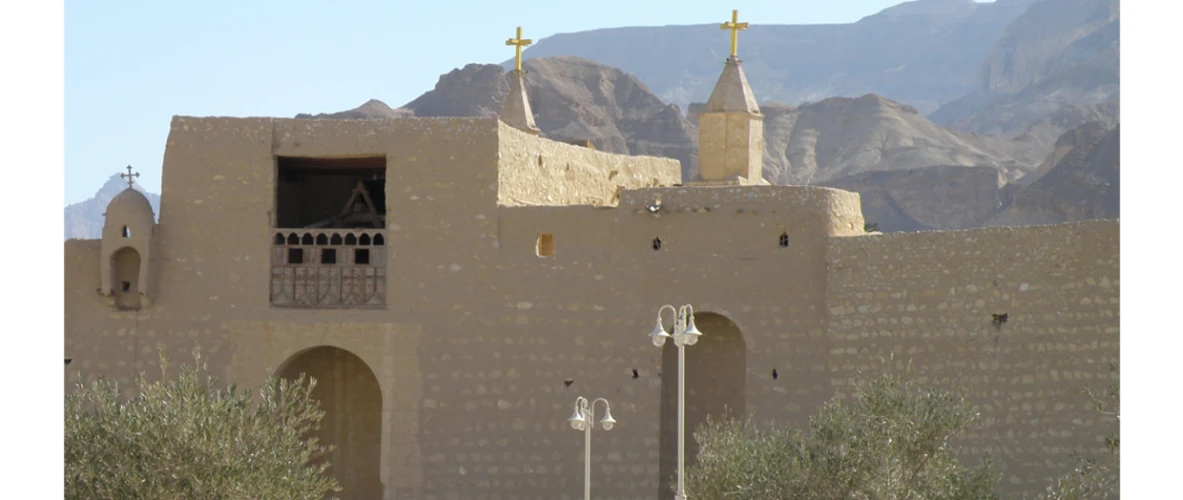
Monastery of Saint Anthony Guide: Red Sea Desert, Cave Pilgrimage, and Coptic History
The Monastery of Saint Anthony: History, Desert Monasticism & Spiritual Legacy
Nestled deep in those rough mountains of Egypt’s Eastern Desert, near the Red Sea, the Monastery of Saint Anthony (Deir Anba Antonios) sits almost like a stubborn secret. It is recognized around the world as the oldest active Christian monastery, and for more than 1,600 years it has stayed a kind of spiritual oasis where people come for prayer, quiet reflection and a retreat that feels… strange, in a good way.
Long before the huge medieval abbeys started showing up across Europe, one devout Egyptian hermit withdrew into the desert loneliness to find a deeper tie with God. That man was Saint Anthony the Great, the widely accepted Father of Christian Monasticism.
Starting from a small cluster of caves, and moving into something more fortified, almost like a desert fortress, filled with ancient frescoes and priceless manuscripts, this place holds the full story, the architectural memory, and the lasting spiritual legacy of the Monastery of Saint Anthony.
1. The Origins: Saint Anthony and the Birth of Monasticism
The tale of the monastery kinda clings to the life of Saint Anthony, like it cant really be separated, because it is inseparable, from his own story—he was born around 251 AD, in Coma (modern-day Qiman al-Arus) in Upper Egypt.
After his wealthy parents died, 20-year-old Anthony went into a church, and there he heard the Gospel verse. “If you want to be perfect, go, sell what you have and give to the poor, and you will have treasure in heaven; and come follow Me” (Matthew 19:21) ,and he took it more literally than most people would. So he distributed his inheritance to nearby villagers, then he withdrew into the wilderness.
For decades he lived in total solitude, in abandoned forts and desert tombs, and later he migrated even farther east toward the Red Sea. He settled at the foot of Mount Colzim, where a natural spring still supplied water, in the middle of that severe desert.
Even if Anthony tried to keep his mind quiet with solitary prayer, his spiritual insight, his patience under temptation, and even his reputation for healing drew in hundreds of seekers. In the end ,disciples built small cells around his mountaintop shelter, and somehow it became the worlds first informal monastic settlement.
2. From Cave to Fortress: Evolution of the Monastery
After Saint Anthony died in 356 AD, aged 105, his disciples kinda kept going and built a more permanent church together with living quarters close to his cave and that natural spring, and that’s how the monastic place, the whole formal monastery, really got set up.
Because it was way out there in the Eastern Desert, the monastery saw frequent raids from nomadic tribes, especially during late antiquity and also through the Middle Ages. So, Byzantine emperors and afterward the Egyptian patriarchs decided to fortify the sanctuary, they put in massive stone walls that rise above 12 meters or so.
For a long time, centuries, the monastery didn’t have doors at ground level. Instead, visitors, supplies, and the monks were lifted up inside, using a wooden basket that was pulled with a manual winch, it’s a sort of safety measure and it can still be seen on site today, which is kinda wild.
3. Key Artistic and Architectural Treasures
Sprawling over 18 acres, in the shadow of Mount Colzim, the monastery kinda holds extraordinary architectural elements, ancient churches, and world-renowned Coptic art, all together in one place.
The Church of Saint Anthony
The historical core of the monastery is the Church of Saint Anthony , dating back to the early 4th century. Inside, you’ll find 13th-century Coptic frescoes, they cover the walls in a really striking way, with biblical moments, archangels, and early desert saints like Saint Anthony, Saint Paul the Hermit, and Saint Athanasius. They were meticulously repaired in the late 1990s by the American Research Center in Egypt (ARCE), and those murals represent the most full and complete set of medieval Coptic art that exists today.
The Spring of Saint Anthony
A natural spring runs without interruption, at about 100 cubic meters of water per day. So it kept people alive here, even through this barren desert for more than 1,600 years. The water supplies clean drinking water for the resident monks and it also waters lush gardens of olive trees, palms, and vegetables, inside the fortress boundaries.
The Keep (Al-Jawsaq)
Built in the 6th century as, a sort of final shelter in case of a siege, the three-story fortified tower has a drawbridge and a chapel specifically for Saint Michael. It also includes water cisterns and food storage rooms, enough to keep the monks going for months, even when things get tough.
4. The Cave of Saint Anthony: A Sacred Pilgrimage
For visitors and pilgrims who can manage the climb, the final spiritual stop ends up being The Cave of Saint Anthony (Magharat Anba Antonios) , honestly.
It sits about 2 kilometers from the monastery walls and almost 300 meters up along the cliff face, and getting there means you have to ascend a winding staircase, with over 1,100 stone steps, all together.
In the tight , rock-carved cave, pilgrims stand in the very place where Anthony spent years in fierce prayer, while they look out over broad views across the Red Sea desert hills. That scenery has barely shifted since antiquity, or at least that is how it feels.
5. Global Impact and Living Monastic Tradition
The influence of the Monastery of Saint Anthony seems to go well beyond the usual limits of Egypt, like it never really stops.
When Saint Athanasius wrote his well known biography, The Life of Saint Anthony, back in the 4th century, it got translated rather quickly into Latin and then it spread across Western Europe. People reading that text, were moved in countless ways—including Saint Augustine, and this helped so many souls decide on an ascetical life. In effect, the Egyptian desert approach became the core model, for monastic orders across Ireland, Italy, France, and Greece, too.
Even now, the Monastery of Saint Anthony is still lively and actively used as a spiritual place, with dozens of monks living there. They continue the everyday rhythm of psalmody, fieldwork on the land, studying manuscripts, and receiving pilgrims with hospitality.





-webp.webp "Hilton")
-webp.webp "dusit")
-webp.webp "Marriott Hotels")
-webp.webp "Azimut Hotel")
-webp.webp "Golden Tulip")
-webp.webp "sheraton")
-webp.webp "westin hotel")
-webp.webp "Movenpick")